
Instant Bank Transfer Casinos Australia 2026: PayID, Osko & the Four Rails Explained
 Available in AU

The label “bank transfer casino” hides four distinct payment rails in Australia, and the gap between the slowest and fastest is three business days versus eight seconds. That gap is the only number worth caring about when picking where to play.
PayID and Osko sit on the New Payments Platform, moving money in under a minute. BECS and BPAY are legacy batch systems that shut down outside business hours and take one to three days to settle. Operators list “bank transfer” in their cashiers without specifying which rail they use, so a player deposits expecting instant credit and waits until Tuesday morning because the site routes through BECS.
POLi is gone. The instant-deposit gateway that moved money from an Australian bank account into a casino balance in ten seconds ceased operations on 30 September 2023. Every affiliate page still ranking POLi casinos in 2026 is describing a service that no longer exists. What replaced it is the NPP infrastructure PayID and Osko run on, and the offshore operators serving Australian players have rebuilt their cashiers around it.
The Interactive Gambling Act 2001 prohibits providing online casino services to anyone in Australia. No state, territory, or Commonwealth regulator issues licenses for pokies, blackjack, roulette, or live dealer tables online. Every operator an Australian player can deposit at holds a Curaçao, Malta, or Anjouan license and operates from outside the country. The law criminalises the provision, not the use, but zero consumer protections apply.
This guide maps which offshore casinos accept instant bank transfers via PayID and Osko, how the four Australian payment rails differ in speed and technology, what happened to POLi, and what the two-stage withdrawal timing actually means when a site claims “instant” payouts.
What Is Instant Bank Transfer for Australian Casinos (And Why “Bank Transfer” Hides Four Different Rails)

Bank transfer is not a single method. Four separate rails move money between Australian bank accounts, and they differ in settlement speed, operating hours, and the technology they run on. Casinos list “bank transfer” as a deposit option without clarifying which rail processes the payment, and that ambiguity costs players time.
BECS is the Bulk Electronic Clearing System, also called Direct Entry. It processes batches overnight and settles in one to three business days. BPAY is a bill-payment overlay that runs on similar batch infrastructure and takes one to two days. Both shut down outside business hours. A deposit initiated Saturday afternoon sits in a queue until Monday morning.
The New Payments Platform launched in February 2018 as a real-time alternative built by the Reserve Bank of Australia and the major banks. NPP uses ISO 20022 messaging and the Fast Settlement Service to clear transactions in seconds, 24 hours a day, every day of the year. PayID is the addressing layer: instead of typing a BSB and account number, you send to a phone number or email that resolves to the recipient’s account. Osko is the consumer-facing brand for NPP instant transfers and reaches 128 million accounts across 85-plus financial institutions in Australia, carrying 1.93 billion payments a year.
PayTo is the newest rail, built on NPP infrastructure for real-time debit agreements and recurring payments. It launched for subscriptions and mandates rather than one-off casino deposits, so most operators have not integrated it yet.
The speed difference is the whole point. BECS and BPAY were designed when overnight batch processing was acceptable. NPP was built because it is not acceptable anymore. A PayID deposit clears in ten to sixty seconds. A BECS transfer initiated Friday evening does not land until Tuesday if Monday is a public holiday.
Australian banks offer gambling-block toggles in their apps. CBA, NAB, Westpac, and ANZ all let account holders restrict transactions to merchants classified as betting or casino operators. The block applies to all four rails, and it can silently reverse a deposit attempt without warning the player first. If a PayID deposit bounces for no obvious reason, the first place to check is the banking app’s gambling-block setting.
Legacy domestic batch networks are scheduled to retire by the end of the decade. NPP is not a niche alternative; it is the replacement infrastructure the Reserve Bank and the industry are migrating to. Operators still routing deposits through BECS are paying the cost in player friction, and players choosing a casino in 2026 have the leverage to pick one that uses the fast rail.
What is the difference between PayID, Osko, and regular bank transfer at Australian casinos?
PayID is an alias linking your phone number or email to your bank account, so you send money without sharing BSB or account details. Osko is the instant-transfer service running on the New Payments Platform, settling in under a minute. Regular bank transfer typically means BECS, the legacy batch system that takes 1–3 business days.
| Rail | Technology | Speed | Operating Hours | Cost | Primary Use |
|---|---|---|---|---|---|
| BECS | Batch clearing (Direct Entry) | 1–3 business days | Business hours only | Zero | Legacy deposits/withdrawals |
| BPAY | Bill-payment batch overlay | 1–2 days | Business hours only | Zero | Bill payments (rare in casinos) |
| NPP/Osko | Real-time Fast Settlement Service | 10–60 seconds | 24/7/365 | Zero | Instant deposits, fast withdrawals |
| PayTo | Real-time debit agreements (NPP) | Seconds | 24/7/365 | Zero | Recurring payments, mandates (not yet common in casinos) |
POLi Is Gone — What Replaced It and Why It Matters

POLi shut down its Australian operations on 30 September 2023. The instant-deposit gateway that moved money from an Australian bank account into an online casino cashier in under ten seconds no longer exists, and every “POLi casino” ranking page still live in 2026 is outdated.
Three pressures converged. Banks withdrew support for screen-scraping gateways, viewing them as a security risk compared to API-based alternatives. The New Payments Platform offered a faster, bank-native instant transfer that made POLi’s value proposition redundant. Australia Post, which owned POLi through SecurePay, decided the Australian market was not worth continuing and wound the service down rather than collapsed it. No funds were trapped because POLi never held balances; it only facilitated deposits.
What replaced POLi is the NPP infrastructure underneath PayID and Osko. Offshore casinos that once listed POLi as their instant-deposit option rebuilt their cashiers to accept PayID directly. The player experience is similar: log into the casino cashier, select PayID, get an identifier, open the banking app, send the payment, and see the funds land in seconds. The difference is the casino now receives the payment through a bank-operated rail rather than a third-party gateway, and the player uses the same banking app they use for every other instant transfer.
The shutdown matters because affiliate content ranks well for years. A player searching “POLi casino Australia” in 2026 finds pages written in 2021 that list ten operators and step-by-step deposit guides, and none of it works anymore. POLi ceased operations two and a half years ago, but the pages describing it as current infrastructure still occupy search results because no one bothered to update them. That is noise, not signal.
Why did POLi shut down, and what replaced it?
POLi shut down on 30 September 2023 because banks reduced support for screen-scraping gateways, the New Payments Platform offered a faster and more secure alternative, and Australia Post decided the local market was not worth the compliance cost. PayID and Osko on NPP infrastructure took its place — same instant-deposit experience, bank-native rails.
Top Instant Bank Transfer Casinos for Australians (2026)

Seven offshore operators with verified PayID and Osko integration dominate the Australian instant-banking market in 2026. All hold Curaçao licenses, operate from outside Australia, and accept AUD deposits through the New Payments Platform. None are licensed by any Australian regulator because the Interactive Gambling Act prohibits local licensing of online casino services.
The comparison below ranks operators by withdrawal speed and instant-banking reliability, not by bonus size. A large welcome package is worthless if the payout sits in a pending queue for four days or the site routes withdrawals through legacy BECS instead of PayID.
| Operator | License | Min Deposit | Withdrawal Speed | Distinguishing Feature |
|---|---|---|---|---|
| SkyCrown | Curaçao 8048/JAZ | A$30 | 2–4 hours (PayID) | Fastest stated withdrawal time; back-loaded bonus (150% on 4th deposit) |
| Bizzo Casino | Curaçao 8048/JAZ | A$10 | <24 hours | 125% first deposit (vs typical 100%); Evolution Gaming live dealer |
| RocketPlay | Curaçao OGL/2024/1307/0748 | A$20 | 1–3 business days | Casino + sportsbook + esports; weekly auto-cashback (15%/10%/5%) |
| JeetCity | Curaçao 8048/JAZ2020-13 | A$10 | 24–72 hours | 6,000+ pokies; Dama N.V. multi-brand network; eCOGRA audits |
| Fair Go | Curaçao 8048/JAZ | A$5 (crypto), A$20 (cards) | Bitcoin 24h, bank wire 3–5 days | RTG-exclusive since 2017; no live dealer; A$5 Lightning Bitcoin minimum |
| Royal Reels | Curaçao (unverified) | A$30 | Not specified | A$10 no-deposit chip; ACMA blocking order (regulatory red flag) |
| Stake | Curaçao OGL/2024/1451/0918 | Crypto only | 15 min–2 hours (crypto) | Crypto-exclusive (no fiat PayID for casino); AU access legally unclear |
Three additional operators (Spinrise, Winzter, Oshi) appear in affiliate top-ten lists but lack sufficient public data for substantive profiles. They are presumed to hold Curaçao licenses and accept PayID, but details on withdrawal speed, game counts, and operator entities are not verifiable in public sources as of 2026.
SkyCrown Casino — A$8,000 Bonus and 2–4 Hour PayID Withdrawals
SkyCrown operates under Curaçao eGaming license 8048/JAZ and has been serving Australian players since 2020. The operator entity is not publicly disclosed in the site’s footer, but the license registry and multiple independent reviews confirm the 8048/JAZ master license. The game library runs to 7,000-plus titles from 40-plus providers, including Pragmatic Play, BGaming, and NetEnt, with 75-plus live dealer tables powered by Evolution Gaming.
The withdrawal speed is the headline feature. SkyCrown states 2–4 hours for PayID payouts after approval, and that claim is faster than the 24–72-hour standard most offshore operators quote. Crypto withdrawals clear in similar timeframes. The minimum deposit is A$30 via PayID, cards, or cryptocurrency, and the site supports AUD accounts natively.
The welcome package is back-loaded. First deposit delivers 120 percent up to A$2,000. Second deposit is 100 percent up to A$1,500. Third deposit is 75 percent up to A$2,000. Fourth deposit is 150 percent up to A$2,500, the single largest bonus chunk in the structure. Total package value reaches A$8,000 plus 400 free spins if you go the distance across all four deposits, but the 150 percent match on the fourth deposit means the structure rewards players who stick around rather than front-loading the value on day one.
Wagering is 40 times on bonus funds. The maximum bet during playthrough is capped, typically A$5–A$7.50 per spin depending on the game type, and exceeding it voids the bonus entirely. First withdrawal requires KYC verification, which takes 24–72 hours, and subsequent payouts process faster once identity is confirmed.
The mobile experience is HTML5 browser-based with no native app. The site is optimised for phone play, and the cashier works identically on desktop and mobile. Customer support is 24/7 via live chat and email. Offshore status means disputes go to the Curaçao regulator, not Australian authorities, and the Interactive Gambling Act means zero local consumer protections apply.
RocketPlay — Casino + Sportsbook with Weekly Cashback
RocketPlay is operated by Scores55 Tech B.V., the same entity behind mBit Casino and KitCasinos, under Curaçao Gaming Control Board license OGL/2024/1307/0748 issued July 2024. The platform integrates a full sportsbook covering 30-plus sports alongside the casino, with live betting and cash-out available. Esports markets include CS2, Dota 2, and League of Legends. One account, one balance, casino and sport together.
The game library advertises 4,000-plus titles, though independent counts suggest closer to 3,600. Providers include Pragmatic Play, BGaming, Play’n GO, and Betsoft. Pokies dominate the catalogue, with table games and a live dealer section rounding out the offering. The site supports AUD accounts, and deposits via PayID, cards (Visa, MasterCard), Neosurf, and cryptocurrency (Bitcoin, Ethereum, Litecoin, Dogecoin, Tether) are accepted. Minimum deposit is A$20 for Neosurf and PayID, A$25 for cards.
The welcome package splits into two deposits: 100 percent up to A$1,000 plus 100 free spins on the first, 200 percent up to A$1,000 on the second, for a total of A$2,000. Wagering is 40 times on bonus funds and free-spin winnings, with a five-day expiry. Maximum bet during playthrough is A$7.50 per spin or hand, and breaching it voids the bonus. The ongoing promotion calendar includes weekly cashback credited automatically on Thursdays: 15 percent on pokies, 10 percent on live dealer, 5 percent on sportsbook. No manual claim required; it lands in the account.
Withdrawal limits are A$6,000 per request for fiat and 0.4 BTC for cryptocurrency. Crypto payouts typically clear in 15–30 minutes after approval. PayID withdrawals take one to three business days, slower than the instant-deposit rail speed because the operator processes them as standard bank transfers rather than NPP pushes. All withdrawals can sit pending for up to 24 hours, creating reversal risk, and the first withdrawal requires KYC verification that adds 24–72 hours to the total timeline.
The VIP program is tiered with cashback, account managers, and higher withdrawal limits at the top rungs. Payouts above EUR 15,000 can be split into monthly instalments per the terms, a clause that affects high rollers. The platform is HTML5 browser-based with mobile optimisation but no dedicated app. Support is 24/7 via live chat and email.
JeetCity — 6,000+ Pokies Under Dama N.V.
JeetCity is operated by Dama N.V., a Curaçao-licensed entity running multiple casino brands across the offshore market. The license is 8048/JAZ2020-13, and RNG audits are handled by eCOGRA and iTechLabs, two of the more credible third-party testing labs in the space. The game library claims 6,000-plus pokies, the largest count among PayID casinos serving Australian players, plus live dealer tables.
Dama N.V. operates a network of brands (including BetAndYou, Casinomia, and others), and the multi-brand operation suggests infrastructure investment and a longer operational runway than single-site operators. That does not guarantee better service, but it means the company has survived regulatory scrutiny and payment-processor vetting across multiple domains, which single-brand startups sometimes fail at.
The welcome bonus is 100 percent up to A$7,500 on the first deposit plus 100 free spins. Wagering is 40 times on the bonus portion, with a 30-day window to clear it. Minimum deposit is A$10 via PayID, cards, or cryptocurrency. Minimum withdrawal is A$75, higher than most competitors, and anything below that floor cannot be cashed out and stays on the balance. The casino approval queue for withdrawals is up to 48 hours on the first payout, faster on subsequent ones after KYC is verified.
Trustpilot reviews are polarised: 64 percent five-star versus 21 percent one-star. The five-star reviews cite fast payouts and large game selection. The one-star reviews cite delayed withdrawals, bonus-term disputes, and account closures. Offshore casinos operating without local oversight tend to produce this split, where satisfied customers leave briefly and dissatisfied ones write essays. The pattern is not unique to JeetCity; it is the norm across Curaçao-licensed operators.
PayID deposits clear in minutes. Cards process instantly when accepted but can be declined due to issuer gambling restrictions. Cryptocurrency deposits are network-speed dependent, typically 10–60 minutes for Bitcoin and 5–20 minutes for Ethereum. Withdrawals follow the two-stage pattern: casino approval (up to 48 hours first time, 30 minutes to 24 hours after KYC) plus payment-rail speed (PayID 1–3 business days, crypto 15 minutes to two hours).
The platform is browser-based with mobile optimisation. No native app exists, and the full game library is accessible via mobile browser. Customer support is 24/7 live chat and email. Disputes are handled by the Curaçao regulator, and the Interactive Gambling Act means Australian consumer protections do not apply.
Bizzo Casino — 125% First Deposit and <24h Payouts
Bizzo Casino is operated by TechSolutions Group N.V. and launched in 2021 under Curaçao eGaming license 8048/JAZ. The game library holds 4,000 to 4,500 titles depending on the source, with a live dealer lobby powered by Evolution Gaming. The platform is pokies-focused with table games and specialty titles rounding out the catalogue. AUD accounts are supported natively, and the minimum deposit is A$10 via cards, PayID, or cryptocurrency.
The first-deposit bonus is 125 percent up to A$2,500, larger than the typical 100 percent match most competitors offer. The full welcome package extends across four deposits and reaches A$7,250 total: 125 percent up to A$2,500 on the first, 50 percent on the second, 30 percent on the third, 25 percent on the fourth. Wagering is 40 times the bonus amount, standard across offshore operators, and the usual maximum-bet-per-spin rule applies during playthrough.
Withdrawal speed is stated at under 24 hours, faster than the 24–72-hour industry baseline. That claim covers the casino approval queue; the payment rail adds time on top. PayID withdrawals after approval take one to three business days depending on whether the operator pushes through NPP or routes via legacy bank transfer. Crypto withdrawals are faster, typically clearing in under two hours after approval. Minimum withdrawal is not specified in public sources but is presumed to be A$20–A$50 based on competitor norms.
The operator has been live since 2021, placing it in the middle age bracket. Not a legacy brand like Fair Go (2017) but not a startup launched last quarter either. Three years of operation suggests the site has cleared payment processor vetting, survived Curaçao compliance checks, and maintained banking relationships, all of which are friction points that knock out operators early if they cannot meet them.
The free-spins promotional calendar is active, with ongoing offers cycling weekly. The site markets itself as “free-spins-heavy,” which translates to frequent low-wager-bonus offers that pad playtime but rarely deliver large cashouts because the win caps are strict. That is not unique to Bizzo; it is how free-spin promotions work across the offshore market. Players chasing free spins for entertainment value get them. Players expecting to withdraw A$2,000 from 50 free spins on a pokie will be disappointed by the A$100 win cap buried in the terms.
Customer support is 24/7 live chat and email. The platform is browser-based with no app, mobile-optimised for phone play. Offshore operation means disputes go to Curaçao, not Australian authorities.
Fair Go — RTG-Exclusive Pokies Since 2017
Fair Go Casino operates under Curaçao eGaming license 8048/JAZ and is run by Deckmedia N.V. Launched in 2017, it is the oldest continuously operating brand in this ranking, making it a nine-year veteran of the Australian offshore market. The game library is 280-plus titles, all supplied by RealTime Gaming. Fair Go is RTG-exclusive, which means no Pragmatic Play, no NetEnt, no Evolution Gaming live dealer. Pure RNG pokies and table games from one provider.
The RTG-exclusive positioning is either a strength or a limitation depending on what a player values. RTG has a back catalogue of high-RTP classics and a release schedule that is slower than multi-provider competitors. Players who want the latest Pragmatic Play release or a live dealer table will not find it here. Players who want RTG staples like Achilles, Asgard, and Cash Bandits without sorting through a 6,000-game bloat menu get exactly that.
The welcome bonus is 100 percent up to A$200, redeemable five times, for a total of A$1,000. Each deposit from the first through the fifth qualifies for the A$200 match. Wagering is 30 times deposit plus bonus, lighter than the 40-times standard most competitors impose. Maximum bet during playthrough is A$10 per spin. Minimum deposit is A$20 for cards, A$10 for Neosurf and eZeeWallet, A$5 for Lightning Bitcoin, the lowest entry point in this ranking.
Payment methods include Visa, MasterCard, Neosurf, Bitcoin, Ethereum, bank transfer, Skrill, and Neteller. AUD accounts are native. Minimum withdrawal is A$150, and the weekly cap is A$7,500. Bitcoin withdrawals complete within 24 hours. Bank wire transfers to Australian accounts take three to five business days. The site does not list PayID explicitly in its cashier, so instant NPP withdrawals are not confirmed. Crypto is the fast route out; fiat goes through legacy rails.
The player demographic skews older and more conservative. Fair Go has survived nine years without pivoting to a multi-provider model or launching a live dealer section, which suggests the RTG-only positioning serves a player base that values stability over novelty. The affiliate network markets Fair Go heavily to Australian audiences, and brand recognition is strong despite the limited game selection.
Customer support is 24/7 live chat and email. The platform is browser-based with mobile compatibility. No app exists. The site design is dated compared to SkyCrown or RocketPlay, reflecting the 2017 launch, but the cashier and game lobby function identically on desktop and mobile. Offshore operation under Curaçao license means disputes are handled outside Australian jurisdiction.
Royal Reels — A$10 No-Deposit Chip (With Regulatory Flags)
Royal Reels claims operation under a Curaçao GCB license but does not publish a verifiable license number in its footer or help pages. The operator entity is stated as Digibrite SRL in the FAQ, though independent verification of this legal entity is sparse. The platform rotates through numbered domain mirrors (royalreels24, royalreels, and variants), a strategy more commonly associated with compliance avoidance than stable operation.
The Australian Communications and Media Authority found Royal Reels in breach of the Interactive Gambling Act and requested ISP blocking. The blocking order does not specify a date in publicly available ACMA press releases, but it confirms the regulator views the site as operating illegally under Australian law. That is not unique—every offshore casino serving Australian players is technically in breach of the IGA—but ACMA rarely issues public blocking orders unless a site has drawn specific enforcement attention.
The game library is advertised as 5,500-plus pokies. Payment methods include PayID, cryptocurrency, Visa, and MasterCard. The minimum deposit is A$30. The standout offer is an A$10 no-deposit chip credited once the account is confirmed, rare in the Australian offshore market where most operators require a deposit before releasing any bonus. The welcome package structure varies by source, with 100 percent plus 50 free spins commonly cited.
One source describes Royal Reels as “the most-searched casino name in Australia,” which reflects high visibility and affiliate marketing saturation rather than operational quality. High visibility combined with domain rotation and an ACMA blocking order suggests the brand is either extremely popular or extremely aggressive in affiliate partnerships, and the regulatory scrutiny tilts interpretation toward the latter.
Withdrawal speeds are not specified in public sources. The lack of transparency on payout timelines, license verification, and operator entity details is a red flag. Players depositing here should weigh the A$10 no-deposit offer against the regulatory warning and the absence of verifiable operational data. Offshore casinos with public license numbers, consistent domains, and documented payout speeds are the safer bet.
Stake — Crypto-Primary Global Brand (AU Access Unclear)
Stake operates under Curaçao Gaming Authority license OGL/2024/1451/0918, issued in 2024, and is run by Medium Rare N.V. The platform launched in 2017 and carries global brand recognition through UFC sponsorships and high-profile partnerships. The offering spans casino, sportsbook, and poker, with one account and one balance covering all three verticals.
Deposits and withdrawals on the casino side are cryptocurrency-only. No fiat PayID, no cards, no bank transfer. Ten-plus cryptocurrencies are supported, including Bitcoin, Ethereum, Litecoin, and various stablecoins. Crypto withdrawals clear in 15 minutes to two hours after approval, the fastest route out among all operators in this ranking because there is no fiat rail delay. The trade-off is the player manages crypto wallets, network fees, and exchange-rate volatility.
The legal status of Stake in Australia is ambiguous. One source states “you cannot legally play at Stake in Australia” as of 2026, citing regulatory restrictions. Other sources describe Stake as accessible to Australian players and list it in top-casino rankings. The contradiction suggests either geo-blocking inconsistencies or conflicting interpretations of the Interactive Gambling Act’s applicability to crypto-only offshore platforms.
Stakeshop Pty Ltd, a separate Australian entity, holds AFSL 548196 from ASIC for stock and ETF trading. That financial services license is not connected to the casino operation at stake.com. The casino operates offshore under Curaçao jurisdiction with no Australian regulatory approval. The shared “Stake” branding creates confusion, but the entities are distinct: one is a licensed Australian stockbroker, the other is an offshore crypto casino.
The game library is large but not quantified in public sources. Providers are not specified. The VIP rewards model is play-based rather than deposit-based, with cashback and level-up bonuses earned through wagering volume. The platform is browser-based with an iOS app available for some regions. Android support is browser-only due to Google Play Store gambling restrictions.
If the geo-blocking reports are accurate, Australian players attempting to access Stake may hit a redirect or a jurisdiction block. If the ranking-page inclusions are accurate, the site remains accessible. The discrepancy is unresolved in public sources as of 2026. Players considering Stake should verify access before depositing, and the crypto-only requirement means it is not an instant-bank-transfer option in the traditional sense. It sits in this ranking because of brand prominence and affiliate visibility, not because it fits the PayID-casino profile.
How to Deposit and Withdraw via PayID/Osko — Step-by-Step
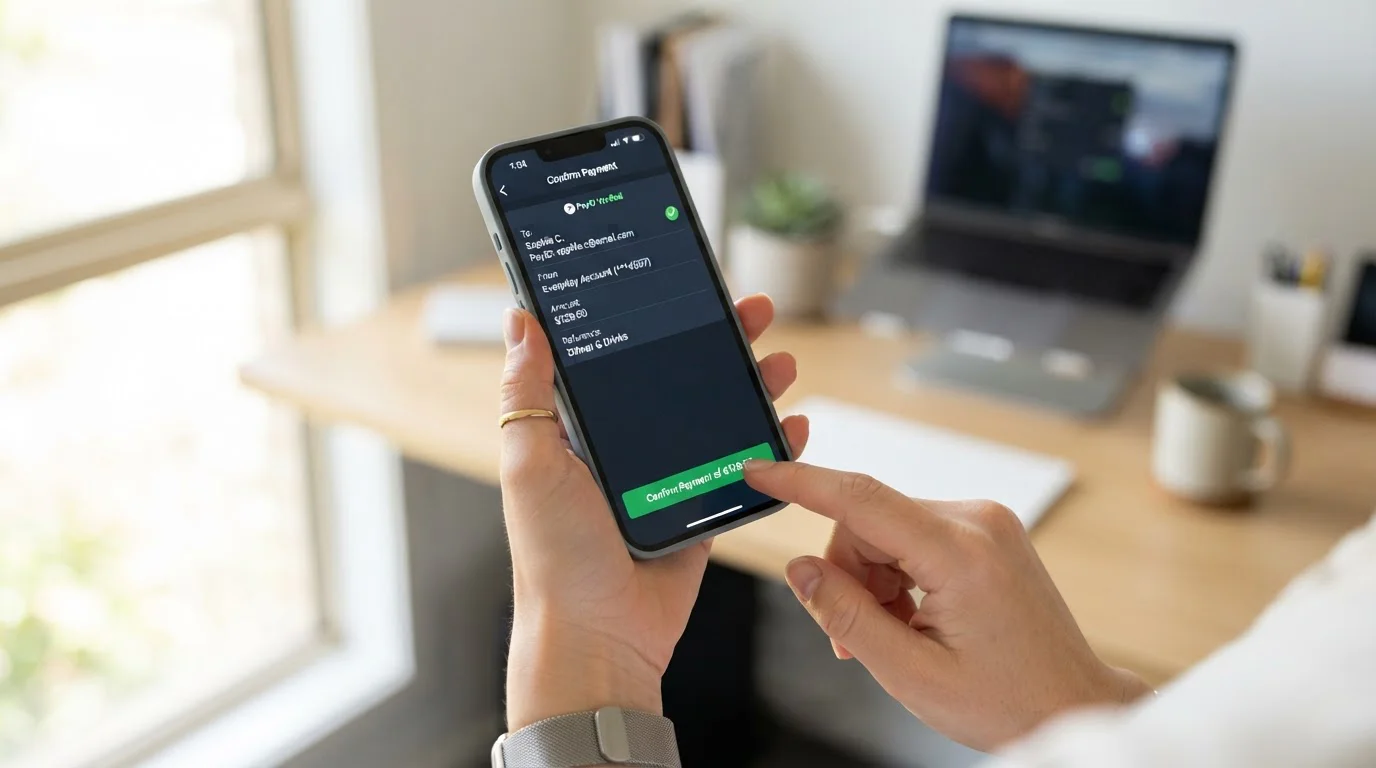
PayID deposits move money from an Australian bank account into an offshore casino balance in under a minute, 24 hours a day, seven days a week. The process uses the New Payments Platform and bypasses legacy batch clearing. Here is the step-by-step walkthrough from casino login to balance update.
Depositing with PayID (6-Step Walkthrough)
Log into the casino and navigate to the cashier. Most sites place the deposit button in the top-right corner or in a sidebar menu. Select “Deposit” or “Add Funds.”
Choose PayID or instant bank transfer from the payment method list. Some cashiers label it “Osko,” “NPP,” or “Bank Transfer (Instant).” All four terms point to the same rail.
Enter the deposit amount. Minimum deposits range from A$10 to A$30 depending on the operator. The cashier will display the casino’s PayID identifier, typically a phone number or email address registered to the operator’s Australian bank account.
Open your banking app. Navigate to “Pay Anyone” or “Send Money.” Select PayID as the payment type. Enter the PayID identifier the casino displayed. Your banking app will resolve the identifier and show the payee name. Confirm the name matches the casino or its payment processor. A mismatch triggers a hold because banks flag it as potential fraud.
Enter the deposit amount again in your banking app. Double-check the figure matches what you entered in the casino cashier. Authorize the payment with your PIN, fingerprint, or face ID.
Return to the casino. The funds appear in your casino balance in ten to sixty seconds. If the balance does not update within two minutes, refresh the cashier page or contact support. Delays beyond two minutes usually indicate a bank gambling block, a name mismatch hold, or the casino routing the payment through BECS instead of NPP despite the “instant” label.
Withdrawals — Two-Stage Timing (Approval Queue + Rail Speed)
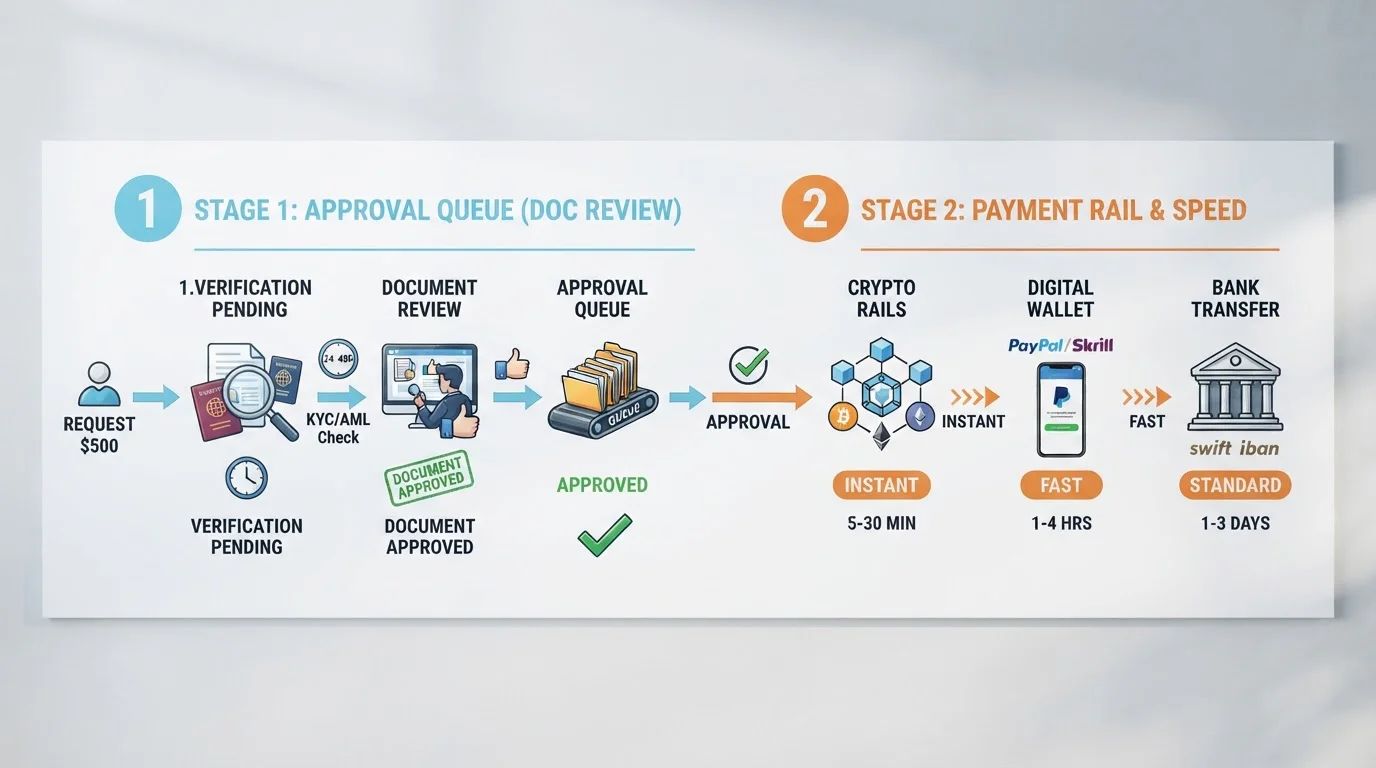
Casino withdrawal speed is two numbers, not one. The “instant” claim in marketing materials refers to the payment rail, not the casino’s internal approval process. Understanding both stages is the difference between a realistic timeline and a customer-support argument.
Stage one is the casino approval queue. You request a withdrawal in the cashier, and the operator’s finance team reviews it. First withdrawal at any offshore casino takes 24 to 72 hours because KYC verification is required: passport or driver’s license, proof of address, sometimes a selfie holding the ID. The operator checks the documents against the account details and clears the payout once satisfied. Subsequent withdrawals process faster, typically 30 minutes to 24 hours, because identity is already confirmed.
Stage two is the payment rail. Once the casino approves the withdrawal and pushes the funds, the speed depends on which method you selected. PayID withdrawals via NPP should clear in minutes, but most offshore operators route fiat payouts through legacy bank transfers that take one to three business days. Crypto withdrawals hit the blockchain immediately and confirm in 15 minutes to two hours depending on network congestion. Bank wire transfers via BECS take three to seven business days.
The gap between the two stages is where “instant withdrawal casino” claims fall apart. SkyCrown states 2–4 hours for PayID payouts, which is the combined total of approval plus rail speed. Bizzo claims under 24 hours. RocketPlay quotes 1–3 business days. Fair Go is three to five days for bank wire, 24 hours for Bitcoin. The operator with the shortest approval queue and the fastest rail wins. Crypto is the fastest route out across the board because it bypasses fiat entirely.
Weekend and after-hours timing matters. NPP operates 24/7, so a PayID withdrawal requested Saturday afternoon processes the same speed as one requested Tuesday morning. Legacy bank transfers sit in a queue until Monday 9am. Crypto networks run continuously. The casino approval queue runs on the operator’s finance team schedule, which is usually business hours in the operator’s timezone, not the player’s. A withdrawal requested at 11pm Sydney time might not reach the approval desk until the next morning in Curaçao.
Pending withdrawal periods create reversal risk. Some operators hold approved payouts for 24 hours in “pending” status, during which the player can cancel the withdrawal and return the funds to the casino balance. That window is designed to generate reversal revenue: a player requests a A$500 cashout, sees it pending, logs back in, cancels it, loses it. The player lost money they had already decided to withdraw. Operators with zero pending windows or short pending windows (under six hours) respect the withdrawal decision. Operators with 24-hour or 48-hour pending windows are betting the player will reverse.
Bank Gambling Blocks — The Silent Deposit Killer
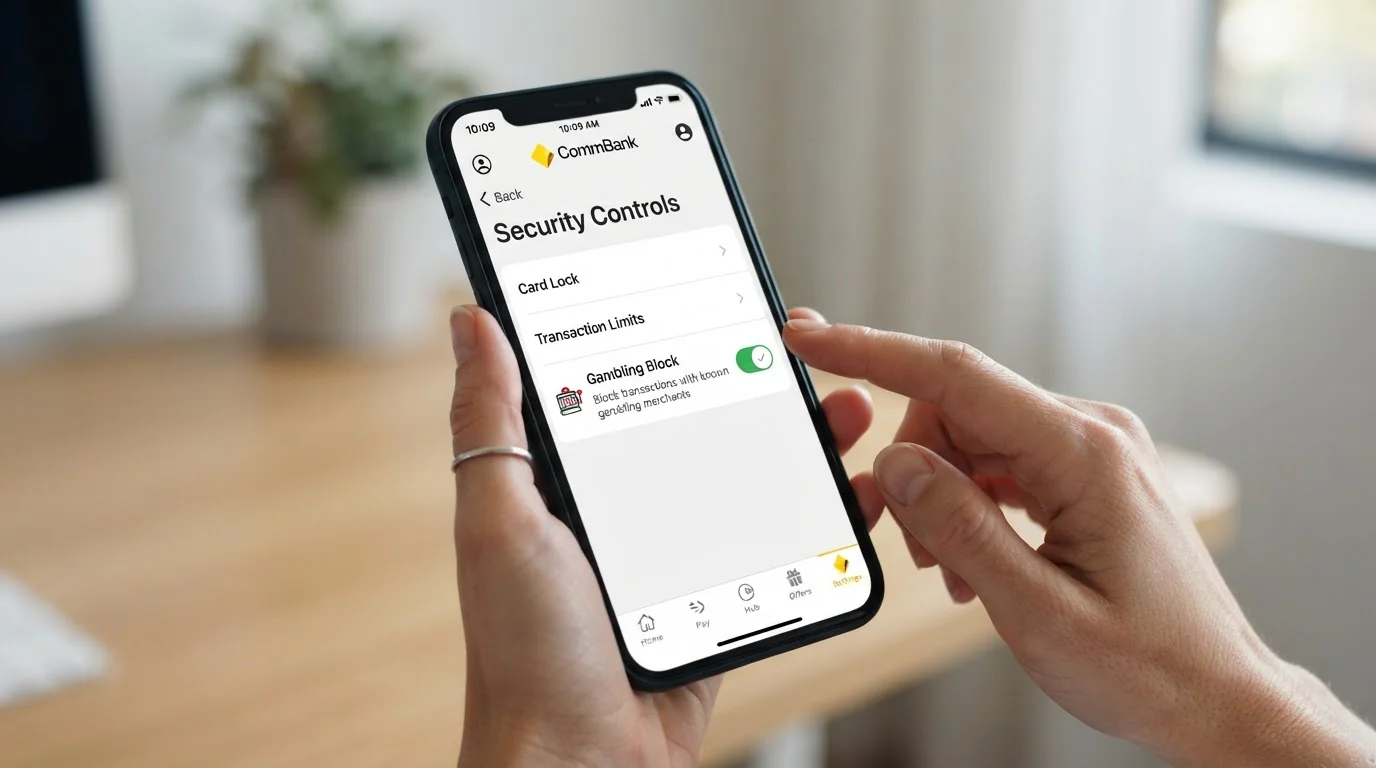
CBA, NAB, Westpac, and ANZ all offer gambling-block settings in their banking apps. The toggle restricts transactions to merchants classified under “betting/casino gambling” merchant category codes. A player enables the block as a self-exclusion measure, forgets about it six months later, attempts a PayID deposit to an offshore casino, and the payment bounces with no explanation.
The block applies to all payment methods: PayID, cards, BECS, BPAY. It is not method-specific. It triggers on the merchant category code the casino’s payment processor uses when requesting the funds. If the MCC matches gambling, the bank declines the transaction. If the casino uses a generic MCC or obscures the merchant name, the block might not trigger, but that is compliance evasion on the operator’s side and creates other risks.
The setting is in the banking app under card controls, account settings, or responsible banking. The exact location varies by bank. CBA lists it under “Card Controls.” Westpac places it in “Gambling Block” under card settings. ANZ has it in the ANZ Plus app under card controls. NAB labels it “Gambling Transactions” in the app’s responsible banking section. The toggle is usually off by default, meaning gambling transactions are allowed unless the account holder explicitly enables the block.
If a PayID deposit fails for no obvious reason, check the gambling-block setting first. Disable it, retry the deposit. The payment will clear if the block was the only issue. If the deposit still fails, the casino might be routing through a blocked payment processor, the account might have other restrictions, or the bank might have flagged the transaction as suspicious for unrelated reasons.
The block is a legitimate self-exclusion tool. Players who want to restrict gambling spending should use it. Players who want to deposit at casinos should check it is disabled before attempting the first deposit. The friction comes from forgetting the setting exists, not from the setting itself.
How long does a PayID deposit take to reach my casino account?
PayID deposits via the New Payments Platform settle in 10–60 seconds. You authorise the payment in your banking app and funds appear in the casino balance within a minute. Delays beyond two minutes usually point to a bank gambling block, a payee-name mismatch, or the casino silently routing the payment through BECS instead of NPP.
How fast are PayID withdrawals compared to crypto or card withdrawals?
PayID withdrawals via NPP should clear in minutes, but most offshore operators route fiat payouts through legacy bank transfers that take 1–3 business days. Crypto clears in 15 minutes to two hours because it bypasses fiat rails. Card withdrawals are rare. Total time is casino approval (24–72 hours first, then hours) plus rail speed.
Can my bank block casino deposits even if I use PayID?
Yes. CBA, NAB, Westpac and ANZ all offer gambling-block toggles in their apps that restrict transactions to merchants coded under betting or casino categories. The block covers PayID, cards and bank transfers alike. If enabled, offshore deposits bounce with no prior warning — check the setting in the banking app before attempting a first deposit.
Do I need to provide my BSB and account number for PayID deposits?
No. PayID links your phone number or email to a bank account, so you send using that identifier rather than sharing BSB and account number. The casino shows its PayID, you enter it in the banking app, and the app resolves it to the recipient. The account number never appears in the transaction.
What happens if the casino name doesn’t match the PayID recipient name?
Your bank flags it as a mismatch and may hold the payment. Casinos often use processors with names that differ from the brand — the site is “SkyCrown” but the PayID payee shows “Payment Solutions Ltd”. Normal offshore, but a fraud alert in Australian apps. Ask support to confirm the payee name before authorising.
Why does my first withdrawal take longer than the “instant” claim?
The “instant” label refers to the payment rail, not the casino’s approval process. First withdrawals require KYC verification: upload ID, proof of address, sometimes a selfie. The finance team reviews documents in 24–72 hours. Once approved, the rail (NPP/PayID) clears in minutes — but instant does not mean the operator skips compliance.
Pokies, Live Dealer, and Bonuses on Instant Transfer Deposits
The game library and bonus terms at PayID casinos mirror what offshore operators offer across all payment methods. Instant bank transfer is a deposit route, not a game-type restriction. Every pokie, live dealer table, and table game available to card or crypto depositors is available to PayID depositors. The distinction is withdrawal speed, not content access.
Pokies dominate the catalogues. SkyCrown lists 7,000-plus titles, JeetCity claims 6,000-plus, Bizzo holds 4,000 to 4,500. Fair Go is the outlier with 280 RTG-exclusive games, no multi-provider bloat. Pragmatic Play, BGaming, NetEnt, and Play’n GO supply most of the pokies across the top-ranked operators. High-RTP staples like Wolf Gold, Sweet Bonanza, and Starburst appear on every list. Megaways mechanics and grouped-symbol variants fill the “new releases” sections.
Live dealer lobbies are powered by Evolution Gaming at most operators with live table offerings. SkyCrown lists 75-plus live tables. Bizzo markets Evolution as a key feature. RocketPlay includes live dealer in its casino section. Fair Go does not offer live dealer because it is RTG-exclusive and RTG does not supply live tables. Stake has a live section but does not specify the provider.
Bonuses at PayID casinos are not payment-method-specific. The same welcome package, wagering requirements, and maximum bet limits apply whether you deposit via PayID, cards, or cryptocurrency. Some operators historically offered payment-method bonuses—deposit via Bitcoin, receive an extra 10 percent—but that practice is rare in 2026. The bonus structure is set by the casino, not the deposit rail.
Mobile play is browser-based across all listed operators. No native apps exist because Apple and Google restrict gambling apps in their stores for most jurisdictions. HTML5 optimisation means the full game library, cashier, and live dealer lobby work identically on desktop and mobile browsers. Performance is adequate on 4G and 5G connections. Older devices or slow networks may struggle with live dealer streams, but pokies load without issue.
Legal Status — Why No Australian Casino Is Licensed and What That Means

The Interactive Gambling Act 2001 prohibits providing online casino services to anyone in Australia. Pokies, blackjack, roulette, baccarat, and live dealer tables played for real money online are classified as prohibited interactive gambling services. No Australian state, territory, or Commonwealth regulator issues licenses for these products.
Tabcorp, TAB, and state-licensed wagering operators hold licenses for sports betting and race wagering, not online casinos. Land-based casinos like Crown, Star, and SkyCity operate under state licenses for physical venues but do not offer legal online casino products to Australian residents. The distinction is sharp: betting on horses or football is legal and regulated under Australian law. Playing pokies or blackjack online is prohibited under the IGA.
The law targets the provision, not the use. Section 15 of the IGA makes it an offence to provide an interactive gambling service to customers in Australia. It does not criminalise the player. An Australian resident logging into an offshore casino and depositing via PayID is not breaking the law under the IGA. The offshore operator providing the service is. Enforcement focuses on operators, not players.
The Australian Communications and Media Authority blocks offshore gambling domains. ACMA has blocked 1,455 to 1,564 domains as of March 2026, depending on the source. The blocking is done via ISP-level filters that redirect requests for blacklisted domains to a warning page. The blocks are not perfect—VPNs bypass them, mirror domains appear as fast as the originals are blocked—and ACMA’s enforcement capacity is limited by the volume of offshore operators and the ease of launching new domains.
The Interactive Gambling Amendment (Gambling Reform) Act 2026 (No. 72, 2026) introduces new enforcement measures commencing 1 January 2027. The amendment gives banks authority to block transactions to offshore gambling operators. This is separate from the voluntary gambling-block toggles CBA, NAB, Westpac, and ANZ already offer. The 2027 reforms allow banks to refuse payments to offshore casinos at the institutional level, not just at the account-holder level. How this will be implemented in practice—whether via merchant category code filtering, domain blacklists, or payment processor blocking—is not specified in public summaries of the Act.
BetStop is Australia’s national self-exclusion register for online wagering services. It covers licensed Australian betting operators like Sportsbet, TAB, and Ladbrokes. It does not cover offshore casinos because offshore casinos are not licensed in Australia and do not participate in the BetStop system. A player who registers with BetStop will be excluded from licensed sports betting sites but can still deposit at SkyCrown, RocketPlay, or any other offshore operator. The exclusion gap is intentional: BetStop only binds licensees, and offshore operators hold no Australian license.
Zero consumer protections apply. Disputes with offshore casinos are handled by the operator’s licensing jurisdiction, typically Curaçao. Curaçao eGaming processes complaints through a web form, and resolution timelines stretch into months. The operator can ignore the complaint, settle it, or close the player’s account. Australian courts have no jurisdiction over offshore entities operating under foreign licenses. Credit card chargebacks rarely succeed because the deposit was authorised, and the “service” (casino play) was delivered.
The risk is not legal prosecution. The risk is no recourse. If an offshore operator delays a payout, imposes bonus-term conditions not disclosed at deposit, or closes an account with funds in it, the player has limited options. Complaint to the Curaçao regulator, public review on Trustpilot or affiliate forums, and walking away. Licensed Australian operators offer ACMA oversight, dispute resolution schemes, and enforceable consumer protections. Offshore operators offer none of that.
Are instant bank transfer casinos legal in Australia?
No Australian-licensed online casinos exist — the Interactive Gambling Act 2001 prohibits providing online casino services to anyone in Australia. Every instant-bank-transfer casino serving Australians is offshore, usually Curaçao-licensed. The IGA criminalises provision, not use, so playing offshore is not illegal for residents — but zero consumer protections apply and disputes go to foreign regulators.
Mobile Play and Withdrawal Limits
Mobile optimisation is standard across PayID casinos because most players in 2026 access casinos from phones, not desktops. Every operator listed here runs on HTML5, meaning the full game library, cashier, and account management functions work in mobile browsers without a download. Native apps are rare because Apple and Google restrict gambling apps in the App Store and Play Store for most jurisdictions.
Performance on 4G and 5G is adequate for pokies and table games. Live dealer streams require stable bandwidth and can buffer on slower connections or congested networks. The operator’s server location also affects latency—Curaçao-hosted sites serving Australian players route traffic across long distances, which adds milliseconds to every action. The difference is imperceptible in pokies but noticeable in live dealer when the stream lags behind the dealer’s hand.
Withdrawal limits vary by operator and payment method. Per-transaction caps range from A$6,000 at RocketPlay to no specified limit at other operators. Weekly caps include A$7,500 at Fair Go. High rollers should check the limits before depositing because payouts above certain thresholds can be split into monthly instalments. RocketPlay’s terms state payouts above EUR 15,000 may be paid in instalments, a clause that affects large wins.
Fees are operator-dependent. PayID and Osko are zero-fee on the banking side because they run on NPP infrastructure, but some casinos charge withdrawal fees. One competitor source mentions A$35 withdrawal fees, though the specific operators imposing that fee are not named in this research. Crypto withdrawals carry network fees determined by blockchain congestion, typically A$2 to A$20 depending on the coin and urgency. BECS bank transfers may incur A$10 to A$25 fees depending on the operator and the receiving bank.
Currency conversion is not an issue for AUD accounts. All listed operators support AUD natively, so deposits and withdrawals happen in Australian dollars with no exchange-rate markup. Operators that only support USD or EUR force the player to accept the operator’s conversion rate, which is always worse than the mid-market rate. AUD-native cashiers remove that friction.
Is there a fee for using PayID at online casinos?
PayID and Osko transactions are zero-fee on the banking side because they run on the NPP. Some offshore casinos charge withdrawal fees — one source cites A$35 for fiat payouts, though policies vary. Check the cashier terms first. Crypto withdrawals carry network fees of A$2–A$20, and legacy BECS bank transfers may incur A$10–A$25 operator fees.
Responsible Gambling and Self-Exclusion
Offshore casinos operate outside Australian regulation, and that extends to responsible gambling measures. BetStop, Australia’s national self-exclusion register, covers licensed wagering operators like Sportsbet and TAB. It does not cover offshore casinos because they hold no Australian license and are not bound by Australian consumer protection frameworks.
A player who registers with BetStop will be excluded from licensed sports betting sites but can still deposit at SkyCrown, RocketPlay, Bizzo, or any other offshore operator. The exclusion gap is structural: BetStop only works for licensees, and offshore casinos are unlicensed in Australia by definition. Some offshore operators offer self-exclusion through their own account settings, but enforcement is voluntary and the player can open accounts at other operators without restriction.
Deposit limits, session timers, and reality checks exist at some offshore casinos as account settings. The player sets a daily, weekly, or monthly deposit cap in the account dashboard, and the system prevents further deposits once the limit is reached. These tools are voluntary and operator-dependent. They are not mandated by Curaçao licensing standards the way deposit limits are mandated for UK or Swedish licensees.
Links to problem gambling resources appear in the footers of most offshore casino sites. Gambling Help Online, Lifeline, and Beyond Blue are the commonly listed Australian services. The links are there for compliance theatre more than active intervention. If a player shows signs of problem gambling—chasing losses, depositing repeatedly after large losses, contacting support in distress—the offshore operator’s response depends on internal policy, not regulatory obligation. Licensed Australian operators are required to intervene. Offshore operators are not.
The practical self-exclusion option for players who want to restrict offshore casino access is the bank gambling block. CBA, NAB, Westpac, and ANZ all offer toggles that block transactions to gambling merchants. Enabling the block prevents PayID deposits, card deposits, and bank transfers to offshore casinos. It is not a perfect solution—crypto deposits bypass it, and the player can disable the block at any time—but it is the only restriction mechanism that works across all offshore operators because it sits at the bank level, not the operator level.
If gambling is causing harm, the resources are Gambling Help Online (1800 858 858, available 24/7), Lifeline (13 11 14), and Beyond Blue (1300 22 4636). These services are staffed by trained counsellors and offer free, confidential support. Offshore casinos do not replace harm-minimisation frameworks. They operate in a regulatory vacuum where player protections are optional.
Casino Deposit Methods Australia 2026 — Full Comparison
Content created by the «Payment Methods Online» team