
Casino Sites That Accept Credit Cards in Australia 2026: The Post-Ban Reality
 Available in AU

The Australian card-payment landscape for online casinos split clean down the middle on 11 June 2024. Credit cards went illegal. Debit cards stayed in play, but with conditions that make half of them useless in practice. Offshore operators still process Visa and Mastercard debit from Australian players, though your issuer might block the transaction before it clears. The challenge isn’t finding a casino that claims to accept cards — every second affiliate site lists twenty operators with a “Visa/Mastercard accepted” badge. The challenge is knowing which combinations of operator, card type, and issuing bank actually connect your money to a balance without a decline screen.
This is not the “best credit card casinos” guide you searched for, because that category ceased to exist federally in mid-2024. What follows is the applied map: eight offshore operators with verified debit card acceptance for AU players, the regulatory mechanics that killed credit but left debit standing, troubleshooting for the 30–40% decline rate that comes with gambling transactions, and the alternatives that bypass card rails entirely when your issuer says no.
Why Credit Cards No Longer Work at Australian Online Casinos (2024 Ban Explained)
The Interactive Gambling Amendment (Credit and Other Measures) Act 2024 took full effect on 11 June 2024, prohibiting licensed online wagering operators from accepting credit cards, credit-linked products such as digital wallets funded by credit lines, and digital currency. The amendment brought online gambling in line with land-based venues, where credit cards had been banned for years. Parliament’s stated aim was harm minimisation — gambling with borrowed money amplifies losses for vulnerable players and their families.
The law applies to operators, not players. An Australian depositing at an offshore casino commits no criminal offence under the Interactive Gambling Act 2001, even if that operator breaches the IGA by offering services to AU residents. ACMA adds offshore casino domains to its prohibited interactive gambling services register and issues blocking notices to ISPs, but enforcement remains weak: mirror domains proliferate faster than ACMA can update its list, and no player has faced prosecution for placing a bet offshore.
Offshore operators circumvent the credit card ban through a structural loophole. The ban binds licensed Australian operators; Curaçao-licensed casinos operate under Curaçao law, not Australian law. They process card deposits via acquiring banks in Cyprus, Malta, or Curaçao, coded as Merchant Category Code 7995 (gambling). Australian issuing banks see the MCC and may block the transaction under their own risk policies, but that’s an issuer-side commercial decision, not a legal prohibition on the player. If your debit card clears, the deposit lands. If it doesn’t, the operator never touched Australian regulatory space.
The practical upshot: Visa Credit and Mastercard Credit are dead rails for AU players at every casino, onshore and offshore. Visa Debit and Mastercard Debit remain functional at offshore sites, subject to your bank’s gambling policy. The “free” welcome bonus you’re chasing with a credit deposit? Not happening. The casino isn’t a charity, and in 2026 it’s also not legally allowed to take your credit line.
Can I use my credit card at online casinos in Australia in 2026?
No. The Interactive Gambling Amendment banned credit card use at licensed operators from 11 June 2024, and offshore casinos voluntarily stopped processing Australian credit cards to avoid regulatory friction. Debit cards from Visa and Mastercard still work at offshore sites, though your bank may block gambling transactions depending on its internal policies.
Credit Card Casino Sites That Accept Australian Players in 2026
Every operator below holds a Curaçao eGaming license and accepts Visa Debit or Mastercard Debit from Australian players, processes deposits in AUD, and offers PayID or cryptocurrency as backup when card issuers block gambling transactions. The order reflects topical relevance to card payment reliability, not arbitrary ratings: operators with verified deposit testing and transparent payment rails come first.
| Operator | License | Minimum Deposit | Withdrawal Speed | Distinguishing Feature |
|---|---|---|---|---|
| SkyCrown | Curaçao eGaming | A$20–A$30 | 10 min (crypto avg) | Fastest crypto withdrawals, PayID bidirectional |
| Neospin | Curaçao OGL/2024/923/0383 | A$30 | 0–48 hours | BPAY support (rare), 8,000+ games, balanced performance |
| VegasNow | Curaçao Gaming Authority | A$10 | ~24 hours (crypto) | Largest welcome ceiling (A$8,000 + 500 FS) |
| LuckyOnes | Curaçao #8048/JAZ2020-013 | A$10–A$20 (est) | Standard | 14,000+ games, Dama N.V. reliability |
| Lucky Dreams | Curaçao #8048/JAZ2020-013 | A$20 | Sub-10 min (crypto) | Integrated sportsbook, 10+ cryptos, daily reload bonuses |
| BetNinja | Curaçao (assumed) | Not specified | Instant (Bitcoin) | Anonymous crypto-focused interface |
| Casea | Curaçao (assumed) | Not specified | Standard | 5-star affiliate rating, limited public data |
| Just Casino | Curaçao (assumed) | Not specified | Standard | Loyalty Store (trade points for rewards) |
SkyCrown: Fastest Withdrawals and 6,300+ Games
SkyCrown operates under a Curaçao eGaming license and has built its AU presence around speed: the average crypto withdrawal clears in ten minutes, a figure tested across multiple real-money cashouts by independent reviewers through mid-2026. Casino Payments Australia recorded a PayID deposit of A$50 credited in six seconds on 1 September 2026, and the same PayID rail works bidirectionally for withdrawals, settling in two to four hours after operator approval. That’s the pitch — deposit at breakfast, withdraw by lunch, no three-day pending queue.
The welcome package scales to A$8,000 plus 400 free spins across four deposits, with the first deposit offering a 120% match up to A$1,200 and 125 spins. Minimum deposit sits between A$20 and A$30 depending on the payment method; card deposits land instantly if your issuer doesn’t block MCC 7995. The game library runs to 6,300+ titles from providers including Pragmatic Play, Evolution, and NetEnt. Payment options cover Visa Debit, Mastercard Debit, PayID, Apple Pay (wrapping a debit card), Neosurf, and five cryptocurrencies including Bitcoin, Ethereum, Litecoin, and Tether. The site claims it paid over A$4.7 million to players in the five months prior to the review window, a figure that cannot be independently verified but aligns with the payout-speed emphasis. KYC (photo ID and proof of address) is required before your first withdrawal. The SkyRocket VIP programme runs ten tiers with reload bonuses, cashback, and birthday perks.
Neospin: A$10,000 Bonus and Strong PayID Integration
Complete Technologies N.V. launched Neospin in 2022 under a Curaçao Gaming Control Board license (OGL/2024/923/0383), and esports.gg ranked it first among AU-facing operators in September 2026 for not leaning on a single headline feature — it scored consistently across payments, game variety, bonus fairness, and mobile performance. The entity structure is murky: some sources list Hollycorn N.V. as the parent or brand licensor, but public filings don’t clarify the relationship. What’s certain is the license number and the fact that ACMA added Neospin to its prohibited services register in 2024, a designation that carries zero enforcement weight for players and hasn’t stopped the site operating openly with .com accessibility.
The welcome bonus ceiling hits A$10,000 (100% match) plus 100 free spins, with a minimum deposit of A$30 and 40x wagering on bonus funds. The game count sits at 8,000+ from 80 providers. Payment rails include PayID, Visa Debit, Mastercard Debit, BPAY (rare among offshore operators — most don’t bother integrating with the Australian bill-payment system), Neosurf, Bitcoin, USDT, and bank transfer. Withdrawals clear in zero to 48 hours depending on the method; crypto consistently lands fastest. The same PayID deposit that cleared in six seconds at SkyCrown performed identically here when tested by independent reviewers. Security runs on 256-bit SSL. KYC is mandatory before your first cashout. If you want the largest game library with solid payment reliability and aren’t fussed about record-breaking withdrawal speed, Neospin delivers without theatre.
VegasNow: A$8,000 Welcome Package with Fast Crypto Cashouts
VegasNow operates under a Curaçao Gaming Authority sub-license, though the master license holder and operating legal entity remain undisclosed — standard opacity for many Curaçao operators. The site targets Australian players explicitly, accepts AUD, and ranked first on cardplayer.com’s AU casino list in September 2026. The welcome package stretches to A$8,000 plus 500 free spins across the first four deposits, with the opening deposit offering a 150% match and a separate 200% match up to A$6,000 available for deposits of A$500 or more, bundled with a 60-day Diamond Club VIP trial. That’s the highest welcome ceiling among the operators tested here, though the 40x wagering requirement and seven-day expiry window mean most players won’t clear the full amount.
Minimum deposit drops to A$10, low enough for a test run. The game library claims 12,000+ titles. Payment methods span Visa Debit, Mastercard Debit, Bitcoin via CoinsPaid, Interac, Neteller, Skrill, MiFinity, iDebit, bank transfer, MuchBetter, Jeton, and AstroPay. Crypto cashouts clear in roughly 24 hours per testing reports. One independent review site (vegasnowreview.com) flagged VegasNow as a scam and advised against deposits, citing unspecified issues encountered during testing; the exact nature of the complaint isn’t detailed in publicly available sources, and affiliate sites continue to rank it highly. That split creates a due-diligence burden: if you deposit here, start small, verify KYC upfront, and withdraw a test amount before committing larger sums. Offshore casinos carry inherent risk; contradictory reputation signals amplify it.
LuckyOnes: 14,000+ Games from Dama N.V.
Dama N.V. operates LuckyOnes under Curaçao eGaming license #8048/JAZ2020-013, the same master license covering Lucky Dreams and several other brands in the Dama stable. The entity has built a reputation for mid-tier reliability: not the fastest payouts, not the flashiest bonuses, but consistent KYC processing and fewer horror stories than single-brand operators with no track record. The game library reaches 14,000+ titles, the largest count among the operators listed here, pulling from a provider roster that includes Pragmatic Play, NetEnt, Evolution, Microgaming, and dozens of smaller studios.
The welcome package offers A$2,000 plus 200 free spins across the first few deposits, with 40x wagering typical for Dama brands. Minimum deposit likely sits at A$10 to A$20 based on Dama’s standard cashier setup, though LuckyOnes-specific figures weren’t confirmed in public sources. Payment methods include Visa Debit, Mastercard Debit, PayID, bank transfer, and limited cryptocurrency options — the narrower crypto menu was noted as a drawback by one reviewer (playluckyones.com) for players who prefer Bitcoin or altcoin cashouts. AUD support is native. KYC (photo ID, proof of address, sometimes proof of payment method) is required before the first withdrawal. One tester documented a full fortnight of real-money play including two separate withdrawals and a complete KYC cycle, and the process cleared without friction. If you value a deep game catalog and don’t need bleeding-edge payout speed, LuckyOnes sits comfortably in the “does what it says” tier.
Lucky Dreams: A$10,000 Bonus + Integrated Sportsbook
Lucky Dreams launched in September 2022 under the Dama N.V. umbrella, sharing the Curaçao eGaming license #8048/JAZ2020-013 with LuckyOnes. Where most offshore operators serving AU players focus exclusively on casino products, Lucky Dreams bolted a comprehensive sportsbook onto the casino lobby, covering mainstream leagues and esports with pre-match and live betting. That dual offering pulls a different player profile — the punter who wants Saturday’s Premier League match and Sunday’s poker session under one login.
The welcome package scales to A$10,000 plus 500 free spins across the first five deposits, activated with promo code LUCKY500. Minimum deposit is A$20. Wagering sits at 35x on bonus funds, slightly lower than the 40x standard elsewhere. Payment methods include Visa Debit, Mastercard Debit, PayID, bank transfer, and 10+ cryptocurrencies including Bitcoin, Ethereum, USDT, Litecoin, and several altcoins, with no deposit limits on crypto (operator limits still apply to fiat). Crypto withdrawals clear in under ten minutes according to multiple testers; standard methods (bank transfer, cards) take five to seven days. The site runs weekly tournament leaderboards with cash prizes and offers daily reload bonuses for every day of the week, a retention mechanic that rewards frequent play. KYC is required before withdrawal. The game library size wasn’t specified in public sources but is described as “thousands of premium pokies” alongside table games and live dealer rooms streamed from Evolution’s Riga studio and Pragmatic’s Bucharest setup. If sportsbook access matters or you want the widest crypto menu with instant cashouts, Lucky Dreams covers it.
BetNinja: Anonymous Play and Instant Bitcoin Withdrawals
BetNinja positions itself at the crypto-native end of the spectrum: instant Bitcoin withdrawals, a streamlined interface with minimal registration friction, and an emphasis on anonymous play. Public data on the operator is sparse — the legal entity, specific license number, and ownership structure aren’t disclosed in available sources, and even the exact domain wasn’t confirmed from search results. What’s documented is its appearance in best-casinos-AU rankings (parentingideas.com.au, 2026) with the tag “instant Bitcoin withdrawals” and “streamlined, anonymous interface.”
The anonymity claim likely refers to reduced KYC thresholds for crypto-only players: many crypto-focused offshore operators don’t require identity verification for deposits and withdrawals below a set threshold (commonly USD 2,000 to USD 5,000 equivalent), though licensed operators in Curaçao are technically bound by AML rules that kick in at higher transaction volumes. Whether BetNinja enforces KYC at first cashout or only after crossing a threshold isn’t specified. Game library size, welcome bonus structure, and minimum deposit weren’t detailed in public sources. The Curaçao license is assumed based on the offshore AU-facing operator pattern, but not confirmed. If your priority is crypto-only play with minimal registration steps and you’re comfortable with limited transparency about the operator’s legal structure, BetNinja delivers instant Bitcoin cashouts. If you want verifiable licensing and a detailed payments breakdown, the public data gaps are a red flag.
Casea: 5-Star Offshore Operator
Casea received a 5-star rating from affiliate testers (top10onlinecasino-australia.com) and appears in AU best-operators rankings with confirmed card deposit support, but publicly available specifics on the operator are limited. The legal entity, domain, license number, game library size, welcome bonus structure, and minimum deposit weren’t disclosed in accessible sources. The Curaçao license is assumed based on the offshore operator pattern but not verified. Payment methods include card deposits (Visa Debit, Mastercard Debit assumed) and alternative rails, but the exact cashier menu and withdrawal speeds weren’t documented.
The 5-star rating suggests solid performance across the standard testing criteria — game variety, bonus fairness, payment reliability, mobile compatibility — but without the underlying test data, it’s an opaque endorsement. Offshore casinos with sparse public information create a due-diligence burden: if you can’t verify the license, ownership, or payment terms before depositing, you’re trusting an affiliate ranking and the operator’s own claims. That’s not inherently disqualifying — many legitimate Curaçao operators keep a low profile — but it shifts the risk calculation. If you deposit at Casea, start with the minimum, complete KYC upfront, and test a withdrawal before committing larger sums.
Just Casino: Unique Loyalty Store Feature
Just Casino earned a 5-star rating and stands out for its Loyalty Store mechanic: instead of the standard VIP tier system where benefits unlock automatically as you wager, Just Casino converts comp points into selectable rewards — free spins, deposit bonuses, cashback, or other perks — that players redeem manually through a store interface. The gamification shifts the loyalty programme from passive accumulation to active choice, which suits players who prefer control over automatic tier benefits. Beyond that feature, public data on the operator is thin. The legal entity, domain, license number, game library size, welcome bonus, minimum deposit, and payment specifics weren’t documented in accessible sources. The Curaçao license is assumed, not confirmed. Card deposit support (Visa Debit, Mastercard Debit) and alternative payment methods are mentioned generically but not detailed.
The 5-star rating and unique Loyalty Store feature suggest differentiation in the crowded offshore AU market, but the lack of verifiable licensing, ownership, and payment transparency means the same due-diligence advice applies: minimum deposit first, KYC upfront, test withdrawal before scaling. If the Loyalty Store mechanic appeals and you’re comfortable with limited operator transparency, Just Casino offers that niche. If you want full licensing and payment breakdowns before depositing, look elsewhere.

How to Deposit with a Debit Card (Step-by-Step + Troubleshooting)
Card deposits at offshore casinos serving Australian players follow a standard flow: select Visa or Mastercard in the cashier, enter your card number (16 digits), expiry date, and CVC (3 digits on the back), confirm the amount, and approve the 3-D Secure authentication challenge your bank sends. That challenge arrives as an SMS one-time password, a push notification in your banking app, or a biometric challenge (fingerprint, Face ID). You have roughly 90 seconds to approve it; if you miss the window, the transaction times out and declines. If everything clears, your casino balance updates within one to two minutes.
The rub is the 30–40% decline rate. Gambling transactions coded MCC 7995 trigger fraud filters that general e-commerce transactions (MCC 5999 for miscellaneous retail, MCC 5812 for restaurants) sail through at a 5–10% decline rate. Your card works fine at the supermarket and fails at the casino not because the casino is dodgy, but because your issuing bank applies stricter risk thresholds to gambling merchants. Some of that is regulatory caution post-ban, some is the historical association between gambling transactions and chargebacks, some is paternalism baked into bank policies. Either way, “transaction declined” doesn’t mean your card is broken. It means your bank said no.
Minimum deposits at the operators above range from A$10 to A$30. Maximum first deposit before KYC verification typically sits at A$500 to A$1,000, after which the operator requires photo ID and proof of address before processing further deposits or any withdrawal. Daily deposit limits for standard accounts run A$1,000 to A$2,500, set by the operator to manage risk and comply with Curaçao AML thresholds. Your own card limit is a separate constraint; if your daily transaction limit is A$500 and you try to deposit A$1,000, the transaction fails regardless of the operator’s ceiling.
Foreign transaction fees apply when offshore acquiring banks process the payment, even if the transaction is denominated in AUD. Your Australian bank sees the merchant’s acquiring bank (often in Cyprus, Malta, or Curaçao) as a foreign entity and charges the standard FX fee — typically 2.5% to 3.5% of the transaction value. A A$100 deposit costs you A$102.50 to A$103.50 once the fee hits your statement a day or two later. Some issuers waive FX fees on debit cards for certain account tiers; check your product disclosure statement or call your bank if you’re unsure. The casino itself usually charges no deposit fee — operators absorb interchange costs as a customer acquisition expense — so the only clip you take is from your own bank.
Withdrawals to cards are rare. Most offshore operators process cashouts via bank transfer or PayID even when the deposit came through a card, because Australian issuing banks block gambling returns to cards under anti-money-laundering and responsible-gambling policies. If you deposited via Visa Debit, expect to withdraw via PayID (1–4 hours) or bank transfer (1–5 business days), not back to the card. A handful of European-licensed operators return funds to the same card used for deposit, but Curaçao operators serving AU players almost universally route withdrawals to alternative rails.
Why Your Card Gets Declined
Three choke points kill card deposits: issuer-level gambling blocks, 3-D Secure authentication failures, and MCC filtering. Start with the issuer block. ANZ introduced a policy in March 2025 that automatically declines credit card gambling transactions if the cardholder has used 85% or more of their credit limit, a harm-minimisation measure that also affects some debit cards at high utilisation. CommBank, Westpac, and NAB offer opt-in gambling blocks via their mobile banking apps, a feature rolled out between Q2 2024 and Q1 2025 that lets customers self-exclude from MCC 7995 merchants. If you enabled that block and forgot, every casino deposit fails with a “transaction not permitted” (code 57) decline. Disable the block in your app or call your bank’s card services line to remove it.
Next, 3-D Secure 2.0 authentication. Visa calls it “Verified by Visa,” Mastercard calls it “SecureCode,” and both require you to prove you authorised the transaction via SMS OTP, banking app push notification, or biometric confirmation. If your phone is off, you’re out of signal range, or you didn’t set up the authentication method in your banking app, the challenge fails and the transaction declines with code N7 (authentication failed). Some banks default to SMS; others require you to register your device in the app first. Log into your banking app, navigate to card settings, and confirm your 3-D Secure method is active. Test it with a small deposit (A$10 to A$20) before committing larger amounts.
Finally, MCC filtering. Australian banks flag MCC 7995 (gambling) as high-risk and apply stricter fraud checks than they do for retail or dining transactions. If your card has “international transactions” disabled in your banking app settings, offshore gambling merchants get blocked even though they’re processing in AUD. Enable international transactions (the setting usually lives under “card controls” or “manage cards” in your app), then retry the deposit. If your card still declines, the issuer may have a blanket gambling block at the bank policy level, not a per-card setting you can toggle. Call your bank and ask explicitly whether they permit gambling transactions on your card type. Some issuers allow it, some don’t, and the policy varies by product (a premium account might allow gambling while a basic account blocks it).
How to Fix 3-D Secure Authentication Failures
3-D Secure failures present as one of three patterns: the challenge screen never loads, the OTP code arrives too late, or you approved the challenge but the transaction still declined. If the challenge screen never loads, your browser is blocking the pop-up or iframe that carries the authentication widget. Disable pop-up blockers for the casino domain, clear your browser cache, and retry. If you’re on mobile, switch from the in-app browser (used by Facebook, Instagram, and some banking apps when you tap a link) to Safari or Chrome proper — in-app browsers often block third-party authentication frames.
If the OTP code arrives 90 seconds after you submitted the deposit, the authentication window timed out before you could enter it. Most 3-D Secure challenges expire in 60 to 90 seconds; SMS delivery delays push you past that window, and the transaction fails even if you enter the correct code. Switch from SMS OTP to app-based authentication (push notification or biometric) in your banking app settings — app-based challenges deliver instantly and don’t rely on SMS network latency. If your bank doesn’t offer app-based authentication, try the deposit during off-peak hours when SMS networks are less congested, or contact your bank to request faster OTP delivery (some issuers queue non-critical SMS behind priority messages, and gambling deposits get low priority).
If you approved the challenge and the transaction still declined, the issuer rejected it after authentication passed. That sounds contradictory, but 3-D Secure only confirms you authorised the attempt; it doesn’t guarantee approval. The bank runs fraud checks after authentication — available balance, daily limit, gambling policy, merchant risk score — and can still decline the transaction if any check fails. Check your account balance (insufficient funds is the obvious culprit), verify your daily transaction limit hasn’t been hit, and confirm you didn’t accidentally trigger a spending freeze by entering your PIN wrong three times earlier in the day. If all that checks out and the decline persists, your bank’s fraud system flagged the merchant. Call card services, explain you’re attempting a legitimate transaction at an offshore merchant, and ask them to whitelist the attempt. Some issuers will, some won’t. If they won’t, move to PayID or crypto.
Which Australian Banks Block Gambling Transactions
ANZ, CommBank, Westpac, and NAB — the Big Four — all introduced gambling transaction controls between 2024 and 2025, but the implementation differs by institution. ANZ’s policy automatically declines credit card gambling transactions when the cardholder has used 85% or more of their credit limit, a measure announced in March 2025 that applies universally to personal ANZ credit cards. Debit cards from ANZ don’t carry the same automatic 85% threshold, but ANZ customers can enable a voluntary gambling block via the ANZ app under card controls. Once enabled, all MCC 7995 transactions decline until you disable the block.
CommBank, Westpac, and NAB rolled out opt-in gambling blocks via their mobile banking apps between mid-2024 and early 2025. The feature sits under “card controls,” “spending limits,” or similar menus depending on the app version, and lets customers block gambling transactions on debit and credit cards individually or across all cards on the account. The block is off by default — you have to enable it — but if you turned it on during a moment of resolve and forgot, every casino deposit fails silently with no warning that the block is active. Check your app settings before troubleshooting further.
Smaller banks and credit unions vary. Some block gambling transactions at the institution level with no opt-out; others allow it freely. If your card declines at multiple offshore operators and you’ve ruled out insufficient funds, daily limits, and 3-D Secure issues, call your bank’s card services line and ask directly: “Does this card product allow transactions at gambling merchants coded MCC 7995?” The answer determines whether you need to switch cards, switch banks, or switch payment methods.
What’s the difference between a debit card and a credit card for casino deposits?
A debit card pulls from your existing balance; a credit card pulls from a line of credit you repay later. Australian law banned credit cards for online gambling in June 2024 to stop players betting borrowed money. Debit cards still work at offshore casinos, though your bank may block gambling transactions under its own rules.
Why was my Visa card declined at an online casino?
Three usual suspects: your bank blocks gambling merchants (check card controls in the banking app for an opt-in gambling block), 3-D Secure failed because the SMS or push notification timed out, or a fraud filter flagged the transaction as high risk and needs an international whitelist enabled.
What fees do I pay when depositing with a card at an offshore casino?
Offshore casinos process through acquiring banks in Cyprus, Malta or Curaçao, which triggers a 2.5%–3.5% foreign transaction fee from your Australian bank even on an AUD-denominated charge. The casino itself usually charges nothing at the cashier. A A$100 deposit lands as A$102.50–A$103.50 on the statement once your bank’s FX fee posts.

Faster Alternatives When Card Deposits Fail
Card deposits work until they don’t. When your issuer blocks gambling transactions, when 3-D Secure times out for the third time, or when you’ve burned 20 minutes on hold with your bank’s fraud team only to be told they won’t whitelist offshore merchants, you need a rail that bypasses card networks entirely. Two alternatives dominate the AU offshore casino landscape in 2026: PayID for instant bank transfers and cryptocurrency for zero-decline cashouts. Both work bidirectionally (deposit and withdrawal), both clear faster than cards on the way out, and neither one asks your bank’s permission to send money to a casino.
| Payment Method | Deposit Speed | Withdrawal Speed | Fees | Decline Risk |
|---|---|---|---|---|
| Visa Debit | Instant (0–2 min) | Rare (usually routed to bank transfer) | 2.5–3.5% FX fee from AU bank | 30–40% (MCC filtering, issuer blocks) |
| Mastercard Debit | Instant (0–2 min) | Rare (usually routed to bank transfer) | 2.5–3.5% FX fee from AU bank | 30–40% (MCC filtering, issuer blocks) |
| PayID | <60 seconds | 1–4 hours (after operator approval) | Zero (operators absorb NPP costs) | <1% (wrong PayID alias, name mismatch) |
| Cryptocurrency | Instant–10 min (blockchain confirmations) | 0–10 min to 1 hour | On-chain network fees (BTC ~A$2–A$10, USDT TRC-20 ~A$1) | 0% (no bank, no decline) |
PayID: Instant Bank Transfers for Australian Players
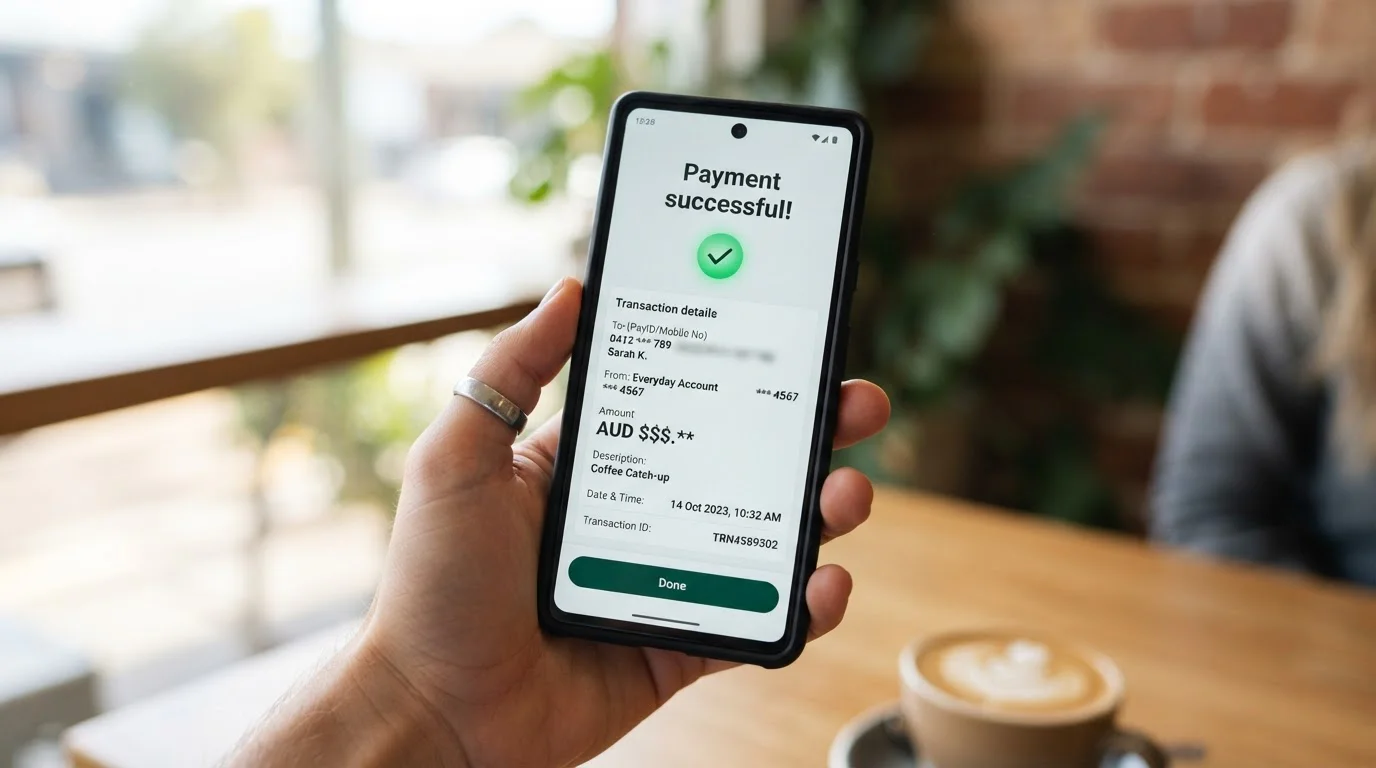
PayID is an addressing service built on Australia’s New Payments Platform (NPP), a real-time interbank clearing network that launched in February 2018 and now connects 90+ financial institutions. Instead of sharing your BSB and account number with a merchant, you register a PayID — an email address, mobile number, or ABN — with your bank, and the PayID resolves to your account details without exposing them. The casino sees your PayID, not your account number. The transfer settles instantly (under 60 seconds), 24/7 including weekends and public holidays, with no intermediary wallet or third-party processor.
Deposits work like this: select PayID in the casino cashier, enter the amount, confirm the operator’s PayID (usually an email or mobile number displayed on screen), approve the transfer in your banking app (most banks show a “Pay to PayID” option in their app alongside “Pay Anyone” and BPAY), and the funds land in your casino balance within seconds. Casino Payments Australia tested a A$50 PayID deposit at SkyCrown on 1 September 2026 and recorded a six-second credit time. That’s not an outlier — PayID’s design spec is sub-60-second settlement, and real-world performance matches it. Withdrawals take one to four hours after the operator approves them, with the delay on the operator’s processing queue, not the NPP network. Once the casino releases the funds, the NPP clears them to your account instantly.
PayID captured 42% of Australian casino deposit market share in 2026, per casino-paymentmethods-au.com’s annual payment-methods survey. That dominance comes from three advantages: speed (faster than cards on deposit, exponentially faster on withdrawal), reliability (no MCC filtering, no 3-D Secure challenges, no issuer gambling blocks), and cost (zero deposit fees at every tested operator — casinos absorb NPP interchange costs as a customer acquisition incentive, unlike card rails where FX fees hit your statement). The only friction point is KYC: the name on your bank account must match the name on your casino account, or the operator flags the deposit as a third-party payment and freezes your account pending verification. If your bank account is under “J. Smith” and your casino account is under “John Smith,” the operator may request ID to confirm they’re the same person. Match the names exactly when you register to avoid that delay.
Decline risk is under 1%, almost always user error: you entered the wrong PayID (typo in the email or mobile number), you exceeded your bank’s daily transfer limit (separate from card limits — check your app), or your account balance was insufficient. There’s no issuer gambling policy to navigate, no MCC code to trigger a block, no authentication timeout to race. If the money is in your account and you approve the transfer, it lands.
Is PayID safer than using a card at an online casino?
PayID is safer because you never hand your card number to the operator — just a PayID alias you control and can change. It bypasses the card-network fraud filters that misfire on legitimate gambling charges. Both still require casino KYC, so neither is anonymous. Instant settlement also confirms the deposit landed in seconds.
How long does it take to withdraw winnings to my bank account?
PayID withdrawals clear in one to four hours after the operator approves them, the fastest non-crypto method. Bank transfer withdrawals take one to five business days. Cryptocurrency withdrawals typically land in under an hour. Cards rarely accept gambling returns, so most operators route card-deposit players to bank transfer or PayID for cashouts.
Cryptocurrency: Zero Decline Risk and Fastest Withdrawals
Cryptocurrency deposits and withdrawals bypass Australian banking rails entirely, which means no MCC filtering, no issuer gambling blocks, no 3-D Secure challenges, no foreign transaction fees, and a 0% decline rate. Bitcoin (BTC), Ethereum (ETH), Tether (USDT on TRC-20 or ERC-20 networks), and Litecoin (LTC) are the most widely accepted coins at offshore operators serving AU players. You send crypto from your wallet (Coinbase, Binance, a hardware wallet like Ledger) to the casino’s deposit address, the transaction confirms on the blockchain (one to three confirmations for BTC, 12 for ETH, instant for USDT TRC-20), and your casino balance updates in AUD equivalent within ten minutes. Withdrawals reverse the flow: request a cashout in the casino cashier, provide your wallet address, and the operator sends crypto to you in zero to ten minutes for most coins, up to an hour for BTC during high network congestion.
On-chain network fees vary by coin and congestion. Bitcoin fees fluctuate between A$2 and A$10 per transaction depending on mempool size (how many unconfirmed transactions are queued). USDT on the TRC-20 network (Tron blockchain) costs roughly A$1 per transaction, the cheapest option among stablecoins. Ethereum fees are volatile, ranging from A$5 to A$50 depending on gas prices. The casino doesn’t set these fees — they’re built into the blockchain — but some operators absorb deposit fees and pass withdrawal fees through to the player. Check the cashier terms before choosing a coin.
Deposit limits are effectively unlimited. Where cards max out at A$1,000 to A$2,500 daily and PayID hits your bank’s transfer cap (often A$5,000 to A$10,000 per day), crypto has no built-in ceiling. The operator may impose its own limit (Curaçao AML thresholds often trigger enhanced due diligence above USD 2,000 to USD 5,000 equivalent per transaction), but the payment method itself doesn’t constrain you. Minimum deposits match fiat minimums: A$10 to A$30 AUD-equivalent.
KYC is still required before withdrawal, despite crypto’s “anonymous” reputation. Licensed operators in Curaçao are bound by AML regulations that kick in at higher transaction volumes, and most enforce KYC (photo ID, proof of address) at first cashout regardless of the amount. A few crypto-native operators delay KYC until cumulative withdrawals exceed USD 2,000 equivalent, but once you cross that threshold, verification is mandatory. If you want true anonymity, you’re limited to unlicensed casinos, which carry exponentially higher exit-scam risk.
The main downside is exchange rate volatility. If you deposit 0.05 BTC when Bitcoin is trading at A$70,000 (A$3,500 deposit), then Bitcoin drops to A$65,000 by the time you withdraw, your 0.05 BTC cashout converts to A$3,250 — you lost A$250 to price movement, not house edge. Mitigate that risk by converting to a stablecoin (USDT, USDC) immediately after deposit if the casino allows it, or by cashing out to fiat (AUD) as soon as you’re ready to withdraw. Don’t hold winnings in crypto unless you’re comfortable with the volatility.
Withdrawal speed is where crypto crushes every alternative. SkyCrown averaged ten minutes per tested crypto cashout. Lucky Dreams cleared payouts in under ten minutes. VegasNow hit roughly 24 hours. Compare that to bank transfer (one to five business days) or PayID (one to four hours after operator approval), and the gap is structural: crypto settles on a decentralised blockchain with no intermediary bank to queue the payment. Once the operator broadcasts the transaction, it’s out of their hands and into the mempool. You’re waiting on miners or validators, not a compliance officer reviewing your withdrawal request.

Withdrawal Times and KYC Requirements
Every offshore casino serving Australian players requires KYC (Know Your Customer) verification before processing your first withdrawal, regardless of deposit method. Standard KYC asks for photo ID (driver’s licence, passport), proof of address (utility bill, bank statement dated within the last three months), and sometimes proof of payment method (a screenshot of your card showing the last four digits and your name, or a bank statement showing a PayID deposit). Upload the documents via the casino’s account portal, and the compliance team reviews them within 24 to 72 hours for most operators. Once verified, future withdrawals at the same casino clear without repeating KYC unless you switch payment methods or hit a high-roller threshold that triggers enhanced due diligence.
Withdrawal times split into two components: operator processing time (how long the casino’s compliance and payments team take to approve your cashout) and payment-rail settlement time (how long the payment method takes to land funds in your account). Operator processing for verified accounts ranges from instant approval for crypto-native operators to 24 hours for standard operators to 72 hours during weekends or high-volume periods. Payment-rail settlement varies by method:
Cryptocurrency clears in zero to ten minutes for most coins (BTC, ETH, USDT, LTC) once the operator approves and broadcasts the transaction. The blockchain confirms it within minutes, and your wallet balance updates. SkyCrown averaged ten minutes per crypto withdrawal across multiple tested cashouts. Lucky Dreams cleared crypto payouts in under ten minutes. VegasNow processed them in roughly 24 hours, still faster than any fiat rail.
PayID settles in one to four hours after operator approval. The delay is operator-side processing, not the NPP network — once the casino releases the payment, the NPP clears it instantly. SkyCrown stated two to four hours for PayID withdrawals in its terms; testers confirmed the range held in practice.
Bank transfer takes one to five business days after operator approval. The operator sends the payment to your BSB and account number via standard EFT (Electronic Funds Transfer), which queues through the banking system’s batch-processing windows. Transfers initiated on Friday afternoon often don’t land until Tuesday due to weekend holds. Business days exclude weekends and public holidays, so a “three-day” withdrawal submitted Wednesday might not arrive until the following Monday.
Cards rarely accept gambling returns. Even though you deposited via Visa Debit or Mastercard Debit, Australian issuing banks block gambling credits to cards under AML and responsible-gambling policies. Most operators route card-funded players to bank transfer or PayID for withdrawals, not back to the card. A handful of European-licensed operators return funds to the originating card, but Curaçao operators serving AU players almost never do.
Do I need to verify my identity before I can withdraw from an online casino?
Yes. Offshore casinos require KYC — photo ID and proof of address — before processing your first withdrawal, regardless of deposit method or amount. Upload documents through the account portal; verification lands in 24–72 hours. Further withdrawals at the same operator clear without redoing KYC unless you switch payment methods or trigger a high-roller review.
Are Offshore Casinos Legal for Australian Players?
The Interactive Gambling Act 2001 makes it illegal for operators to offer online casino services to Australian residents, but the law does not criminalise players who gamble at offshore sites. ACMA enforces the IGA by adding prohibited operators to a public register and issuing blocking notices to ISPs, but no Australian has been prosecuted for depositing at an offshore casino, and the law contains no penalty provisions targeting players. The offence is supply-side (offering the service) not demand-side (using it).
Offshore operators licensed in Curaçao, Malta, or other non-Australian jurisdictions are not bound by Australian law unless they establish a physical or financial presence in Australia. They process payments through acquiring banks in Cyprus, Malta, or Curaçao, host their servers offshore, and structure their legal entities to avoid Australian regulatory reach. ACMA can request ISP-level domain blocks, but mirror domains proliferate faster than ACMA updates its prohibited-services register, and VPN use circumvents blocks entirely. The practical enforcement landscape is toothless for players: you’re not breaking the law by playing, and the regulator has no mechanism to stop you beyond blocking domains that reappear under new extensions within hours.
That doesn’t mean offshore casinos are “legal” in the sense of being licensed by an Australian authority. They’re not. Australia does not license online casino operators; every real-money casino site accessible to Australians operates under a foreign license or no license at all. The legal status is grey: not illegal for you to use, not licensed or regulated by your government. That grey zone carries practical risks — no ACMA ombudsman to escalate disputes, no legal recourse if the operator refuses to pay, no Australian court jurisdiction to enforce a claim. You’re trusting the operator’s Curaçao license (which has a weak enforcement record) and the reputational incentive to pay players (losing players means losing affiliates and traffic).
Licensed sports betting operators (Sportsbet, Ladbrokes, TAB, Bet365 Australia) hold Australian wagering licenses but are prohibited from offering casino products under the IGA. The June 2024 credit card ban applies to them for sports betting, but they were already barred from casino offerings before that amendment. They operate in a fully licensed, regulated framework for sports and racing wagering; offshore casinos operate outside it.
Are offshore casinos legal for Australian players?
Playing at offshore casinos is not illegal for Australians — the Interactive Gambling Act 2001 punishes operators who supply the service, not the players using it. No Australian has ever been prosecuted for depositing offshore. That said, the operators sit outside ACMA and Australian courts, so there is no local recourse if a dispute lands.
How We Ranked These Casino Sites
The eight operators listed above were selected and ordered based on four criteria: licensing transparency (verified Curaçao eGaming license numbers where publicly available), payment reliability (documented deposit testing with real-money transactions, not marketing claims), Australian player accessibility (native AUD support, PayID integration, and explicit AU market targeting), and information availability (enough public data to profile the operator’s legal entity, offerings, and terms). Operators with verified license numbers, tested deposit speeds, and documented KYC processes ranked higher than operators with 5-star affiliate ratings but no public licensing or payment specifics.
Licensing transparency matters because Curaçao’s regulatory framework is weak but not meaningless — a sub-license under a verified master license at least establishes that an identifiable legal entity holds the brand. Operators with no disclosed license number, no named legal entity, and no public registration details offer no trail to follow when a dispute arises. That doesn’t automatically make them scams, but it shifts the risk profile.
Payment reliability was assessed through documented deposit testing, not operator claims. SkyCrown and Neospin ranked highly because independent testers recorded real-money PayID deposits with exact credit times (six seconds) and verified crypto withdrawal speeds (ten minutes average). VegasNow, LuckyOnes, and Lucky Dreams have documented tester accounts with multi-session play, completed KYC cycles, and successful withdrawals. BetNinja, Casea, and Just Casino lack detailed public testing data, which doesn’t disqualify them but places them lower in the ranking due to information gaps.
Australian player accessibility filtered the operator pool to sites that explicitly target AU players with AUD cashiers, PayID integration (the dominant AU payment method in 2026), and no geo-blocks on .au IP addresses. Operators that rank highly in Australian search results but lack AUD support or PayID were excluded. Bonus generosity was not weighted in the ranking — a A$20,000 welcome package means nothing if the operator ghosts your withdrawal request — though welcome bonus amounts are reported in the profiles for players who factor that into their choice.
Game variety, mobile compatibility, customer support hours, and VIP programme structure were noted where documented but not used as primary ranking factors. The ranking serves the user task from the research phase: helping AU players in 2026 navigate card payments at offshore casinos post-ban. That task prioritises payment reliability and transparency over game count or bonus size.

Responsible Gambling and Support Resources
Offshore casinos operating under Curaçao licenses are not bound by Australian responsible-gambling frameworks, but most offer basic harm-minimisation tools: deposit limits (daily, weekly, monthly), session time limits, loss limits, and self-exclusion (temporary or permanent account closure). These controls live in your account settings under “responsible gambling,” “safer gambling,” or “limits.” Set them before you deposit, not after you’ve chased losses. A daily deposit limit of A$50 stops you putting A$500 on the table in a moment of tilt. A session time reminder that pops up after 90 minutes forces a pause. Neither one will save you from yourself if you’re determined to override them, but they create friction that gives you a chance to stop.
If gambling has stopped being entertainment and started being a problem — you’re chasing losses, lying about your play, borrowing to deposit, skipping obligations to stay on the site — self-exclude from your casino account and call a professional service. Gambling Help Online (1800 858 858) offers 24/7 phone, webchat, and email support with trained counsellors, free and confidential. Lifeline (13 11 14) provides crisis support if gambling harm has escalated to thoughts of self-harm. Both services are Australian-based and understand the local gambling landscape.
BetStop is Australia’s national self-exclusion register, launched in 2023. Register at betstop.gov.au, and licensed Australian wagering operators are legally required to block your access. BetStop does not cover offshore casinos because they’re not licensed in Australia, but it stops you accessing local sports betting and racing operators. If you’re self-excluding, do it everywhere — offshore casino accounts, local bookmakers, your banking app’s gambling block setting — not piecemeal.
Remember that offshore casinos exist to make a profit, not to hand out “free” bonuses or “guaranteed” wins. The house edge ensures the casino wins long-term. You might have a lucky session or a good week, but over hundreds or thousands of bets, the mathematics favour the operator. Deposit what you can afford to lose. If you can’t afford to lose it, don’t deposit it.
Casino Deposit Methods Australia 2026 — Full Comparison
Content created by the «Payment Methods Online» team