
$1 Deposit Pokies in Australia: What a Single Dollar Really Buys 2026
 Available in AU

A dollar buys you a servo coffee that tastes like regret, or roughly one hundred spins at a cent a line. The second option is what brings most people to this page. The pitch is everywhere: deposit a single gold coin, unlock a full pokies lobby, chase a bonus worth thousands. It sounds like the house forgot to read its own maths textbook.
It didn’t. The $1 minimum deposit is real, offered by a specific set of offshore operators that take Australian players, but the version sold in glossy affiliate banners and the version that lands in your account are two different animals. Some sites genuinely take a dollar. Many that advertise it quietly set the floor at ten. The welcome package you were promised usually needs a deposit ten to twenty times larger before it activates. And the winnings you scrape together from that dollar may sit trapped behind a withdrawal minimum you didn’t see coming.
This is the honest map. Which operators actually accept a dollar in 2026, what that dollar unlocks, how PayID behaves at the low end (spoiler: rarely at $1), and where the Interactive Gambling Act leaves you standing when something goes wrong. No cheerleading. If a dollar were a smart bankroll, casinos wouldn’t advertise it so hard.
What $1 Minimum Deposit Pokies Actually Mean in 2026
Strip away the marketing and a “$1 deposit pokie” is a simple thing: an online casino that lets you fund your account with one Australian dollar and then play real-money slots with it. Not a demo. Not play money. A genuine balance you can win from and, in theory, withdraw. The catch lives in the gap between “can deposit $1” and “the $1 does what the banner implies.”
Here is what a dollar reliably buys. Full access to the pokies library, in almost every case. Once your balance shows $1.00, the reels spin for real stakes, usually from one cent per line. You can lose it slowly or feed it into a single high-volatility spin and watch it vanish in four seconds. Both are on the menu. The games don’t discriminate by deposit size, and no operator locks its slot catalogue behind a higher entry point.
Here is what a dollar usually does not buy: the welcome offer. That “up to A$5,000 plus 200 free spins” splashed across the top of every operator’s homepage almost always carries a minimum qualifying deposit of A$10 or A$20. Deposit a dollar and you are playing on a dollar, full stop, no matched bonus, no free spins bundle. A handful of sites run a specific low-tier promo, something like a small batch of free spins for a $1 deposit, but the headline package and the dollar coin rarely occupy the same sentence honestly.
Then there is the exit door, which matters more than anyone admits. Withdrawal minimums at these operators typically sit between A$50 and A$100. Turn your dollar into forty through a lucky run and you may find you cannot take the forty out, because it hasn’t cleared the operator’s floor. The money is yours on screen and stuck in practice until you either deposit more, keep gambling until you cross the threshold, or lose it trying. That asymmetry, tiny to get in, harder to get out, is the quiet engine of the whole model.
So treat the $1 deposit for what it is. A test drive. A way to see whether a site’s cashier works, whether the lobby loads on your phone, whether withdrawals are fantasy or fact, all for the price of a lolly. As a genuine bankroll it is a joke, and a short one. As reconnaissance before you commit real money, it’s the cheapest due diligence going.
Do I get the welcome bonus if I only deposit $1?
Usually not. Most offshore operators require a minimum qualifying deposit of A$10 or A$20, so a single dollar leaves you playing with exactly one dollar and no matched funds. Some sites offer a small free-spins promo at the $1 tier, but the headline four-figure bonus stays locked until you deposit more.
The Offshore Operators Accepting $1 Deposits from Australians
Every casino below is offshore. None holds an Australian licence, because no such licence exists for online pokies, and we’ll get to why in a moment. What they share is that they take Australian players on AUD accounts, and each sits somewhere on the spectrum from “genuinely accepts a dollar” to “advertises a dollar, wants ten.” The profiles are built from what these operators publish, what independent reviewers report from real-money testing, and what the licence registers show as of September 2026. Where a claim couldn’t be verified, it says so.
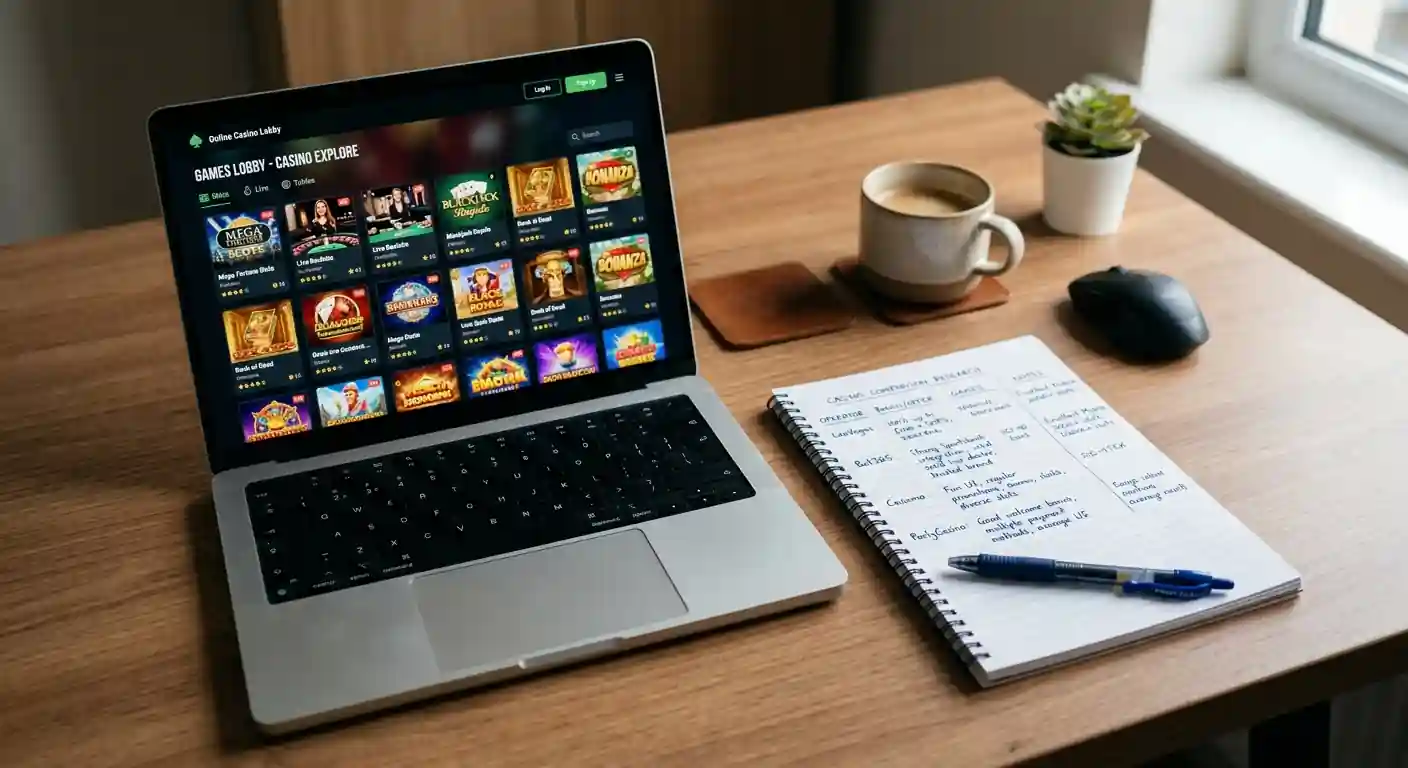
One thing to hold in your head before the names start: a low deposit floor is not the same as a good casino. The dollar gets you in the door. Whether the room behind it pays out is a separate question, and the two don’t correlate. Some of the lowest minimums belong to the shakiest operators.
Royal Reels Casino
Royal Reels is the closest thing to a low-deposit specialist on this list. It launched in 2023, runs under Digibrite SRL out of Costa Rica, and currently operates on a PAGCOR licence from the Philippines, after an earlier Curaçao master licence (the 365/JAZ line) lapsed in August 2024. The lobby carries somewhere north of three thousand pokies from more than forty studios, alongside live dealer and table games. No sportsbook, no downloadable app, just browser play that behaves on a phone.
What earns Royal Reels its spot is the A$10 PayID minimum, which independent Australian reviewers repeatedly flag as the lowest genuine PayID floor in the offshore market. It also dangles an A$10 no-deposit chip on signup, so you can poke around the real-money games before your own money touches the account. Add a welcome package of 125% up to A$1,000 plus seventy-five free spins, and PayID withdrawals that clear inside two hours on a verified account, and it reads well on paper. The honest asterisk: this is a Costa Rica and Philippines-regulated brand with the usual mirror-site sprawl, so bookmark the live domain and treat the no-deposit chip’s winnings cap as the real number, not the free tenner.
HellSpin Casino
HellSpin is one of the older heads in this crowd, live since 2021 and operating under a Curaçao Gaming Authority licence, number GLH-OCCHKTW0702282021, through Gaming Services Provider N.V. That licence line matters here because it’s actually verifiable, which is more than a couple of its rivals can say. The catalogue runs past three thousand titles from over sixty studios, covering slots, live tables and jackpot games, all in AUD.
The welcome side is generous on the surface: 150% up to A$450 on the first deposit plus 150 free spins, scaling across several deposits toward a headline figure around A$5,200. The minimum deposit sits at A$20 for cards and A$30 for crypto, so this is not a genuine $1 operator, and you should ignore anyone who files it under that heading. Crypto withdrawals are the fast lane here, reported under twelve hours; card and bank routes drag out to seventy-two. Player feedback splits hard. One Trustpilot regular of four years reports every withdrawal, including a A$10,000 one, landing promptly; others describe waits past thirty-six hours. That variance is the offshore experience in miniature.
Bizzo Casino
Bizzo has been running since 2020 under TechSolutions Group N.V., and it’s one of the few here carrying two licences at once: Curaçao through Antillephone N.V. and a second from the Kahnawake Gaming Commission in Canada. Two regulators is not double the protection, but it’s a marginally sturdier paper trail than the single-licence norm. The library is deep, north of 4,500 games, leaning pokies-first, with the usual heavyweight studios behind it: Pragmatic Play, Evolution, BGaming, Microgaming.
The entry point is A$10 on cards and PayID, A$20 on crypto, with a 100% up to A$250 welcome match and a hundred free spins on top. Where Bizzo genuinely distinguishes itself is the exit: crypto and PayID withdrawals frequently clear inside four hours on verified accounts, the withdrawal minimum sits at A$50, and there’s a daily payout ceiling of A$4,000, which is roomier than most. A thirty-tier loyalty ladder rewards volume, and live chat runs around the clock. For a player who wants a low floor and a fast, predictable cashier, Bizzo is one of the more sensible names in this list.
Betzillo Casino
Betzillo is the cautionary tale, and it belongs here precisely because it shows up on so many “$1 deposit” lists. It launched late in 2024, likely December, though the operator won’t confirm a date. The contracting party is Betzillo Limited. Its marketing claims a Curaçao licence, sometimes citing the 8048/JAZ Antillephone line, but independent reviewers checking public regulator records in August 2026 couldn’t match a verifiable licence number to the brand, and ownership is undisclosed. ACMA, the Australian regulator, has listed Betzillo among services investigated for providing a prohibited interactive gambling service to Australian customers.
On the product itself: over six thousand pokies, plus live betting and a sportsbook stitched into one account, and an “Early Bird” promo that bundles an A$50 free sports bet (bet A$10), sixty free spins and up to A$1,500 in casino bonuses. Deposits are reported to start around A$10. KYC happens before your first withdrawal, with clearance times ranging from nine hours to three days depending on who’s telling the story. The verdict writes itself: functional, pays some players, but a 2024 brand with an unverified licence and hidden owners is a “fun money only” proposition, not somewhere to park a balance you’d miss. If you play here, play with what the dollar suggests and nothing more.
The Pokies
The Pokies trades hard on Australian familiarity, pub-style slots, the kind of titles you’d see in a club from Parramatta to Fremantle, delivered through a lightweight web app. It’s been around since 2018, which is genuinely long-lived for this market, and the library sits around 1,700 to 2,000 games. The hook is an A$10 no-deposit chip plus a 100% match up to A$500, a loyalty club with cashback, and an A$10 PayID floor.
Here’s the problem, and it’s a big one. The Pokies operates behind a thicket of domain mirrors, thepokies.net, thepokies-au.com, and numbered variants like thepokies119 and thepokies172, and licence claims shift from mirror to mirror; some cite Curaçao, others show nothing at all. One investigative review in September 2026 flatly recommends against playing, citing disputed licence claims and the domain instability. Trustpilot is split down the middle: long-term players report smooth withdrawals, while others describe payouts stuck past thirty-six hours or blocked outright. The brand recognition is real. So is the risk. If you go near it, verify you’re on the live, genuine domain and not a spoofed clone, because the mirror sprawl is exactly the environment scammers exploit.
Oliver Casino
Oliver Casino is the odd one out, and in a good way. It runs on a Malta Gaming Authority licence, an MGA credential, which sits a tier above the Curaçao and Anjouan paperwork most of this market carries. The MGA holds operators to stricter fund-segregation and dispute-handling standards, so an MGA licence is a meaningfully stronger consumer signal, even for a player Australia’s own regulator won’t protect. The lobby is smaller than its rivals at 1,741 games, but it’s audited to a 96.7% average return figure, and withdrawals reportedly average thirteen minutes, almost certainly via crypto.
The catch is that a stronger licence doesn’t guarantee a smooth ride. Oliver’s Trustpilot page carries complaints about delayed withdrawals and thin customer support communication, with at least one player reporting documents submitted and money still pending. The minimum deposit isn’t confirmed at $1; MGA-licensed operators typically sit at A$10 to A$20. So Oliver is the pick for a player who values regulatory backbone over the lowest possible floor, and who’s willing to trade a shorter game list for a cleaner licence. Just don’t read “MGA” as “flawless.”
SpinsUp Casino
SpinsUp closes the list as the PayID-forward option. It’s Curaçao-licensed, carries more than four thousand pokies plus live dealer tables, and several PayID-focused guides ranked it top of their 2026 lists on the strength of near-instant PayID deposits and a 20% weekly cashback that actually returns something to grinders. The welcome offer reaches up to A$5,000, and the PayID minimum sits at A$10 with withdrawals landing in one to four hours on verified accounts.
The reservation is familiar: the operating entity behind SpinsUp is undisclosed, which is standard for Curaçao brands and still worth naming. What you’re buying is a fast, PayID-native cashier and a big slot library, wrapped in the usual offshore opacity about who actually owns the thing. For a player whose priority is moving AUD in and out through the banking rail they already use, SpinsUp does that job well. Whether it does it in two years is the bet you’re making with every offshore name here.
How do I know if a $1 deposit casino is a scam?
Check three things. Does the operator name a verifiable licence number you can match in a public register? Is ownership disclosed, or hidden behind a shell? Do independent reviewers report withdrawals actually landing, not just deposits clearing? A site that takes your dollar but stalls every cashout is the classic “scambling” pattern ACCC warns about.
| Operator | License | Min Deposit | Withdrawal Min | Payment Methods | Distinguishing Feature |
|---|---|---|---|---|---|
| Royal Reels | PAGCOR (Philippines) | A$10 PayID, A$20 crypto | A$50 | PayID, cards, crypto | Lowest PayID minimum in AU market (A$10), A$10 no-deposit bonus |
| HellSpin | Curaçao GLH-OCCHKTW0702282021 | A$20 cards, A$30 crypto | A$50 | Cards, crypto, PayID | Established 2021, fast crypto withdrawals (under 12 hours) |
| Bizzo | Curaçao + Kahnawake | A$10 cards/PayID, A$20 crypto | A$50 | PayID, cards, crypto | Dual licensing, under-4-hour PayID/crypto payouts, A$4,000 daily limit |
| Betzillo | Disputed (claims Curaçao 8048/JAZ, unverified) | A$10 reported | Not confirmed | PayID, cards, crypto | Combined casino + sportsbook, launched late 2024, ACMA investigation confirmed, undisclosed ownership |
| The Pokies | Disputed (varies by mirror) | A$10 PayID | Not confirmed | PayID, crypto, cards | AU-branded pub-style pokies, A$10 no-deposit bonus, multiple domain mirrors, licence status inconsistent |
| Oliver Casino | Malta Gaming Authority (MGA) | A$10–A$20 likely | Not confirmed | Cards, crypto, likely PayID | MGA Tier-1 licence (stricter than Curaçao), 13-minute average crypto withdrawal, smaller library (1,741 games) |
| SpinsUp | Curaçao | A$10 PayID | Not confirmed | PayID, cards, crypto | Ranked #1 in PayID guides 2026, 20% weekly cashback, 4,000+ pokies |
PayID, Cards, and Crypto: Which Payment Method Works at $1
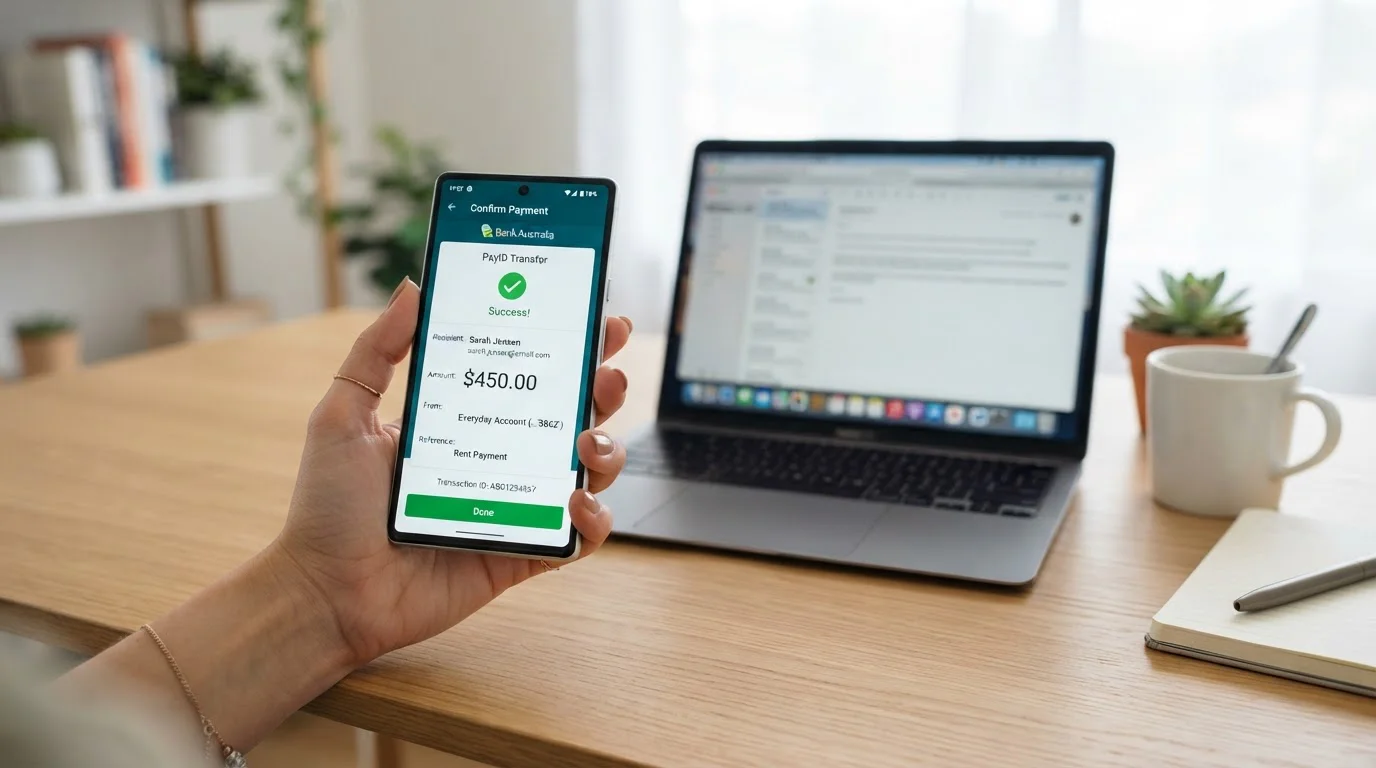
Here is the single most useful thing on this page, and the thing the ranking guides get wrong most often. PayID, the payment method every Australian actually wants to use, is usually not the one that accepts a dollar. The $1 floor, where it genuinely exists, almost always lives on cards or crypto. Conflating “this casino accepts PayID” with “this casino accepts $1 via PayID” is the industry’s favourite sleight of hand, and it sets players up for a small, annoying disappointment at the cashier.
PayID Reality Check: A$10+ Minimums, Not $1
PayID is brilliant technology for this use case. It links a payment identifier, your mobile number or email, to your bank account through the New Payments Platform, the rail owned by Australian Payments Plus and supervised by the Reserve Bank. Deposits settle in under a minute. The casino never sees your card details, because the money moves inside the Australian banking system. Withdrawals, when an operator supports them on PayID, land in one to four hours once your identity is verified. No fees on the network side. For moving AUD in and out, nothing else comes close.
But the minimum is the sticking point. Across fifteen-plus operators, the PayID floor sits at A$10 to A$30, not $1. Royal Reels, Bizzo, The Pokies and SpinsUp all land at A$10, which is the lowest genuine PayID entry going. HellSpin and Betzillo push it to A$20. Nobody serious runs a A$1 PayID deposit, because the per-transaction economics don’t work for the operator at that size on a bank rail. So if PayID is non-negotiable for you, adjust the expectation: your real floor is a tenner, and the “$1 pokies” framing simply doesn’t apply to your preferred method. PayID withdrawal minimums, separately, tend to sit at A$50 to A$100.
Credit and Debit Cards: The True $1 Entry Point
Visa and Mastercard are where the dollar actually lives. Card deposits at most of these operators start at A$1 to A$10, and the low end of that range is where the “$1 minimum deposit” claim is genuinely true. The trade-off is on the way out: many offshore operators accept cards for deposits only, routing withdrawals back through PayID, crypto or bank transfer. So a card might be your $1 entry ticket and useless for collecting anything you win.
There’s a second wrinkle worth knowing. Australian banks are increasingly wary of gambling transactions to offshore merchants, and card deposits to these sites are sometimes declined or flagged, especially with the payment-blocking regime arriving in 2027 (more on that below). A card that worked last month may bounce this month. It’s the least reliable rail long-term, even though it’s the one most likely to honour a literal one-dollar deposit today.
Cryptocurrency: Low Minimums, Fast Payouts
Crypto is the other genuine low-floor route, with minimums typically A$1 to A$20 in equivalent value, and it’s consistently the fastest way to get paid, often clearing in minutes rather than hours. Bitcoin, Ethereum and the stablecoins USDT and USDC are the common options. For a player who’s already crypto-fluent, this is frequently the smoothest end-to-end experience: low entry, fast exit, no bank sitting in the middle deciding whether it approves of your Saturday night.
The barrier is obvious. If you don’t already hold crypto, acquiring it to deposit a dollar is a comically disproportionate errand, buy through an exchange, verify your identity there, transfer to a wallet, then to the casino, all to gamble one dollar. Crypto rewards people already in that world and punishes tourists. It also introduces price volatility: the dollar you deposit might be worth ninety cents by the time you cash out, or a dollar ten. For small stakes that noise is negligible; it’s just worth naming.
E-Wallets and Bank Transfers
Skrill and Neteller show up at some operators, usually with A$10-plus minimums, so they’re not a $1 route, and they add a wallet layer between you and your bank without the PayID speed advantage. Standard bank transfers and POLi-style direct rails appear occasionally, but they’re slow, three to five days is common, and rarely worth it when PayID exists. For the specific goal of depositing a dollar, e-wallets and old-school transfers are a sideshow. Cards or crypto for entry, PayID for withdrawals, is the combination that actually functions.
Which payment method works for $1 deposits, PayID, cards, or crypto?
Cards and crypto are your genuine $1 routes; both accept minimums as low as A$1 at many operators. PayID, despite the marketing, almost always starts at A$10. A common working pattern is a card or crypto deposit to enter at the low floor, then PayID for withdrawals, since many sites accept cards for deposits only.
Why do some operators say “$1 deposit” but then require $10 for PayID?
Because the $1 figure applies to their lowest-minimum method, usually cards or crypto, while PayID carries a separate, higher floor of A$10 to A$30. The headline quotes the cheapest possible entry across all methods; the payment page shows the real per-method minimums. It’s technically accurate and practically misleading.
| Payment Method | Typical Minimum | Deposit Speed | Withdrawal Speed | Fees |
|---|---|---|---|---|
| PayID | A$10–A$30 (most common A$10) | Under 60 seconds | 1–4 hours (operator processing) | Zero on NPP; operator may charge |
| Credit/Debit Cards | A$1–A$10 | Instant | Often deposits-only; where supported, 24–72 hours | Zero on deposit; operator may charge withdrawal |
| Cryptocurrency | A$1–A$20 equivalent | 5–30 minutes (network confirmations) | Minutes to hours (fastest option) | Network gas fees only |
| E-Wallets (Skrill, Neteller) | A$10+ | Instant | 12–48 hours | Operator and e-wallet may charge |
| Bank Transfer / POLi | A$10+ | 3–5 business days | 3–5 business days | Often free, slow |
The Interactive Gambling Act and What It Means for You
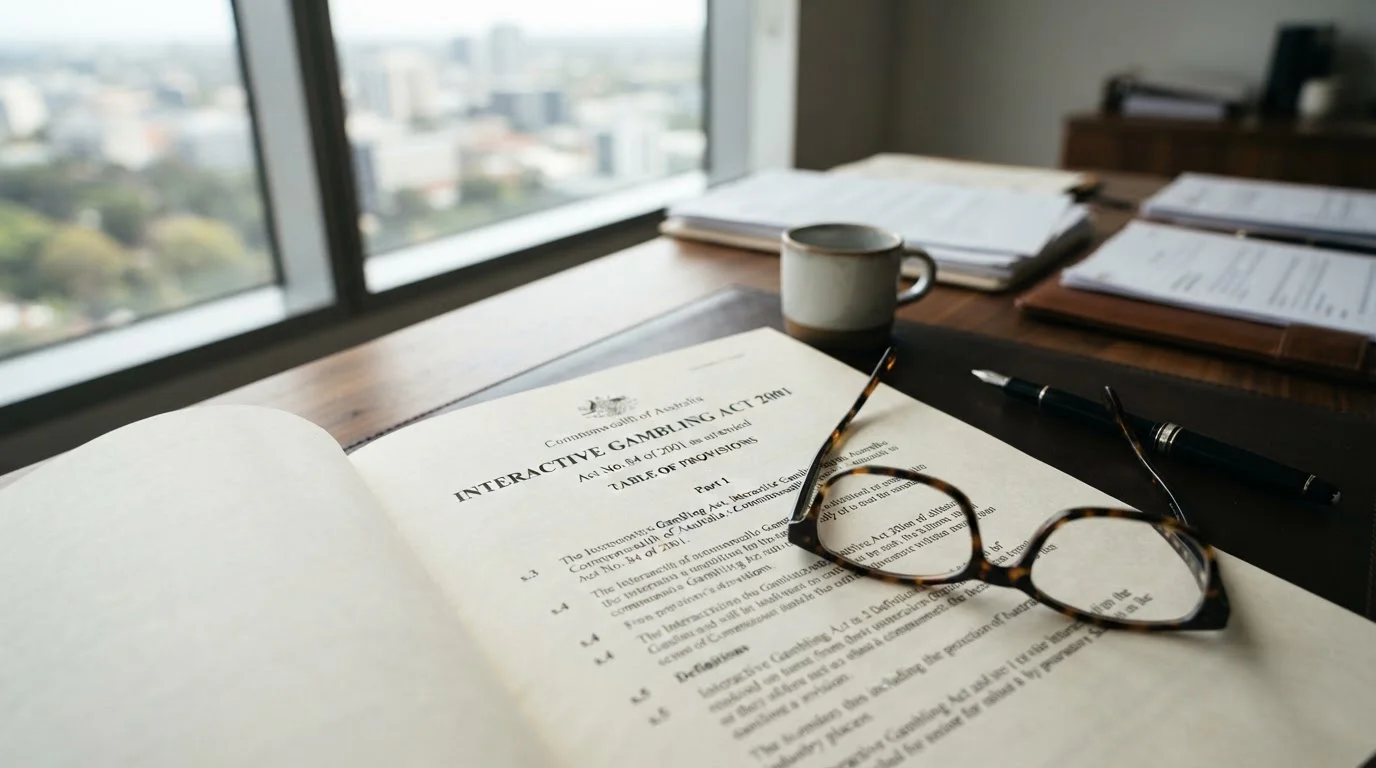
Time for the part everyone skims and shouldn’t. Every operator on this page is illegal to run for Australian customers. You, playing at them, are breaking no law. Both of those statements are true at once, and understanding why is the difference between an informed player and a mark.
No Australian Licence Exists, and Why
The Interactive Gambling Act 2001 makes it an offence to provide a “prohibited interactive gambling service” to a person physically in Australia. Online casino games, pokies, blackjack, roulette, baccarat, casino poker, live dealer tables, all fall squarely inside that prohibition. What sits outside it: sports and race wagering, and lotteries, which is why you can legally bet on the Melbourne Cup through a locally licensed bookmaker but cannot legally be offered an online pokie by an Australian company. No federal, state or territory regulator issues a licence for online casino games. None. When an operator’s homepage implies it’s “licensed for Australian players,” that’s a licence from Curaçao or Malta, not from anyone in Australia, because the Australian version cannot exist.
So the entire market you’re shopping in is, by design, offshore. That’s not a loophole players are exploiting; it’s the structural reality of Australian online gambling law. The operators are based in Curaçao, Malta, Costa Rica, the Philippines, Anjouan, wherever the licensing is available, and they accept Australian traffic knowing the IGA targets them, not you.
You’re Not Breaking the Law, But You Have No Protection
The IGA aims at providers. It has never criminalised the act of playing. An Australian who deposits a dollar at an offshore pokie commits no offence, faces no penalty, and needn’t lose a minute’s sleep over the legality of their own conduct. That much is genuinely settled.
The cost is elsewhere, and it’s steep. Because no Australian regulator licenses these sites, no Australian regulator protects you at them. There is no ombudsman to escalate a blocked withdrawal to. No dispute-resolution body with power over the operator. No enforceable requirement that player funds be segregated, that games be independently fair, or that winnings be paid at all. If a Curaçao-licensed casino simply refuses to pay you, your recourse is a complaint to a Curaçao regulator on the other side of the planet, which is roughly as effective as it sounds. The “protection” you rely on at a pub pokie, backed by state gaming law, evaporates the moment you play online at an offshore site. That’s the real trade for the convenience, and it’s why the licence tier of the operator, and its track record on payouts, matters far more here than any welcome bonus.
ACMA Blocks Sites, and Payment Blocking Starts 2027
ACMA, the Australian Communications and Media Authority, enforces the ban the only way it practically can: by asking internet providers to block access to offending sites. Since 2019 it’s referred more than 1,700 illegal gambling and affiliate sites for blocking. Recent rounds in 2026 have taken down names like Lucky Mate, Vegastars, Rolletto and Velobet, and later batches including 7Signs, Chromabet and Lucky Start. The catch: blocked brands routinely resurface on fresh domains within days, which is the entire reason operators run those mirror networks. A blocked site is not necessarily a scam, and an unblocked one is not necessarily safe; blocking is a game of whack-a-mole, not a seal of quality.
The bigger change is coming. From 1 January 2027, new enforcement measures take effect, including payment-blocking requirements that push Australian banks to stop transactions to offshore gambling operators, plus expanded ACMA takedown powers. In plain terms: the card and bank rails that fund these accounts today are going to get harder to use. If you’re weighing whether to bother with an offshore pokie at all, factor in that the funding path is scheduled to narrow, and crypto may become the last reliably open door. That’s not a scare tactic; it’s the legislated timetable.
Is it legal for Australians to play at $1 deposit pokies sites?
Yes, for the player. The Interactive Gambling Act 2001 targets operators who provide online casino services to Australians, not the individuals who play. You commit no offence by depositing at an offshore pokie. The trade-off is total: no Australian licence means no Australian consumer protection, no ombudsman, and no guarantee your winnings get paid.
Welcome Bonuses, Withdrawal Conditions, and Small-Bankroll Realities
The bonus is the bait, and it’s worth understanding the hook before you bite. Every operator on this list leads with a big matched offer, and every one of those offers is engineered so the house keeps its edge regardless. A $1 player mostly stands outside this whole apparatus, which is either a disappointment or a mercy, depending on how you read wagering terms.
Bonus Eligibility at the $1 Tier
The headline numbers are designed to stop your scroll: A$5,625 at Axe, A$5,200 at HellSpin, A$5,000 at SpinsUp. What the banner shrinks to the fine print is the qualifying minimum, almost always A$10 or A$20, and the wagering requirement, commonly 35 to 40 times the bonus. Deposit a dollar and you’re beneath the bonus floor entirely: no match, no free spins bundle, just your dollar doing dollar things.
Honestly, that might be the better seat. A “free” A$450 match at HellSpin comes chained to a wagering requirement that means turning over thousands before a cent of it becomes withdrawable. Put “free” in quotes and keep it there, because a casino is not a charity and that bonus is a customer-retention cost the maths department signed off on, not a gift. The dollar player, locked out of the bonus, is also spared the wagering treadmill. You play your dollar, and if it becomes forty dollars, that forty is real money subject only to the withdrawal rules, not bonus-locked funds you can’t touch. There are worse positions.
Withdrawal Minimums: The A$50 to A$100 Catch
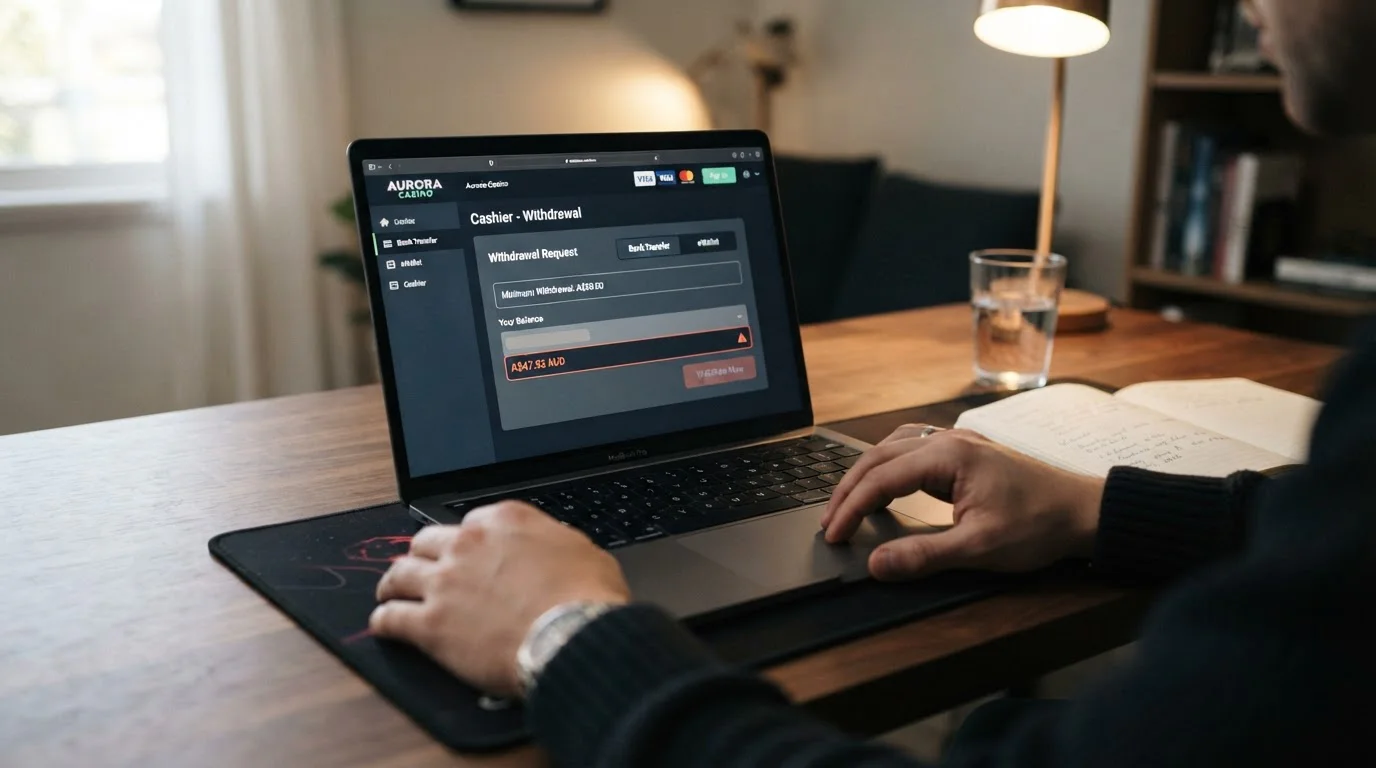
This is the trap that catches small-bankroll players off guard, and the ranking guides almost never mention it. Withdrawal minimums at these operators sit between A$50 and A$100. Do the arithmetic on a dollar deposit. You put in $1, you get lucky, your balance climbs to $47. You go to cash out and the cashier tells you the minimum withdrawal is $50. Your $47 is real, it’s yours, and it’s stuck. Your options are grim: deposit more to top up and cross the line, keep gambling that $47 hoping to reach $50 (and probably losing it), or walk away and leave it.
That asymmetry is not an accident. Cheap to enter, expensive to exit, is the design. It’s the same logic as a “free” trial that’s easy to start and a nightmare to cancel. Before you deposit your dollar anywhere, find the withdrawal minimum, it’s in the terms or the cashier, and understand that any winnings below it are decorative until you cross it. A site with a A$50 withdrawal floor and a $1 deposit floor is telling you exactly how it expects the relationship to go.
KYC Verification Before Your First Cashout
One more gate stands between you and your money: identity verification. Know Your Customer checks, the KYC process, are mandatory before your first withdrawal at every legitimate operator here. You’ll upload a driver’s licence or passport, proof of address like a utility bill or bank statement, and sometimes verification of the payment method you used. It’s an anti-money-laundering requirement, not the operator being difficult, and it applies whether you deposited one dollar or one thousand.
The practical advice from people who’ve been burned: get KYC done early, before you have winnings pending. A verification queue is a miserable place to sit with a balance you want out, and operators are in no hurry to clear documents for someone waiting on a payout. Betzillo, for instance, checks ID before the first withdrawal rather than at signup, and reported clearance times swing from nine hours to three days. Upload your documents the day you register, get verified while you’ve got nothing on the line, and the first cashout, if you’re lucky enough to have one, becomes a formality instead of a standoff.
Can I withdraw winnings from a $1 deposit, or is there a minimum?
There’s almost always a minimum, typically A$50 to A$100, and it applies regardless of how much you deposited. Win $40 from your $1 and you may be unable to withdraw it until the balance clears the operator’s floor. Check the withdrawal minimum before depositing; below it, your winnings stay locked on screen.
How to Spot a Scam and Pick a Legitimate Operator

No Australian regulator is vetting these sites for you, so the vetting falls to you. The good news is that the signals separating a functional offshore casino from an outright scam are learnable, and they’re more concrete than the “just check the licence” advice that passes for guidance everywhere else.
License Verification: What a Curaçao License Looks Like
Most operators here carry a Curaçao licence, and a real one has a specific shape. You’re looking for a licence number in a format like GLH-OCCHKTW0702282021 (HellSpin’s) or a master-licence reference like 8048/JAZ from Antillephone N.V. The key move is that a legitimate operator names both the licence number and the licensing entity, and under Curaçao’s newer regulatory regime you can cross-check a licence against the official register rather than taking a footer badge on faith. A clickable “licensed” seal that leads nowhere, or a licence “number” that’s really just marketing text, is a red flag by itself.
Malta licences, MGA credentials like Oliver Casino’s, are a tier up and easier to verify through the MGA’s own public register. The practical hierarchy: MGA is stricter than Curaçao on fund segregation and dispute handling, Curaçao is the market standard, and Anjouan or Costa Rica licences are the lightest touch. None of them gives you Australian consumer protection, but a verifiable MGA or Curaçao licence beats an unverifiable claim every time. When an operator won’t name a checkable number, as with Betzillo, treat the silence as the answer.
ACMA Blocked vs. Legitimate Offshore
This trips people up constantly, so be clear on it. An ACMA-blocked site is not automatically a scam, and an accessible one is not automatically safe. ACMA blocks sites for operating without an Australian licence, which, since no Australian casino licence exists, means it blocks essentially every offshore casino it gets around to. A well-run Curaçao operator with a decade of clean payouts and a fly-by-night fraud both end up on the same block list. Blocking is about jurisdiction, not integrity.
So don’t use “is it blocked?” as your safety test; use it as a signal that you’re firmly in offshore territory with no local backstop. The genuinely useful checks are the ones about payout track record and transparency, not about whether your ISP has gotten around to blocking the domain this week. If anything, the constant blocking is why the mirror-site problem exists, and mirrors are exactly where spoofed, credential-stealing clones hide.
Red Flags: Fake Licenses, Blocked Withdrawals, No KYC
A few patterns reliably mark trouble. Undisclosed ownership paired with an unverifiable licence, the Betzillo profile, means there’s no one accountable and no regulator you can actually reach. A site that processes deposits instantly but stalls every withdrawal is running the “scambling” playbook the ACCC’s taskforce named in 2026: build a legitimate-looking platform, take deposits, then block cashouts or demand fresh payments to “release” funds. An operator that doesn’t ask for KYC at all is not doing you a favour; it’s often a sign it never intends to pay out large enough sums for verification to matter, or that it’s harvesting deposits and vanishing.
Watch too for the impersonation scams that surged in 2026, fake apps and sites borrowing the names of Crown, The Star and The Lott to look legitimate. Those brands do not offer offshore online pokies; anything claiming to be “Crown online casino” taking your PayID is a fraud wearing a trusted logo. When in doubt: verify the licence number, confirm ownership is disclosed, read independent withdrawal reports, and if the domain doesn’t exactly match the operator’s known live address, close the tab. The dollar you’re risking is small. The card details and ID you’d hand a scam site are not.
What’s the difference between a Curaçao license and a Malta license?
A Malta Gaming Authority licence holds operators to stricter standards on player-fund segregation, fair-play auditing and dispute resolution, and it’s easily verified through the MGA register. A Curaçao licence is the market standard, lighter-touch but still verifiable under the newer regime. Malta is the stronger consumer signal; neither provides Australian protection.
Mobile Play, Game Access, and What You Can Actually Do with $1

The practical question behind all of this: what does a dollar let you actually play, and can you do it from the couch on your phone? Mostly yes to the phone, and mostly pokies to the games, with some real limits once table stakes enter the picture.
Mobile Compatibility: Browser Play, No App Store Presence
You won’t find these casinos in the Apple App Store or on Google Play. The IGA prohibition keeps offshore gambling apps out of the Australian storefronts, so operators deliver mobile play through the browser instead, usually as a progressive web app you can pin to your home screen. Royal Reels, Bizzo, The Pokies and the rest all run this way: no download, HTML5 games that load in Safari or Chrome, and a lobby that reflows for a phone screen. In practice it’s seamless, most players never notice they’re not using a “real” app, and the browser route sidesteps the store restrictions entirely.
The one caveat is the download-app pitch itself. If a site pushes you hard to install an APK file directly, outside the Play Store, be cautious; sideloaded gambling apps are a known vector for the fake-casino scams targeting Australian players. Browser play from a verified domain is the safer default, and it’s what the legitimate operators here actually offer.
Pokies Libraries: 1,500 to 7,000+ Titles
Game count is where these operators compete hardest, and the numbers are genuinely large. Bizzo carries past 4,500 titles, SpinsUp over 4,000, Betzillo north of 6,000, HellSpin and Royal Reels around 3,000-plus each, with The Pokies and Oliver running leaner at roughly 1,700. The libraries pull from the studios that matter, Pragmatic Play, Evolution, BGaming, Microgaming, NetEnt, Play’n GO, so the actual games are the same titles you’d find anywhere, running on the same audited return-to-player percentages regardless of which lobby hosts them.
For a dollar player this abundance is slightly academic, since you’ll sample a handful of spins before your balance decides your session length, but it matters for the “test drive” logic. A large, provider-backed library is itself a legitimacy signal: real studios license their games to real operators, and a casino stocked with genuine Pragmatic Play and Evolution titles has cleared at least that commercial bar. A lobby full of knock-off games you’ve never heard of is its own warning.
Live Dealer and Table Games: Minimum Bets vs. a $1 Bankroll
Here’s where the dollar hits its ceiling. Pokies you can play from a cent a line, so a dollar buys real, if brief, action. Live dealer tables are a different economy. Live blackjack, roulette and baccarat typically carry minimum bets of A$1 to A$5 per hand, which means a one-dollar bankroll buys you exactly one hand, maybe, before you’re done. Progressive jackpot pokies compound the problem: to qualify for the jackpot prize you usually need to bet maximum, often several dollars a spin, so the dollar can’t chase the big number even in principle.
The honest read: a $1 deposit is a pokies instrument and nothing else. It’s enough to spin low-stakes slots, watch how the site behaves, and test the cashier. It is not enough to sit at a live table, not enough to hunt a progressive, and not enough to do anything that resembles a strategy. If your interest is table games or jackpots, the dollar is the wrong tool and you know your real minimum is much higher. For low-stakes pokies reconnaissance, though, it does precisely the job it advertises.
Can I play pokies on my phone at a $1 deposit casino?
Yes. These operators deliver mobile play through the browser as a progressive web app, since offshore gambling apps aren’t allowed in the Australian App Store or Google Play. You get the full pokies library in Safari or Chrome with no download. Be wary only of sites pushing APK installs outside official stores.
Responsible Gambling and Where to Get Help
A dollar deposit looks harmless, and that’s exactly what makes the low-entry model worth a sober word. The whole design, tiny deposits, big bonus banners, one-tap top-ups, is built to keep you feeding the machine, and the offshore operators here run without the deposit limits, activity statements and self-exclusion tools that Australian-licensed wagering sites are required to provide. You are your own regulator here, which means the guardrails are the ones you set.
Set them before you play, not after you’re chasing a loss. Decide the amount you’re willing to lose and treat it as the cost of an evening’s entertainment, not an investment expecting a return, because the maths guarantees the house wins over time. If you find yourself depositing past your limit to clear a withdrawal minimum, or topping up to keep a session alive, that’s the model working as intended and the moment to stop. If gambling has stopped being fun, free and confidential help is available in Australia through Gambling Help Online (gamblinghelponline.org.au) and the national helpline on 1800 858 858, both available around the clock. Financial counselling through the National Debt Helpline on 1800 007 007 is there if the losses have gone beyond entertainment. The dollar is small. Keep it that way.
Minimum Deposit Casinos Australia 2026 — $1, $5, $10, $20
Content created by the «Payment Methods Online» team