
Best Crypto Casinos for Aussies: Offshore Sites That Actually Pay Fast
 Available in AU

Banks block your card. The IGA bans the games. Traditional casinos make you wait three days for a payout that might get declined anyway.
Crypto casinos bypass all of it. No AUD sitting in a payment gateway, no bank even knowing you gambled, no three-day “processing” excuse. Deposit clears in ten minutes, withdrawal lands in your wallet before the next spin. That’s the pitch, and for once it’s mostly true — provided you pick an operator that won’t suddenly demand a passport scan the moment you try to cash out a modest win.
Australia licenses sports betting. It does not license online casinos or pokies. The Interactive Gambling Act 2026 makes supplying those games illegal, but playing them offshore has never been prosecuted. Enforcement targets the supply side. Individual punters using Curaçao or Anjouan-licensed crypto casinos face no legal risk under Australian law, only the commercial risk of dealing with operators whose home regulator might be one person in a beachside office.
This guide ranks eight offshore crypto casinos that accept Australians, explains why crypto solves the bank-blocking problem the IGA created, breaks down which coins actually save you money on fees, and walks through the no-KYC reality that review sites conveniently simplify. No casino is “giving” you a $20,000 bonus. We’ll show you the maths.
Why Crypto Casinos Work for Aussies in 2026
Crypto casinos solve two problems Australian punters face: access to prohibited games, and banking friction that makes traditional offshore casinos a logistical headache.
The Interactive Gambling Act 2001 prohibits anyone — domestic or offshore — from offering online casino games or pokies to Australian residents. Sports betting through licensed operators is fine. Casino games are not. No state or territory issues a license for online pokies. The Northern Territory Racing Commission handles wagering only. For individual players, the IGA creates no criminal liability. Section 15 targets providers, not punters. ACMA blocks offshore casino domains under the Act, but using those casinos — via VPN, mirror domain, or direct access where geo-blocks are loose — has never resulted in a prosecution of an Australian player. Enforcement goes after the supply infrastructure: payment processors, advertisers, hosting. Demand remains legal in practice.
Banks know this, and many decline transactions flagged as gambling-related even when the transaction itself is lawful. Card networks see “online casino” in the merchant descriptor and reject it to avoid compliance headaches. PayID and POLi work for licensed sports betting; they don’t work for offshore casinos. E-wallets used to bridge the gap until Skrill and Neteller tightened their terms in 2023. By mid-2026, the cleanest path into an offshore casino from Australia is a blockchain: no merchant descriptor, no intermediary that can say no, no bank statement with “CasinoXYZ” printed on it. You control the rail.
Payout speed is the other half. A traditional offshore casino accepting AUD takes your deposit via card (if the processor allows it), converts it to EUR or USD in their system, holds your balance in fiat, then reverses the process on withdrawal: they initiate a bank transfer, it routes through correspondent banks, lands in your Australian account two to five business days later if nothing flags it for review. A crypto casino skips the entire fiat layer. Your Bitcoin is Bitcoin when you deposit it, Bitcoin while you play, Bitcoin when you cash out. The operator approves the withdrawal, broadcasts a transaction to the blockchain, and ten minutes later it’s in your wallet — confirmed, irreversible, yours. No “pending” status stretching into Wednesday.
Are crypto casinos legal for Australian players in 2026?
Using offshore crypto casinos is not illegal for Australian players. The IGA prohibits supply, not use. Section 15 makes it an offence to provide interactive gambling to Australians, but no provision criminalises accessing it. ACMA enforces against operators and blocks domains. No resident has been charged. The risk is commercial, not legal.
The Top 8 Crypto Casinos for Australian Players

These eight operators accept Australians, pay in crypto, and have operating histories long enough to separate them from the monthly churn of new casino launches that vanish after six months. They are ranked by a combination of payout reliability, breadth of crypto support, bonus clarity, and game-library depth. None holds an Australian license because no such license exists for online casinos. All operate offshore under Curaçao, Anjouan, or no published license at all.
| Operator | License | Withdrawal Speed | Min Deposit | Cryptos Accepted | Game Count | Standout Feature |
|---|---|---|---|---|---|---|
| BC.Game | Anjouan | ~10 min | 0.0001 BTC | 130+ | 10,000+ | Broadest crypto support, BCD token economy |
| Vave | Unlicensed | ~12 min | 0.0001 BTC | 20+ | 16,900+ | Largest game library in crypto gambling |
| Stake | Curaçao 8048/JAZ | ~15 min | $1 equivalent | 20+ | 6,000+ | Mainstream brand, F1 sponsorships, native app |
| Cloudbet | Curaçao OGL/2024/328/0599 | ~12 min | 0.001 BTC | 15+ | 2,500+ | Veteran (2013), no-wagering bonus model |
| BitStarz | Curaçao OGL/2024/165/0185 | ~10 min | $20 or 0.0001 BTC | 6 major + fiat | 7,000+ | Hybrid crypto/fiat, indefinite license term |
| mBit Casino | Curaçao | ~10 min | 0.0001 BTC | 10+ | 2,500+ | RTP displayed on every game thumbnail |
| FortuneJack | Anjouan | ~15 min | 0.001 BTC | 15+ | 3,120+ | Provably fair verification blog, 2014 veteran |
| 7Bit Casino | Curaçao | ~12 min | $20 or 0.0001 BTC | 10+ | 5,000+ | Dama N.V. group, LCB “Best Crypto Casino 2025” |
BC.Game
BC.Game runs one of the widest crypto nets in gambling: 130+ coins accepted, from Bitcoin and Ethereum down to altcoins most casinos have never heard of. If you hold SOL, AVAX, ADA, TRX, or BNB, you can deposit in that coin directly without converting through an exchange first. The operator also built a token economy around its native BCD coin — rakeback, loyalty rewards, and a yield vault all tie into one in-platform currency system. It’s complex if you ignore it, useful if you learn it.
The casino migrated its license in 2024, moving from Curaçao Gaming Control Board to Anjouan Offshore Financial Authority after disputes in Curaçao courts. That history doesn’t appear on the marketing page. Anjouan sits lower on the regulatory-credibility ladder than Curaçao, which itself is no paragon. For routine play the license jurisdiction rarely matters; it surfaces when something goes wrong and you want someone to complain to. BC.Game’s actual trust signals — operating since 2017, processing high volumes, replying publicly to complaints — weigh heavier than the license badge. Still, the migration is a fact any depositor should know.
The welcome bonus advertises 300% up to AU$20,000. That ceiling requires depositing around $6,500 to hit. A typical AU$100 deposit gets you AU$300 in bonus credit, which you must wager 35 times ($10,500 total turnover) before withdrawal. The game library includes 74 in-house “BC Originals” — provably fair Crash, Plinko, Mines, Dice, Limbo — plus 10,000+ slots and live dealer games from third-party providers. Withdrawals process in about ten minutes for routine amounts; larger wins can trigger KYC checks even though the marketing emphasizes “no KYC required.” That gap between promise and practice is standard across crypto casinos and worth understanding upfront.
Vave
Vave launched in 2022 and grew fast by stacking game providers until the lobby hit 16,900+ titles — the largest selection in crypto gambling as of 2026. Quantity doesn’t always mean quality, but when you’re hunting a specific slot or provider, Vave probably has it. The casino also runs 12 in-house “Vave Originals” at a flat 99% RTP, which is honest by design: provably fair games publish their return rate upfront rather than burying it in a help file.
The site publishes no license number and names no regulator. That’s unusual enough to note. Most offshore operators at least claim a Curaçao sublicense even if verification is difficult. Vave’s terms say nothing about jurisdiction. For players, that means disputes have no formal adjudication path. Trustpilot and forum sentiment have been positive through mid-2026, but the absence of a stated license is a trust trade-off: you’re relying entirely on operational reputation with no regulatory backstop, even a weak one.
The sportsbook runs alongside the casino, offering 3,000+ markets on major football ties and solid coverage of cricket and tennis. The welcome package is priced in Bitcoin, not AUD equivalent, which means its value floats with the market. Vave explicitly states Australia is not on its restricted-country list, so registration and deposit work without VPN theatrics. Withdrawals clear in about twelve minutes post-approval. The casino keeps all balances in crypto; there’s no AUD conversion layer. If that sounds inconvenient, it’s actually the point: you avoid every bank and card-network checkpoint that could decline or delay a fiat transaction.
Stake
Stake is the mainstream face of crypto gambling, plastered across Formula One broadcasts and Premier League shirts. It’s been operating since 2017 under a Curaçao license (8048/JAZ), processing massive volumes and paying out consistently enough that its Trustpilot score sits above the crypto-casino average despite the scale. The brand has the kind of name recognition that forces operational discipline — mess up publicly and sponsors notice.
The Australian government restricted Stake’s advertising in 2023 after the platform became too visible in local sports media, but the restriction applies to promotion, not access. Australians can still register, deposit, and play. The site does not block Australian IPs. The platform offers 6,000+ games, 20+ cryptocurrencies, and a tier-based VIP program that returns a percentage of wagers as rakeback. The “Stake Originals” library includes Crash, Dice, Plinko, Mines, and house-edge card games, all provably fair and carrying the brand’s own design.
The welcome bonus is modest compared to BC.Game or 7Bit — typically around $200 equivalent rather than multi-thousand-dollar headline figures. That restraint shows up in the wagering requirements too: they’re standard (35x) but the max-bet cap while clearing the bonus is higher, which means fewer ways to accidentally void your balance. KYC gets enforced on large withdrawals. Stake’s terms don’t pretend otherwise. If you win big, expect to upload an ID. For smaller cashouts the process is usually frictionless: approve, broadcast, done.
Stake runs a native mobile app, rare among crypto casinos. Most just offer a responsive mobile site. The app handles deposits and withdrawals as smoothly as the desktop version, which matters if you’re not sitting at a laptop when you want to move funds.
Cloudbet
Cloudbet launched in 2013, making it one of the oldest continuously operating Bitcoin casinos still around. Longevity in this space is a signal: the fly-by-night operators are gone by year three. Cloudbet is past year eleven. The casino holds a Curaçao license (OGL/2024/328/0599) that’s listed publicly on its About page and verifiable on the regulator’s registry. It’s still Curaçao, not the UKGC, but at least the number exists and matches.
The welcome bonus structure is unusual: it unlocks over 30 days rather than landing as a single deposit match with 35x rollover. You deposit, you play, and the casino credits bonus tranches daily based on your wagering volume. No wagering requirement to clear because the bonus is already conditional on play. It’s slower but less trap-prone than the standard “here’s $1,000 in locked credit, good luck clearing $35,000 turnover before it expires.” Some players prefer the instant match for the psychological boost; others appreciate not having a countdown timer.
Cloudbet’s terms name an independent adjudicator — IBAS, the UK-based dispute service. That clause is rare in offshore casino contracts. Most limit disputes to “contact support, then arbitration in Curaçao under our choice of arbitrator,” which is another way of saying the house picks the referee. Cloudbet at least acknowledges a neutral path exists. Whether it gets used in practice is harder to verify, but the clause itself shows a level of operational maturity.
The casino publishes its fee structure openly instead of hiding processing charges behind vague “up to X%” disclaimers. There’s no withdrawal ceiling once you’ve passed KYC. Cloudbet pairs the casino with a full sportsbook and esports section, all on one wallet. Withdrawals typically clear in ten to fifteen minutes. The game library sits at 2,500+ titles, smaller than Vave or BC.Game but curated well enough that the depth isn’t missed.
BitStarz
BitStarz has been running since 2014 under a Curaçao license now converted to indefinite term (OGL/2024/165/0185), meaning no expiration date to track. That conversion happened in December 2025. The casino operates as a hybrid: it accepts crypto and fiat (AUD, EUR), processes crypto in about ten minutes at zero fees, and handles fiat through traditional card and e-wallet rails with the usual KYC burden. If you want the optionality of depositing in AUD one session and Bitcoin the next, BitStarz accommodates it.
The game library spans 7,000+ titles from 50+ providers. Pragmatic Play, NetEnt, Play’n GO, and BGaming all feature heavily. BGaming’s provably fair slots are woven throughout the lobby alongside standard RNG titles, so players who care about cryptographic verification have options without hunting for a separate section. BitStarz also runs a handful of proprietary “BitStarz Originals” — in-house games that don’t appear elsewhere.
Trustpilot scores the casino at 4.4/5 across roughly 5,000 reviews, a volume that makes the rating harder to game. The welcome package stretches across four deposits, up to 5 BTC or $500 plus 180 free spins. Wagering requirement is 40x the bonus, slightly higher than the 35x standard, but the bonus unlocks incrementally so you’re not trying to clear a massive lump sum before withdrawal. BitStarz enforces KYC on fiat withdrawals. For crypto-only play at moderate stakes, many users report clearing withdrawals without document checks.
The casino won multiple industry awards between 2014 and 2023, though iGaming awards should be taken with some skepticism — they’re often paid placements. Still, longevity and volume matter more than trophies. BitStarz processes enough transactions that any systemic payout problem would surface loudly. It hasn’t.
mBit Casino
mBit launched in 2014 and carved a niche by doing something simple that most competitors skip: it displays RTP on every slot thumbnail. You don’t dig through a game’s info panel or Google the provider’s sheet; the return rate is right there in the lobby, and you can sort the entire library by RTP if you want. That transparency costs the casino nothing and signals an operator that isn’t afraid of informed players.
The casino operates under Curaçao jurisdiction but doesn’t prominently display a license number as of 2026. That omission is common enough in the Curaçao licensing ecosystem — sublicensees sometimes bury the reference deep in terms — but it’s still a documentation gap worth noting. mBit’s actual operational history does more to establish trust than a license badge would: eleven years, steady cashouts, responsive support, active forum presence. The welcome bonus is aggressive: 375% up to 4 BTC plus 325 free spins, unlocked via promo code VIPBIT. The 375% match is among the highest headline rates in the space, though it still carries 35x wagering on the bonus portion.
The game library holds 2,500+ titles with a heavy slots focus and a smaller live dealer section. BGaming’s provably fair games are integrated throughout. mBit runs a loyalty program with level-based cashback and weekly bonuses that scale with play volume. Each tier brings additional perks: personalized deposit matches, faster withdrawal approvals, mystery bonuses. The structure rewards consistency more than single large deposits.
Withdrawals process in about ten minutes for crypto. mBit offers no fiat option; it’s crypto-only, which keeps the operation simpler and compliance lighter. No-KYC play works up to moderate amounts, typically under $2,000 per withdrawal. Larger wins may trigger verification requests. The casino publishes a rolling three-month cashout total on its homepage — AU$4.2 million as of the last check — though that figure is operator-reported and unverified by a third party.
FortuneJack
FortuneJack has operated since 2014 under an Anjouan license, putting it in the same regulatory tier as BC.Game post-migration. The casino markets itself as “provably fair” and backs that claim with a detailed blog explaining cryptographic verification: how to check seeds, how outcomes are generated, what “provable” actually means beyond the buzzword. That educational effort is rare. Most operators slap a “provably fair” badge on Dice and Crash without explaining how a player would verify it.
The game library includes 3,120+ titles spanning slots, live dealer, sportsbook, and esports. The welcome bonus uses a mission-based unlock structure instead of a simple deposit match: you complete tiers by playing, and each tier grants free spins or bonus credit. It’s slower than “deposit $100, get $300 now,” but it spreads the reward and avoids the psychological cliff of clearing a massive wagering requirement in one sprint.
Trustpilot removed FortuneJack’s rating in 2024 after detecting fake reviews. As of March 2026, 61% of the 182 reviews remaining were one-star. That’s a harsh aggregate, but the operator does reply publicly to complaints, which at least signals engagement. The removal and the review skew are worth knowing before deposit. FortuneJack’s operational history and forum presence suggest it pays out reliably for routine play, but any casino with a contested Trustpilot record warrants extra caution on large deposits.
The casino runs an active Discord community with regular rewards, tournaments, and direct operator interaction. That’s a double-edged feature: it builds community, but it also means player disputes sometimes play out in a semi-public channel where the operator controls moderation. Withdrawals clear in about fifteen minutes post-approval. The casino accepts 15+ cryptocurrencies. No-KYC is marketed, but as with all “no-KYC” casinos, large wins or AML flags can trigger verification.
7Bit Casino
7Bit operates under the Dama N.V. umbrella, the same parent group behind BitStarz. That shared infrastructure shows up in the platform’s polish: clean interface, solid mobile responsiveness, reliable cashier. The casino holds a Curaçao license from the Gaming Control Board, though the specific number isn’t prominently displayed. Casino Guru rates it at 9.1/10 Safety Index (“Very High”), and it won “Best Crypto Casino 2025” at the LCB Awards.
The welcome package is large by headline: $10,800 plus 250 free spins across the first four deposits. Each tier requires a promo code to activate, and each has its own match percentage and wagering requirement (35x on the bonus). The math is worth working out before deposit: to hit the $10,800 ceiling, you’d need to deposit several thousand dollars across four separate transactions. A more realistic AU$100 first deposit gets you a 100% match ($100 bonus) plus 20 free spins. That bonus portion requires $3,500 in wagering before withdrawal.
The game library spans 5,000+ titles from 60+ providers, with heavy representation from Pragmatic Play, NetEnt, and BGaming. The casino offers both crypto and fiat options (AUD accepted). Crypto withdrawals process in ten to fifteen minutes; fiat withdrawals take one to three business days and require KYC. The site runs weekly reload bonuses and cashback for active players, structured around a tier-based loyalty program.
7Bit enforces a $2 max bet while clearing bonuses. That limit is standard but easy to violate accidentally on high-volatility slots where a single spin can cost $5 or $10 if you’re not watching the stake. Violating the max-bet rule voids the bonus and any winnings derived from it, per the terms. The warning is buried in the bonus policy fine print, not flashed at the cashier.
The casino’s terms state disputes are subject to Curaçao law and arbitration. There’s no independent adjudication clause like Cloudbet’s. That’s standard for the jurisdiction but worth knowing upfront.
Instant Withdrawals: How Fast Crypto Really Is

Crypto casinos market “instant” withdrawals. That’s half-true. The blockchain settles a transaction in minutes once it’s broadcast. The operator’s approval process can take longer.
A typical crypto withdrawal moves through three stages: you request it in your casino account, the casino’s finance team reviews and approves it (anywhere from two minutes to two hours depending on time of day, amount, and whether your account is flagged), then the operator broadcasts the transaction to the blockchain. Stage three is fast and deterministic. Stage two is where “instant” becomes “usually within an hour.”
Bitcoin transactions confirm in about ten to sixty minutes depending on network congestion and the fee the operator attaches. One confirmation is enough for the funds to appear in your wallet; some wallets and exchanges require three to six confirmations before crediting the balance, which can stretch the timeline to an hour or more. Ethereum settles faster — two to fifteen minutes — but gas fees fluctuate with network demand and can run $1 to $5 per transaction. During peak congestion, Ethereum fees have spiked to $20+, though mid-2026 levels sit closer to $2 to $3.
USDT on the Tron network (TRC-20) is the fastest and cheapest option for withdrawal: one to three minutes, transaction fees under $1. Tron was built for stablecoin transfers and handles them efficiently. USDT on Ethereum (ERC-20) is slower and pricier, inheriting Ethereum’s gas-fee structure. If the casino offers both, pick TRC-20. Litecoin splits the difference: five to fifteen minutes, fees under fifty cents. It’s faster than Bitcoin, cheaper than Ethereum, and nearly as widely supported.
| Coin / Network | Settlement Time | Typical Fee | Price Stability |
|---|---|---|---|
| USDT (TRC-20) | 1–3 min | Under $1 | Stable (pegged) |
| Litecoin | 5–15 min | Under $0.50 | Volatile |
| Ethereum | 2–15 min | $1–$5 | Volatile |
| Bitcoin | 10–60 min | $2–$10 | Volatile |
| USDT (ERC-20) | 2–15 min | $1–$5 | Stable (pegged) |
| Lightning (BTC) | Under 1 min | Cents | Volatile |
Lightning Network — Bitcoin’s layer-two scaling solution — settles transactions in under a minute with fees measured in single-digit cents. It’s the ideal rail for small frequent cashouts. Almost no crypto casinos support it as of 2026. That’s an infrastructure gap, not a technical limitation. Lightning works; operators just haven’t integrated it yet.
Traditional offshore casinos accepting AUD process card and bank withdrawals in twenty-four to seventy-two hours after approval, assuming no compliance hold. Licensed European casinos under MGA or UKGC jurisdiction typically clear withdrawals in twelve to forty-eight hours. Crypto’s ten-to-twenty-minute standard is genuinely faster. That speed compounds when you’re moving funds between casinos or pulling out after a session rather than waiting days for access.
Network fees matter more at smaller cashout amounts. Withdrawing $50 in Bitcoin with a $5 network fee costs you 10% of the balance. Withdrawing $500 with the same $5 fee costs 1%. Stablecoins on TRC-20 keep that cost under 1% even on $50 withdrawals. If you’re a grinder cashing out $100 twice a week, the fee structure is part of the total return calculation.
How fast are crypto casino withdrawals compared to traditional online casinos?
Crypto cashouts typically clear in ten to twenty minutes from approval, against twenty-four to seventy-two hours for traditional offshore casinos moving AUD via bank transfer. The blockchain settles in minutes—Bitcoin 10 to 60, Ethereum 2 to 15, USDT TRC-20 1 to 3. Operator approval adds anywhere from a few minutes to an hour.
Which cryptocurrency should I use for deposits and withdrawals at Australian crypto casinos?
For stability and low fees, use USDT on Tron (TRC-20): one to three minutes, fees under $1, and the peg keeps your balance steady. If TRC-20 isn’t offered, Litecoin lands next—five to fifteen minutes, sub-50-cent fees. Bitcoin works everywhere but costs $2 to $10. Skip USDT on Ethereum; it’s just slower TRC-20.
No-KYC Crypto Casinos: What “Anonymous” Actually Means

“No-KYC” is crypto casinos’ favorite marketing hook. It’s also their most misleading. What they mean is: you don’t upload an ID to register. What they don’t say is: we reserve the right to demand one later.
A true no-KYC casino would never ask for identification under any circumstances. That casino does not exist at scale, because anti-money-laundering pressure has reached even the loosest offshore jurisdictions. Curaçao tightened enforcement in 2024. Anjouan follows international AML frameworks on paper. Operators can’t afford to let large sums move through their platform without documentation, or their banking and crypto-processing partners cut them off.
What “no-KYC” actually means in practice: you can register with just an email address or wallet address, deposit, play, and withdraw small amounts without ever seeing a verification request. The threshold where KYC kicks in varies by operator and is rarely published explicitly, but player reports point to a range around $2,000 to $5,000 in cumulative withdrawals. Win $500 three times across a month and you might stay under the radar. Win $8,000 in one session and you’re uploading a passport and proof of address before the funds leave.
AML flags trigger verification outside of win thresholds. Rapid deposits from multiple wallets, withdrawals to a fresh wallet that’s never deposited, patterns that resemble structuring — all of these can trigger a manual review. The operator’s terms always include a clause reserving the right to request ID at their discretion. That clause is the escape hatch that makes “no-KYC” legally defensible while still giving the casino full control over when to enforce it.
Some operators are more aggressive than others. BC.Game enforces KYC strictly on wins above $5,000 per user reports. Stake discloses upfront that large withdrawals require verification. FortuneJack and mBit have reputations for processing moderate cashouts without checks, but “moderate” is subjective and the threshold can shift without notice. Vave’s policy is opaque; the site doesn’t publish KYC terms clearly.
For Australian players, the appeal of no-KYC is less about hiding identity from authorities — the IGA doesn’t criminalize playing offshore — and more about transaction privacy from banks and speed. No KYC means no waiting a day for document approval before your withdrawal processes. It also means no casino charge appearing on your bank statement if you’re funding your crypto wallet via card. That convenience holds until you hit the invisible threshold and suddenly the “no-KYC” casino wants your driver’s license.
If you plan to play at meaningful stakes or withdraw large wins, assume KYC will happen eventually and have documents ready. If you’re microstaking $20 sessions and cashing out $50 to $200 a few times, the no-KYC promise might hold. The frustration comes from operators marketing absolute anonymity when the policy is actually conditional and threshold-based.
Do I need to complete KYC at a no-KYC crypto casino?
Eventually, yes, if you win enough or withdraw often. No-KYC means no ID at signup and none for small cashouts, usually under $2,000 to $5,000 cumulative. Larger wins, rapid withdrawal patterns, or AML flags trigger a manual review that freezes funds until you upload passport and proof of address. Every terms page reserves that right.
Crypto Casino Bonuses: Are They Worth It?

Crypto casino bonuses look absurd on paper. 300% up to $20,000. 375% up to 4 BTC. Five-figure “free” money just for signing up. Then you read the wagering requirements and do the math.
A 300% bonus on a $100 deposit gives you $300 in bonus credit and $100 in real balance. To withdraw any of it, you must wager the bonus amount 35 times. That’s $10,500 in total bets. At $2 per spin on a 96% RTP slot, you’re making 5,250 spins with an expected loss of 4% per spin. After cycling through $10,500 in wagers, the house edge eats roughly $420. Your starting balance was $400. You’re statistically broke before you clear the requirement.
That calculation assumes you never hit max-bet violations, never play a restricted game, never let the bonus expire, and variance doesn’t wipe you out early. Most players lose the bonus before clearing. That’s by design. The bonus is a retention tool. It keeps you playing longer. The casino recoups the “gift” through hold.
Welcome bonuses make sense in two scenarios. First, if you were planning to deposit and play that volume anyway, the bonus adds effective rakeback. A grinder depositing $500 and cycling $17,500 through slots over a week (35x on the bonus) gets the bonus as a rebate on expected loss. That player was always making those spins; the bonus just smooths variance. Second, if you’re hunting a jackpot or high-volatility event where one hit pays for everything. The bonus buys extra spins, which buys more lottery tickets. You’re still bucking math, but at least the bonus gives you more attempts.
For casual players depositing $50 or $100 intending to play an hour and cash out, the bonus is a trap. It locks your deposit into rollover hell. You can’t withdraw until you clear, and clearing requires bet volume far beyond what you’d naturally play. If you lose the bonus and want to cash out your remaining deposit, you’re usually stuck — the real balance and bonus balance are often pooled until wagering completes, and the terms block withdrawal until then.
The cleaner move for casual play: decline the bonus, deposit, play with your own money, cash out when you’re done. No rollover, no max-bet restrictions, no expiration countdown. You trade the “300% free!” headline for full liquidity.
No-deposit bonuses are even less realistic. Operators offer $10 to $30 in BTC or USDT with no deposit required. The catch is a 40x to 50x wagering requirement on that tiny amount, which means cycling $400 to $1,500 through slots for a shot at cashing out maybe $20 if variance treats you well. Most players burn through the no-deposit credit in fifteen minutes and deposit real money anyway, which was the point.
Realistic bonus value for a typical $100 depositor claiming a 300% match with 35x wagering: close to zero in expected value, negative if you account for the time cost of rollover. The bonus works as entertainment subsidy if you would have played the volume anyway. It’s negative-EV if it changes your playing pattern to chase clearance.
Are crypto casino bonuses worth it with 35x wagering requirements?
Not for casual players depositing $50 to $200 for a few hours. A 300% bonus on $100 gives $300 in bonus credit requiring $10,500 in wagers to unlock. At 96% RTP you lose $420 clearing it—more than your $400 balance. Worth it only if you already planned the volume or chase a jackpot.
Crypto Pokies and Game Libraries
Australian punters say “pokies.” Everyone else says “slots.” The product is the same: RNG-driven spinning reels, bonus features, and enough variance to bankrupt you or double your balance in ten minutes. Crypto casinos load thousands of them.
Vave leads on raw count with 16,900+ games, though that figure includes every variant of every slot across every provider and definitely counts duplicates. BC.Game and BitStarz hover around 10,000 and 7,000 titles respectively. Stake sits at 6,000+. These numbers are meaningless in practice because nobody plays 6,000 different slots. You find five you like, maybe rotate through twenty, and ignore the other 5,980.
Provider quality matters more than lobby size. Pragmatic Play, NetEnt, Play’n GO, and Hacksaw Gaming show up across every reputable crypto casino because they deliver high-volatility slots with engaging features and solid RTP (typically 96% to 97%). Pragmatic’s Megaways titles and Hacksaw’s high-variance games are grinder favorites. BGaming specializes in provably fair slots where the RNG is cryptographically verifiable rather than trust-based. Most players don’t care about verification, but it’s there if you want it.
Live dealer games — blackjack, roulette, baccarat, game shows — run through Evolution Gaming at most crypto casinos. Evolution holds 80%+ of the live dealer market. A few operators license Pragmatic Play Live or Ezugi as second providers. The experience is nearly identical across casinos because it’s the same studio feeding the stream. Table limits and available variants differ, but the dealers, cameras, and software are standardized.
In-house “Originals” are where crypto casinos differentiate. BC.Game runs 74 provably fair Originals including Crash, Plinko, Mines, Dice, and Limbo. Stake’s Originals library is similarly large. Cloudbet, Vave, and FortuneJack all maintain smaller collections. These games are simpler than third-party slots — often single-mechanic instant-win formats — but they settle faster, carry transparent house edges (usually 1% to 2%), and the provably fair structure lets you verify each result against public seeds. If you’re skeptical of RNG slots, Originals are the closest thing to verifiable randomness you’ll find.
RTP transparency varies wildly. mBit displays the return rate on every game thumbnail and lets you sort the entire lobby by RTP. That’s best-in-class. BitStarz and 7Bit bury RTP in the game’s info panel, accessible via a click-through. BC.Game and Stake don’t surface RTP prominently in the lobby at all; you have to hunt provider sheets. Vave falls somewhere in the middle. For a player who cares about house edge — and anyone playing long-term should care — RTP visibility is a massive convenience feature. mBit’s transparency there is worth noting.
Mobile optimization is universal among the top eight. Every operator runs a responsive mobile site. Stake goes further with a native app for iOS and Android, which feels snappier than a mobile browser and handles crypto deposits and withdrawals without tab-switching friction. The other seven rely on mobile web, which works but isn’t quite as smooth for rapid cashier actions.
Progressive jackpots are less common in crypto casinos than fiat casinos because network-wide jackpots require pooling liquidity across operators. Crypto casinos operate more independently. A few slots from Pragmatic Play and NetEnt carry jackpots (Mega Moolah, if the operator has the right licensing), but don’t expect the multi-million-dollar pools you’d see in European-licensed casinos. The trade-off is higher RTP on regular slots.
Can I play crypto casino games on my phone?
Yes. Every operator listed here runs a mobile-optimised site handling deposits, gameplay, and cashouts on iOS and Android browsers. Stake additionally ships a native app on both platforms for snappier navigation and smoother cashier flow. Mobile browsers cope with casual sessions but can lag during crypto transactions from tab-switching between wallet and casino.
How to Get Started: Buying Crypto and Making Your First Deposit
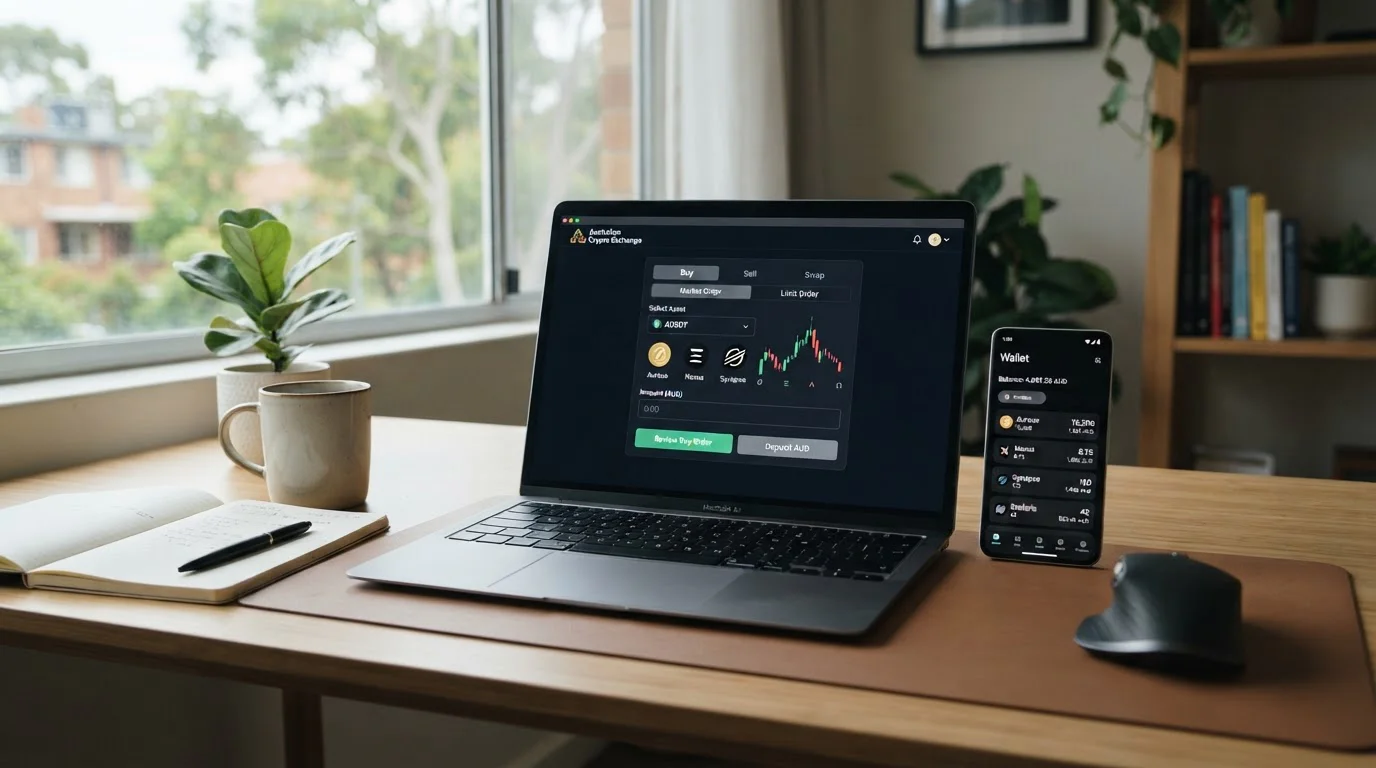
Crypto casinos assume you already own crypto. Most Australians do not. The getting-started friction is real: you need to buy cryptocurrency, move it to a wallet you control, then deposit it to the casino. That’s three steps where traditional casinos have one (enter card details, deposit, done). The extra steps pay off in payout speed and privacy, but you have to clear the setup hurdle first.
Step 1: Buy crypto in Australia
AUSTRAC regulates cryptocurrency exchanges in Australia under AML/CTF law as of March 2026. That means every exchange serving Australians must register with AUSTRAC and enforce KYC. You’re uploading ID regardless. The three largest Australian-registered exchanges are CoinSpot, Swyftx, and CoinJar. All three let you deposit AUD via bank transfer or card, verify identity with a driver’s license or passport, and buy Bitcoin, Ethereum, USDT, or a dozen other coins within an hour of account creation.
The process: sign up, upload ID (takes five to ten minutes for automated approval), link a bank account or card, deposit AUD, then buy crypto. CoinSpot charges around 1% on the spread for small purchases. Swyftx and CoinJar are slightly cheaper. For a $100 first deposit, fees run $1 to $2. Choose the coin you want: Bitcoin is most widely accepted, USDT on Tron (TRC-20) is cheapest and fastest for withdrawals, Ethereum is middle-ground. Your first buy should match what the casino accepts. Check the casino’s deposit page first to confirm supported networks — sending USDT on the wrong network (ERC-20 when they expect TRC-20) results in lost funds.
Crypto ATMs exist in major Australian cities but charge 5% to 10% fees. Only use them if you need cash-to-crypto without a bank account. For everyone else, an exchange is cheaper.
Step 2: Set up a wallet
The exchange holds your crypto after purchase, but withdrawing from an exchange to a casino requires a wallet you control. A “wallet” is just software that manages private keys and generates addresses. You can use the exchange’s built-in wallet for simplicity, or a standalone wallet for better security.
For simplicity: leave the crypto on CoinSpot, Swyftx, or CoinJar and send directly from there to the casino. The exchange’s “Send” function generates a transaction to the address the casino provides. This is the easiest path for beginners. The downside is the exchange controls the keys, and if they freeze your account or go insolvent, you lose access.
For security: transfer crypto from the exchange to a non-custodial wallet like Trust Wallet, MetaMask (for Ethereum and USDT ERC-20), or a Bitcoin-only wallet like Electrum. These wallets give you the private key, which means full control. You send from the wallet to the casino when depositing. That’s one extra step (exchange → wallet → casino instead of exchange → casino), but it separates your gambling funds from your exchange account, which can matter if the exchange reports large outflows to AUSTRAC or freezes accounts suspected of gambling.
Step 3: Deposit at the casino
Register at the casino with an email address. Some operators ask for a username; a few let you register with just a crypto wallet address. You don’t need to upload ID at this stage if it’s a no-KYC casino.
Go to the cashier or deposit page. Select the cryptocurrency you’re depositing (Bitcoin, Ethereum, USDT, Litecoin). The casino generates a deposit address — a long alphanumeric string. Copy it exactly. In your wallet or exchange app, paste that address into the “Send” or “Withdraw” field, enter the amount, select the network (this is critical: if depositing USDT, confirm the casino expects TRC-20 and you’re sending on TRC-20), and confirm the transaction.
The blockchain confirms the deposit in a few minutes. Bitcoin takes ten to sixty minutes, Ethereum two to fifteen, USDT TRC-20 one to three. Once confirmed, the balance appears in your casino account. You’re ready to play.
Common mistakes: sending USDT on the wrong network (ERC-20 instead of TRC-20 or vice versa) results in lost funds. Sending Bitcoin to an Ethereum address does the same. Double-check the coin and network match before confirming. Typos in the address also lose funds, but copy-paste eliminates that risk.
Step 4: Withdraw your winnings
Winning is the easy part. Getting paid is where offshore casinos either prove themselves or don’t. Crypto makes it cleaner than fiat, but the operator’s approval process still matters.
Go to the cashier, select “Withdraw,” choose the cryptocurrency, enter the amount, and paste your wallet address (from your exchange or non-custodial wallet). The casino queues the withdrawal for review. Approval times range from five minutes to two hours depending on time of day, amount, and whether your account is flagged. Routine amounts ($50 to $500) at established operators clear quickly. Larger withdrawals ($2,000+) may sit in “pending” longer.
Once approved, the operator broadcasts the transaction. It hits your wallet in ten to twenty minutes, sometimes faster with USDT TRC-20 or Litecoin. If you’re withdrawing to an exchange (CoinSpot, Swyftx, CoinJar), the exchange credits your balance after the required confirmations — usually one to three. You can then sell the crypto back to AUD or leave it as crypto for the next deposit.
If the casino requests KYC mid-withdrawal, the funds stay frozen until you upload documents. That verification can take twelve to forty-eight hours depending on the operator’s manual review queue. Have a current driver’s license or passport photo and a utility bill or bank statement (proof of address) ready if it happens.
How do I buy Bitcoin in Australia to deposit at a crypto casino?
Use an AUSTRAC-registered exchange—CoinSpot, Swyftx, or CoinJar. Sign up, complete KYC with a driver’s licence or passport, link a bank account, deposit AUD, then buy Bitcoin. First-time setup takes under an hour; fees run 1% to 2%. Send from the exchange to the casino’s deposit address. USDT on Tron is cheaper.
What happens if my crypto casino withdrawal gets delayed?
Check the blockchain first. If the operator broadcast the transaction, it shows on a block explorer (blockchain.com, etherscan.io, tronscan.org) within minutes—delay is then network congestion, not the casino. If not, contact support with your withdrawal ID. Silence past twelve hours usually means a KYC request. Escalate publicly on Trustpilot if days pass.
New Crypto Casinos Worth Watching
Most new crypto casinos vanish within a year. A few survive their first twelve months and grow into long-term operations. Shuffling through weekly launches hunting for diamonds is mostly wasted effort — the operators with staying power are the ones that launched years ago and are still paying out. Still, three recent entrants have shown enough traction to mention.
Rollbit (launched 2020, gained momentum in 2023-2024) built its brand around NFT integrations and a native token economy. It’s less relevant for Australian players who just want crypto pokies without the tokenomics layer, but it handles volume and pays out reliably. The game library is smaller than Vave or BC.Game, around 4,000 titles, and the bonus structure leans toward sports betting more than casino. If you’re already in the crypto-native ecosystem and hold various tokens, Rollbit fits. For traditional punters, the established eight cover more ground.
BetFury (launched 2019, slow growth through 2024) runs a staking model where the casino’s native BFG token pays dividends from house profits. It’s a revenue-share gimmick that appeals to a niche audience. The casino itself is functional: 5,000+ games, Curaçao license, standard crypto rails. Withdrawals process in ten to fifteen minutes. The dividend model adds complexity most players won’t engage with, but the core product works if you ignore the tokenomics.
Duelbits (launched 2021, growing presence in 2024-2025) targets esports bettors and pairs a casino with competitive betting markets on CS:GO, Dota, and League of Legends. Game library sits around 3,500 titles. Curaçao licensed, crypto-only, standard withdrawal speeds. The esports angle differentiates it slightly, but the casino portion is commodified. If you bet on esports regularly, Duelbits consolidates everything in one account. For pure casino play, it doesn’t outpace the established operators on game count or bonus value.
The pattern across new casinos: they add adjacent features (NFTs, staking, esports) to stand out, but the core casino product remains standardized because they’re licensing the same game providers, the same live-dealer studios, and the same provably-fair engines as everyone else. Differentiation happens on bonus generosity, cashier speed, and support quality. New casinos often over-promise on bonuses to attract users, then tighten terms after six months. Established operators have already gone through that cycle and settled into sustainable models.
How We Rank Crypto Casinos (Methodology)
Rankings are always subjective. Here’s what this one weighs.
Payout speed and reliability — the primary filter. If an operator doesn’t pay out, nothing else matters. We checked Trustpilot, AskGamblers, BitcoinTalk, and Reddit for consistent payout reports. Single complaints don’t disqualify an operator; patterns do. Casinos with months of unresolved withdrawal disputes or frozen accounts don’t make the list. Advertised withdrawal speeds (4 minutes, 10 minutes, 15 minutes) are compared against user reports. Most advertised speeds reflect best-case internal approval times, not blockchain settlement, so actual time-to-wallet runs longer.
Operating history — longevity signals survival capability. Crypto casinos launched in 2013-2014 that still operate in 2026 have cleared the churn. Operators live past their first year get a second look; past three years get weight; past five years get trust by default unless recent red flags surface. New casinos (launched 2023-2024) require higher evidence bars because their track record is short and their incentive to pay out large wins is unproven.
License verification — we check stated licenses against public registries where possible. Curaçao’s registry is semi-public; Anjouan’s is not. A stated license number that we can’t verify isn’t automatically disqualifying, but it’s noted. Operators publishing no license at all (Vave) are flagged for transparency. License jurisdiction affects dispute resolution: Curaçao offers minimal but existent adjudication paths, Anjouan offers nearly none, unlicensed operators offer zero formal recourse. That context is given; the ranking doesn’t penalize offshore licenses as long as operational behavior is sound.
Crypto support breadth — more coins accepted means more deposit flexibility. BC.Game’s 130+ coin support stands out; most competitors offer 10-20. For Australian players, breadth matters less than whether the casino supports the cheap, fast options (USDT TRC-20, Litecoin) alongside the standard BTC and ETH.
Bonus clarity — headline bonus figures are ignored. We calculate realistic bonus value for a $100 depositor: what you actually receive, what rollover is required, what restrictions apply. Bonuses presented as pure upside with no clear terms explanation are penalized. Operators publishing wagering requirements, max bets, restricted games, and expiration timelines upfront score higher.
Game library depth and provider quality — raw game count is recorded but weighted lightly. Provider mix matters more: Pragmatic Play, NetEnt, Play’n GO, Hacksaw Gaming, Evolution for live dealer. Operators loading 10,000 games from no-name studios get less credit than operators curating 3,000 titles from top-tier providers. Provably fair Originals are a plus but not required.
RTP transparency — whether the casino displays return rates in the lobby or buries them. mBit’s thumbnail RTP display is gold-standard. Everyone else lags.
Support responsiveness — we messaged support at each operator with a generic question (“What’s the withdrawal time for Bitcoin?”) and noted response speed. Live chat responses under five minutes score well. Email-only support that takes twelve hours scores poorly. We didn’t test dispute resolution because that requires creating real problems, but forum and review-site reports inform the ranking where patterns emerge.
KYC enforcement transparency — operators disclosing KYC thresholds or conditions upfront (Stake) score higher than operators marketing absolute anonymity then enforcing KYC silently. No-KYC is fine as a policy; lying about it is not.
The ranking is Australia-specific. It prioritizes factors Australian players care about: bypassing the IGA ban, avoiding bank friction, fast cashouts. Features irrelevant to Australians (EUR deposits, German-language support, state-specific licensing) don’t factor in.
Crypto Casinos Australia 2026 — Bitcoin, Ethereum, USDT, Solana
Content created by the «Payment Methods Online» team