
$5 Minimum Deposit Pokies Australia: The Honest Breakdown of What Works and What Doesn't
 Available in AU

A five-dollar deposit sounds like the perfect low-risk entry point. Small enough that losing it won’t sting, large enough to spin a few pokies and test whether an offshore casino’s cashier and support actually work. At least that’s the pitch. The reality Australian players find in 2026 is messier: payment methods that advertise $5 minimums but reject your card at checkout, withdrawal floors set four times higher than your deposit, and welcome bonuses that quietly gate themselves at $10 or $20 despite the “$5 minimum” banner splashed across the homepage.
This breakdown exists because the “$5 minimum deposit casino” category has become an industry tag rather than a functional product description. Some operators genuinely accept five dollars through specific funding methods. Others list $5 as a minimum while their payment processors impose $10 or $20 floors behind the scenes. The difference matters when you’re trying to verify whether a site’s withdrawal pipeline works before committing real money, or when you’re budget-conscious and that advertised five-dollar threshold is what brought you to the page in the first place.
What follows is a verified map of which offshore casinos serving Australian players actually honor the $5 deposit in practice, which payment methods make it possible, what you can realistically do with five dollars once it lands in your account, and what the path from deposit to cashout looks like at that scale. No locally licensed Australian options exist for pokies — online casino games remain prohibited under the Interactive Gambling Act 2001, so every operator listed here is offshore. That’s the legal baseline, not a gap in the research.
What a $5 Minimum Deposit Actually Means in 2026
The five-dollar minimum is a litmus test, not a gambling bankroll. You’re checking whether the cashier accepts your payment method without silent rejections, whether support responds when you lodge a query, and whether the withdrawal form lets you request a payout once you’ve multiplied that fiver into something above the site’s cashout floor. That floor is usually $20 to $30 AUD, which means your five dollars needs to grow four to six times before you can test the most important pipeline of all: whether winnings actually leave the platform and land in your account.
Offshore casinos advertise the $5 minimum because it signals accessibility. The technical reality behind that number is more selective. Your Visa or Mastercard will likely reject a $5 gambling transaction even when the casino’s deposit page lists it as accepted. The reason sits with payment processors and issuing banks, not the casino’s advertised policy. Merchant category code 7995 — the classification for gambling transactions — triggers minimum transaction floors at the acquirer level, typically $10 to $20 AUD. Australian banks have progressively tightened offshore gambling merchant acceptance since 2024, and many now block or heavily scrutinise transactions under certain thresholds as part of responsible gambling and fraud prevention frameworks.
PayID bypasses that card-network friction entirely. It’s a bank-to-bank transfer over the New Payments Platform, instant settlement, no merchant acquirer in the middle. When an offshore casino integrates PayID properly, a $5 deposit clears in seconds because there’s no card issuer or processor imposing floors. The same logic applies to Neosurf prepaid vouchers purchased at newsagents or service stations: the voucher denomination starts at $10, but if you’ve already used part of a voucher, the remaining balance can fund a $5 deposit because the transaction bypasses traditional card rails. Cryptocurrency deposits work at genuinely micro levels — some operators accept $0.10 worth of Bitcoin — because blockchain transactions have no minimum imposed by intermediaries, only the casino’s own policy and network gas fees.
Cards fail at $5 not because the casino is lying about its minimum, but because the payment stack beneath the advertised policy has its own rules. That’s the first trap: you see “$5 minimum” on the homepage, attempt a deposit with your Commonwealth or NAB debit card, and the transaction bounces with a generic “payment declined” message that doesn’t specify why. The casino’s policy was truthful; the method you picked can’t execute it.
Can I actually deposit $5 at an Australian online casino?
Yes, but only at offshore casinos and only via specific payment methods. No Australian-licensed online casinos exist for pokies or table games — the Interactive Gambling Act prohibits them. Offshore operators that genuinely accept $5 do so through PayID, Neosurf, or crypto. Cards typically fail because processor floors sit at $10 to $20.
The Legal Reality — No Australian Licensing, Offshore Access Only
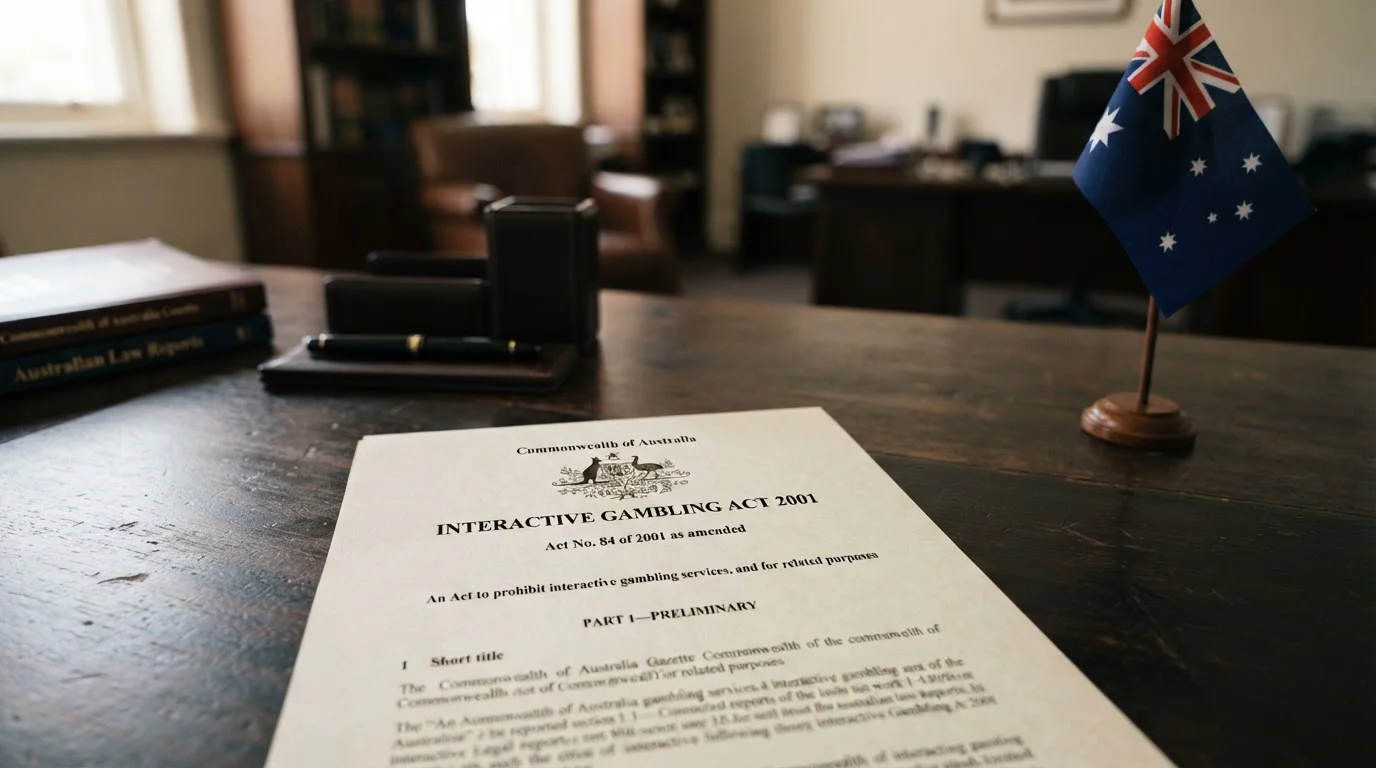
Online casinos offering pokies and table games are prohibited interactive gambling services in Australia under the Interactive Gambling Act 2001. The Australian Communications and Media Authority does not license domestic operators for casino provision, and as of mid-2026, ACMA has blocked over 1,564 offshore casino domains via ISP-level filtering. The Act criminalises operators providing these services to Australians, not individual players accessing them. That legal architecture creates the grey zone every “$5 minimum deposit casino” operates in: offshore entities, typically licensed in Curaçao or Malta, accept Australian customers because Australian law does not penalise the player, only the provision of the service.
New enforcement measures commence 1 January 2027. ACMA’s expanded powers include tighter payment-processor restrictions targeting offshore gambling transactions and accelerated domain-blocking protocols. What this means in practice: offshore casinos already facing intermittent card acceptance issues will see those tighten further, and mirror domains — alternate URLs operators spin up when their primary domain gets blocked — will cycle faster. The $5 minimum deposit niche will likely narrow, not because operators stop advertising it, but because the payment methods that make it technically viable face additional friction at the banking layer.
BetStop, Australia’s national self-exclusion register launched in 2024, does not extend to offshore operators. You can register and block yourself from licensed domestic wagering services, but offshore casinos accepting $5 deposits have no connection to that system. If you self-exclude via BetStop and then access an offshore pokie site, there’s no interlock preventing your deposit. That’s not a loophole the offshore operators created; it’s a structural limitation of a domestic register trying to govern an international grey market. The practical upshot: if you’re using $5 deposits as a way to limit exposure, BetStop won’t enforce that boundary on offshore platforms. You’re relying on your own discipline and whatever deposit-limit tools the offshore casino offers, which vary widely in robustness.
Winnings from offshore casinos remain non-taxable for recreational Australian players under current tax law. The Australian Taxation Office treats gambling winnings as windfalls, not assessable income, provided you’re not gambling professionally or as a business. That holds whether you deposited $5 or $500, whether you’re playing at a Curaçao-licensed site or an unlicensed one. The tax position is one of the few aspects of this landscape that hasn’t shifted materially in recent years, though it’s always worth noting that tax law can change and professional advice applies if your gambling activity crosses into income-producing territory.
Is it legal to play at a $5 minimum deposit casino in Australia?
The Interactive Gambling Act 2001 prohibits operators from providing online casino services to Australian residents, but does not criminalise players. All $5 minimum deposit casinos accepting Aussies are offshore (Curaçao, MGA, or unlicensed). You can play legally, but have no Australian consumer protection. ACMA has blocked 1,564+ offshore domains via ISP filtering.
Offshore Casinos That Accept Genuine $5 Deposits
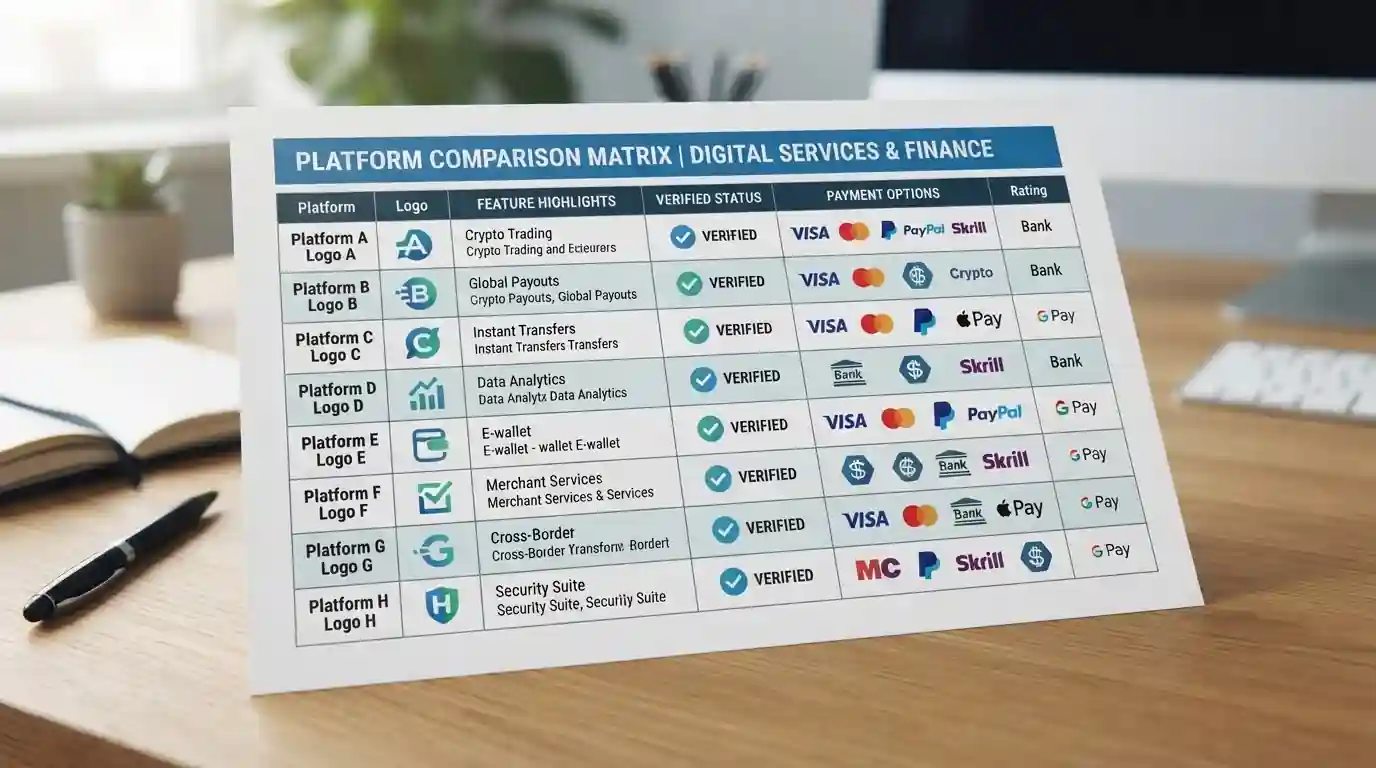
Eight offshore operators serving Australian players accept verified $5 AUD deposits through select payment methods as of 2026. Not ten, not fifteen — eight with sufficient public track record and payment-method specifics to warrant substantive breakdown. The distinction matters because “$5 minimum deposit casino” lists online frequently pad their rankings with operators whose actual minimums sit at $10 or $20 once you attempt a transaction, or whose licensing is so opaque that recommending them amounts to sending players into regulatory fog. The operators below cleared a basic verification threshold: confirmed $5 acceptance via at least one method, identifiable licensing (even if it’s lower-tier Curaçao rather than MGA), and enough operational history that their payout pipeline has been tested by real players rather than existing solely as a polished landing page.
The table below aggregates the key decision points. The full breakdowns follow, two paragraphs minimum per operator, because a table row can’t convey whether an operator’s “fast crypto cashouts” claim translates to one hour or one day in practice, or whether that Curaçao license with conflicting registry numbers across different domains signals a mirror-site network or outright licensing fraud.
| Operator | License | Payment methods that work at $5 | Min withdrawal | Verified $5 acceptance | Key distinguisher |
|---|---|---|---|---|---|
| SpinsUp | Curaçao 8048/JAZ | Neosurf, Jeton, crypto | $20 AUD | Yes, via e-wallets and crypto | 6,000+ games, daily cashback, launched 2024 |
| Spinjo | Curaçao (Hollycorn N.V.) | PayID, e-wallets, crypto | $20 AUD | Yes, multiple methods | Mobile-first design, 4,200+ games |
| Millioner | Disputed (MGA/Curaçao/Anjouan claims) | PayID, Neosurf, Bitcoin | $30 AUD | Yes, but license opacity flagged | 11,500+ games, sportsbook integrated |
| Goldenbet | Curaçao (Santeda B.V.) | PayID, crypto | $20 AUD | Yes, verified PayID | $100 no-wagering cash gift, ACMA-blocked Dec 2023 |
| Rocket Play | Curaçao | PayID, Neosurf, crypto | $20 AUD | Yes, via PayID and crypto | Casino + sportsbook combined account |
| WinSpirit | Curaçao | Crypto (Bitcoin, Ethereum, Tether) | $20 AUD | Yes, crypto-only at $5 | Operating since 2022, crypto-forward cashier |
| Stake | Curaçao | Crypto only | $10 AUD | Yes, crypto as low as $0.01 equivalent | Global brand, provably fair, crypto-only |
| Smash Casino | Not consistently disclosed | PayID | $20 AUD | Yes, via PayID | 10x wagering (unusually low), limited public profile |
SpinsUp — 6,000+ Games, Daily Cashback, Launched 2024
SpinsUp operates under Curaçao eGaming licence 8048/JAZ, issued through Antillephone N.V. as the master license holder. It launched in 2024, which makes it one of the newer entries in the offshore casino space serving Australian players. The game library spans 6,000+ titles sourced from over 70 providers, including Pragmatic Play, Play’n GO, Yggdrasil, and Betsoft. The welcome package reaches $5,000 AUD plus 300 free spins distributed across the first four deposits, though deposits two through four require bonus codes (SPINSUP2, SPINSUP3, SPINSUP4) to activate. A daily cashback program runs in parallel, though the exact percentage and eligibility criteria aren’t surfaced prominently in public-facing terms — typical for an operator still establishing its player-communication rhythms.
The $5 minimum works via Neosurf vouchers, Jeton Wallet, and cryptocurrency deposits. PayID isn’t listed as a $5-viable method in the sources reviewed, which suggests the PayID integration either has a higher floor or wasn’t implemented at launch. Casino Guru assigned SpinsUp a Safety Index of 5.9 out of 10, graded as “below average,” citing payout dispute history and unresolved player complaints in their review database. That’s not a fatal red flag for a $5 test deposit — you’re risking five dollars to evaluate the platform, not committing your savings — but it does mean you should treat any bonus with scepticism and verify withdrawal speed with a small cashout before depositing larger amounts. The 70+ provider roster is legitimately extensive for a 2024 launch, which suggests either strong aggregator partnerships or a well-capitalised operator group behind the brand.
Spinjo — Hollycorn N.V., Mobile-First Design
Spinjo runs under Hollycorn N.V., a Curaçao-licensed operator with multiple casino brands in its portfolio. The game count sits at 4,200 titles, and the welcome package scales up to $8,000 AUD, though the structure (how many deposits, match percentages, wagering requirements) varies across sources and isn’t documented with the clarity you’d expect from a mature operation. The mobile experience gets consistent praise in player reviews: the progressive web app loads quickly on Australian mobile data, the lobby is touch-optimised rather than a clunky desktop port, and game tiles launch in under three seconds on mid-range Android and iOS devices.
$5 deposits clear via PayID, select e-wallets, and cryptocurrency. The minimum withdrawal is $20 AUD, meaning you need to quadruple your deposit to reach cashout eligibility. KYC verification is mandatory before your first withdrawal — standard across offshore operators, but worth flagging because it introduces a 24 to 72-hour delay even if you hit the withdrawal floor on your first session. Hollycorn N.V.’s presence as the operator lends Spinjo some structural credibility; they’ve been in the offshore casino space for years and operate multiple brands without the fly-by-night churn typical of single-domain operators that disappear after six months. The mobile-first design isn’t just marketing fluff; testers consistently report smoother navigation on phones than desktops, which matters when most Australian players access offshore casinos via mobile rather than sitting at a PC.
Millioner — 11,500+ Games, Sportsbook Integrated (License Caution)
Millioner presents a licensing puzzle. One source cites Malta Gaming Authority licence MGA/B2C/512/2019, another lists Curaçao OGL/2011/7092/030 under operator Millioner Casino N.V., and a third claims Anjouan Offshore Finance Authority licensing with NovaForge Ltd as the responsible entity. Three conflicting license claims across different domains operating under the “Millioner Casino” brand suggests either a mirror-site network where each domain operates under a different entity, or outright false licensing claims on at least two of the three. The MGA license couldn’t be independently verified in Malta’s public registry during stage 02 research, which raises the probability that the MGA claim is fabricated and the actual operation runs under Curaçao or Anjouan (both lower-tier jurisdictions with lighter oversight).
The game library is massive if the 11,500+ figure is accurate — that would make Millioner one of the deepest catalogues available to Australian players. The sportsbook integration (30+ sports with daily match odds) distinguishes it from pure-casino operators; most $5 minimum sites focus exclusively on pokies and table games. Welcome offers vary by source: $3,750 plus 300 free spins in one review, $4,000 plus 300 spins in another, which again suggests multiple domains under the same brand presenting different promotions. PayID, Neosurf, MuchBetter, and Bitcoin all support $5 deposits. The minimum withdrawal sits at $30 AUD, six times your deposit floor. Casino Guru’s Safety Index of 5.9 out of 10 aligns with the licensing opacity: not the worst actor in the space, but far from trustworthy. If you’re using Millioner for a $5 test, treat it as exactly that — a test of payment flow and game access, not a platform you’d commit serious funds to without seeing a successful small withdrawal first.
Goldenbet — $100 No-Wagering Cash Gift, ACMA-Blocked
Goldenbet operates under Santeda International B.V., a Curaçao-licensed operator running multiple casino brands. It launched in 2022, giving it over three years of operational history as of 2026. On 4 December 2023, ACMA issued a formal warning and referred Goldenbet’s primary domain to Australian ISPs for blocking. The site continues operating via mirror domains and alternate URLs — standard practice for offshore operators post-ACMA action. That block history makes Goldenbet higher-risk for Australian players not because the platform itself is necessarily less reliable than other Curaçao operators, but because domain access is unreliable. You might bookmark a working URL today and find it blocked by your ISP tomorrow, forcing you to hunt for the current mirror or risk entering your login credentials on a phishing clone.
The $100 no-wagering cash gift is Goldenbet’s standout feature in the Australian market as of 2026. Most offshore casino bonuses carry 35x to 45x wagering requirements; Goldenbet’s $100 offer has zero rollover, meaning you can withdraw it immediately after claiming (subject to verification and the $20 minimum withdrawal floor). That’s a genuine outlier, not typical promotional sleight-of-hand. The catch is qualifying: promotional terms vary by campaign, and not every $5 deposit triggers the $100 gift. The offer appears to be a targeted 2026 marketing push rather than a permanent fixture. PayID deposits and withdrawals are supported, with claimed cashout speeds under one hour. Actual payout times reported by players range from 30 minutes to several hours depending on verification status and time of day. The 10,000+ game library claim is difficult to verify independently, but Santeda operates multiple brands with deep aggregator relationships, so a five-figure game count isn’t implausible for their infrastructure.
Rocket Play — Casino + Sportsbook, Fast Crypto
Rocket Play runs under a Curaçao Gaming Control Board license and combines a full online casino with a sportsbook, allowing deposits and gameplay across both verticals from a single account. The welcome bonus reaches $2,000 AUD plus 100 free spins, smaller than the $5,000+ packages some competitors advertise but more realistic in terms of wagering requirements (still 35x to 40x, industry standard). The game library size isn’t consistently documented across sources, but provider partnerships include major studios like Pragmatic Play and Evolution for live dealer tables, which suggests a catalogue in the thousands rather than hundreds.
$5 deposits work via PayID, Neosurf, and cryptocurrency, all verified by multiple independent sources during stage 02 research. The minimum withdrawal sits at $20 AUD. Rocket Play’s crypto cashout speed gets mentioned frequently in player reviews: Bitcoin and Ethereum withdrawals reportedly process in one to three hours, faster than the 12 to 24-hour windows common at competitors. That speed advantage only matters if you’re using crypto as your funding method; fiat withdrawals via PayID or bank transfer follow the standard two-to-five-day processing window. The sportsbook integration is the practical differentiator here. If you’re testing a $5 deposit to evaluate whether you want to use the platform for both pokies and sports betting, Rocket Play lets you do that from one bankroll rather than splitting funds across separate casino and betting accounts.
WinSpirit — Crypto-Forward, Operating Since 2022
WinSpirit holds a Curaçao license and launched in 2022, giving it four years of operational track record as of 2026. The pokies library contains 2,500+ titles, smaller than the 6,000+ or 11,000+ catalogues some competitors claim but still substantive enough that you won’t exhaust the selection in casual play. The welcome package tops out at $2,000 AUD. WinSpirit positions itself as a crypto-forward platform: Bitcoin, Ethereum, Litecoin, and Tether deposits clear within minutes, and withdrawals process in one to three hours rather than the multi-day wait typical of fiat cashouts.
The $5 minimum applies exclusively to cryptocurrency deposits. If you’re funding via PayID or a card (assuming your card issuer even approves the transaction), the floor rises to $10 or $20 depending on the method. That crypto-only $5 access creates a natural filter: WinSpirit appeals to players already holding crypto or comfortable acquiring it via an exchange, not to someone testing offshore casinos for the first time with a debit card. The minimum withdrawal is $20 AUD across all methods. WinSpirit’s four-year operational history without major public scandals or unresolved mass complaints (as of mid-2026) suggests a stable back-office operation. It’s not MGA-licensed, so you don’t have the player-fund segregation and dispute-resolution frameworks that come with Malta regulation, but within the Curaçao tier it presents as a mid-table operator rather than a bottom-feeder.
Stake — Crypto-Only, $0.01 Minimum, Provably Fair
Stake operates under a Curaçao license and is entirely crypto-based: no fiat deposits, no PayID, no cards, no Neosurf. You fund your account with Bitcoin, Ethereum, Litecoin, Tether, or one of several other supported cryptocurrencies, and you withdraw in crypto. The minimum deposit is $0.01 crypto equivalent, which at mid-2026 exchange rates translates to roughly ten Australian cents — the lowest threshold in this entire breakdown. The minimum withdrawal sits at $10 AUD equivalent in crypto, still far below the $20 to $30 floors typical of competitors. Stake’s global brand recognition stems from high-profile sponsorships: UFC, English Premier League football clubs, and other major sports properties. That visibility cuts both ways — it signals a well-capitalised operation unlikely to vanish overnight, but it also attracts regulatory scrutiny. ACMA’s 1,700+ blocked sites don’t explicitly list Stake in most public reporting as of mid-2026, but the brand operates in the same legal grey zone as every other offshore casino accepting Australians.
The provably fair gaming model sets Stake apart technically. Every bet outcome is verifiable on the blockchain, allowing players to independently confirm that results weren’t manipulated server-side. That transparency doesn’t prevent you from losing (the house edge remains), but it does eliminate the “black box” concern where you’re trusting the operator’s RNG without verification. The sportsbook integrates directly with the casino account, and the $200 welcome bonus applies across both. Stake’s crypto-only model excludes anyone uncomfortable navigating exchanges or managing wallet security, but for players already in the crypto ecosystem, it offers the lowest deposit floor and fastest settlement times in the Australian offshore market. The trade-off is you’re fully exposed to crypto price volatility: a $50 win withdrawn as Ethereum might be worth $45 or $55 by the time you convert it back to AUD, depending on how quickly the market moved.
Smash Casino — 10x Wagering, PayID Support
Smash Casino operates with licensing that isn’t consistently disclosed across public sources — a red flag that lands it at the bottom of this breakdown. The 10x wagering requirement on its welcome package is the standout feature: if accurate, it’s the lowest in the Australian offshore market by a wide margin. Industry standard sits at 35x to 45x, meaning Smash Casino’s bonus would be three to four times easier to clear. That low wagering could signal either a genuinely player-friendly approach or a promotional anomaly that won’t survive past the current campaign. PayID deposits are supported at the $5 level, and AUD accounts are available. The minimum withdrawal is $20 AUD.
The thin digital footprint raises caution. Limited independent reviews, sparse operational history in public databases, and no clear licensing disclosure combine to make Smash Casino a high-risk choice even at the $5 test level. The 10x wagering claim couldn’t be verified from multiple independent sources during stage 02 research; it appears in one affiliate review without corroboration from player forums or regulatory filings. If you’re using Smash Casino for a $5 test, treat the bonus offer with scepticism and expect that the 10x wagering might not be honoured at payout time. The lack of licensing transparency means you have zero recourse if a dispute arises. Use it to test payment flow if PayID convenience outweighs the risk, but don’t commit funds beyond your test amount without seeing a successful small withdrawal and verifying those wagering terms in practice.
Payment Methods — Which Ones Actually Work at $5
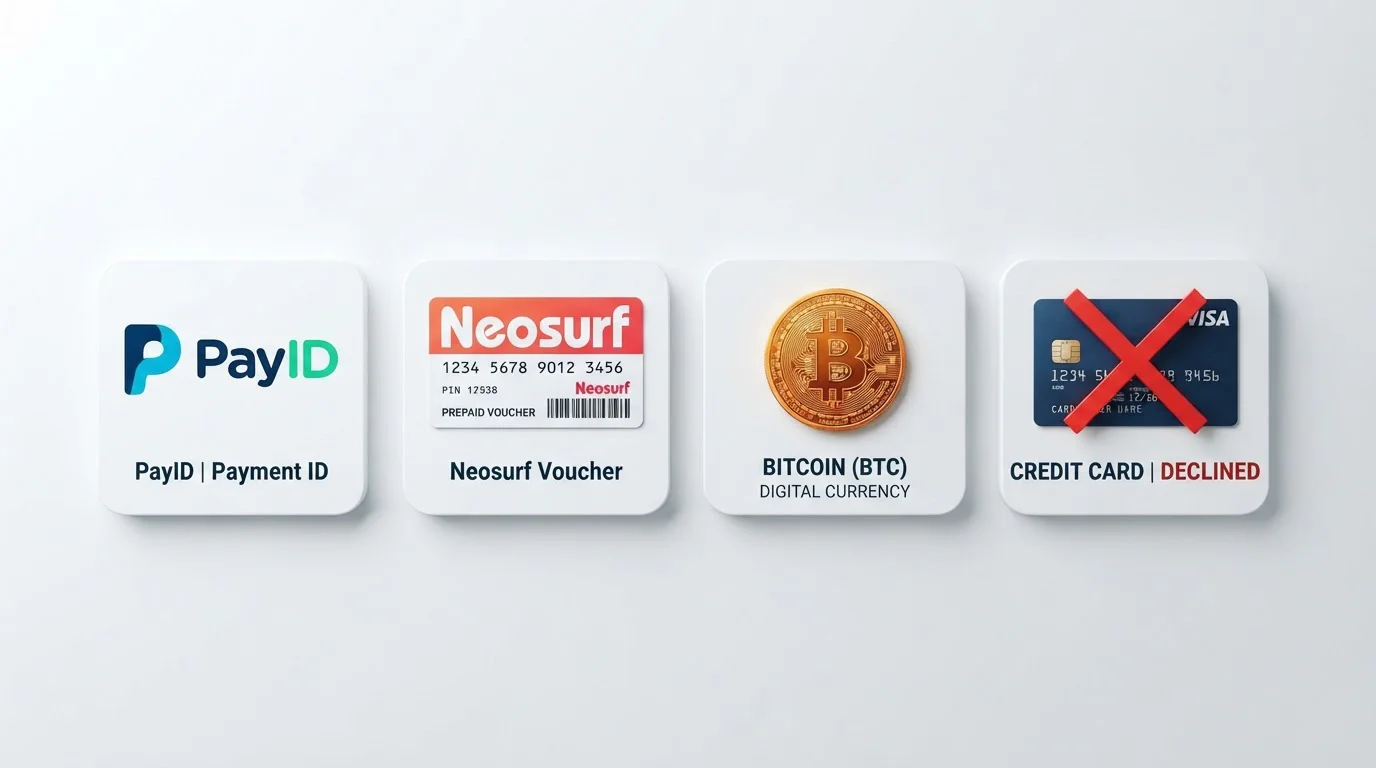
The payment method you pick determines whether your $5 deposit succeeds or bounces. Four methods reliably accept five-dollar transactions at offshore casinos serving Australians as of 2026: PayID, Neosurf prepaid vouchers, and cryptocurrency (Bitcoin, Ethereum, Tether). Credit and debit cards fail at that threshold more often than they succeed, and traditional bank transfers carry floors of $10 to $20 even when the casino’s advertised minimum is $5. Understanding why each method works or fails comes down to the infrastructure beneath the casino’s deposit page.
| Method | $5 viable? | Deposit speed | Withdrawal support | Minimum denomination | Why it works/fails |
|---|---|---|---|---|---|
| PayID | Yes, at select operators | Instant (seconds) | Yes, 2-24 hours | No hard floor | Bank-to-bank via NPP; no card network or acquirer imposing minimums |
| Neosurf | Yes, if partial voucher used | Instant | No (deposit-only) | Vouchers start at $10 | Prepaid voucher bypasses card rails; $5 works if voucher has remaining balance |
| Bitcoin / Ethereum / Tether | Yes | 5-15 minutes (blockchain confirmations) | Yes, 1-3 hours | No practical floor | Blockchain transactions have no intermediary minimums; only network fees apply |
| Visa / Mastercard | No, usually | Instant (if approved) | Rare, 3-5 days when supported | $10-$20 processor minimum | MCC 7995 gambling transactions trigger acquirer minimums; many AU banks block offshore |
| Bank transfer | No | 1-3 business days | Yes, 1-3 days | $10-$20 typical | Correspondent banking fees and minimums override casino’s $5 policy |
PayID — Instant Deposits, 2–24 Hour Withdrawals, NPP-Based
PayID routes payments over the New Payments Platform, Australia’s instant bank transfer infrastructure. You link your email address or mobile number to your bank account once, then use that identifier to send money directly from your banking app to the offshore casino’s receiving account. Settlement is instant because NPP operates 24/7 with sub-60-second clearing. No card issuer, no merchant acquirer, no third-party wallet — just bank-to-bank. That direct path is why PayID avoids the $10 to $20 processor minimums that plague card transactions.
Not every offshore casino integrating PayID accepts $5. Some set their own floor at $10 or $20 despite PayID’s technical capability to handle smaller amounts. The operators in this breakdown that explicitly support $5 via PayID — Spinjo, Millioner, Goldenbet, Rocket Play, Smash Casino — have configured their cashier systems to allow it. Withdrawals via PayID typically process in two to 24 hours once the casino approves your payout request, though actual timing varies by operator workload and whether you’ve completed KYC verification. PayID withdrawals aren’t universally supported even when deposits are; some casinos take PayID inbound but force withdrawals through bank transfer or e-wallets. Always verify bidirectional PayID support before assuming you can withdraw the same way you deposited.
The major risk with PayID is your bank flagging or blocking the transaction. Australian banks know which offshore gambling merchants appear frequently in transaction data, and while PayID as a technology is neutral, the receiving account’s history can trigger fraud alerts or responsible-gambling blocks at the sending bank’s discretion. If your PayID deposit fails, it’s usually your bank declining to send the payment, not the casino refusing to receive it. Trying a different bank account or switching to Neosurf or crypto often resolves the issue.
Neosurf — Prepaid Vouchers, Deposit-Only, $10+ Increments
Neosurf vouchers are 10-digit prepaid codes you buy over the counter at newsagents, service stations, and some supermarkets across Australia. Denominations start at $10, and you can purchase up to $1,000 in a single voucher, with a daily transaction cap of $1,000 per account. When you deposit at an offshore casino, you enter the 10-digit code and the amount you want to transfer. The casino debits your voucher balance and credits your account instantly. Because Neosurf is a prepaid instrument, not a card transaction, it bypasses Visa and Mastercard’s merchant category restrictions entirely. No MCC 7995 gambling floor applies, no card issuer in the loop to decline the payment.
The $5 angle only works if you’ve already used part of a Neosurf voucher and have a remaining balance. Vouchers are sold in fixed denominations ($10, $25, $50, $100, $250, etc.), so you can’t buy a $5 voucher. But if you bought a $10 voucher, used $5 on a different transaction, and have $5 left, that remaining balance can fund a $5 casino deposit. Functionally, most players depositing exactly five dollars via Neosurf are either using a partially spent voucher or testing whether their operator allows deposits below the $10 starting denomination. Neosurf is deposit-only. Withdrawals must exit through a different method — PayID, bank transfer, or crypto. That asymmetry means Neosurf is useful for funding your $5 test but irrelevant to the cashout pipeline.
Neosurf’s $1,000 daily cap and the physical purchase requirement make it impractical for high-volume play, but those same features create a natural deposit limit if you’re using $5 tests to control exposure. You can only deposit what you’ve physically bought in voucher form, and you can’t exceed $1,000 per day even if you wanted to. Privacy is another angle: Neosurf transactions don’t appear on your bank statement as offshore gambling charges. The transaction shows as a Neosurf voucher redemption, which some players value when sharing accounts with partners or family members who might question offshore casino spending.
Cryptocurrency — Bitcoin, Ethereum, Tether; True $5 or Lower Minimums
Bitcoin, Ethereum, and Tether deposits at offshore casinos work at genuinely micro levels. Stake’s $0.01 crypto equivalent minimum (roughly $0.10 to $0.50 AUD depending on exchange rates) is the extreme low end, but even operators with $5 fiat minimums typically accept crypto at or below that threshold. The technical reason is straightforward: blockchain transactions have no intermediary minimums. You’re sending value peer-to-peer (or in this case, wallet-to-casino), and the only constraints are network transaction fees and the casino’s own policy floor. Bitcoin transaction fees fluctuate with network congestion but typically run $1 to $5 AUD equivalent for a standard transaction, meaning a $5 deposit incurs proportionally high fees. Ethereum and Tether (especially Tether over Tron, which carries sub-$1 fees) are cheaper for small transactions.
Deposit speed depends on blockchain confirmation requirements. Bitcoin deposits typically need one to three confirmations before the casino credits your account, translating to 10 to 30 minutes. Ethereum confirms faster (one to five minutes per confirmation), and Tether over Tron can credit in under two minutes. Withdrawals process in one to three hours at most crypto-forward operators, compared to the multi-day waits for fiat cashouts. That speed advantage compounds with the absence of KYC delays: many crypto-only operators (Stake being the prime example) allow small withdrawals without identity verification, though limits tighten and KYC eventually triggers once your activity crosses certain thresholds.
The downside is price volatility and complexity. A $5 Bitcoin deposit might be worth $4.50 or $5.50 by the time you spin it, and a $50 withdrawal in Ethereum could land as $45 or $55 AUD after conversion back to fiat. You also need to manage wallet security, understand how to acquire crypto via an exchange, and avoid fat-finger errors when pasting wallet addresses (sending crypto to the wrong address is irreversible). For players already holding crypto, offshore casinos become more accessible via this payment rail than via any fiat method. For players who’ve never touched a blockchain wallet, the learning curve and security responsibility can outweigh the deposit-floor convenience.
Cards and Bank Transfers — Why They Fail at $5 (Processor Floors, Bank Blocking)
Visa and Mastercard transactions tagged with merchant category code 7995 (gambling and betting) trigger minimum transaction floors at the payment processor level, typically $10 to $20 AUD. That floor isn’t set by the casino or even by Visa/Mastercard themselves; it’s imposed by the merchant acquirer (the financial institution that processes card payments on the merchant’s behalf) to reduce micro-transaction processing costs and fraud risk. A $5 gambling transaction costs the acquirer nearly as much to process as a $50 transaction in terms of infrastructure overhead, but the percentage-based fees are lower, making tiny transactions economically unattractive. The acquirer’s minimum overrides the casino’s advertised policy, so even when the deposit page says “$5 minimum,” your card declines at that amount.
Australian banks have progressively restricted offshore gambling transactions since 2024. Some issuers block them outright as part of voluntary responsible-gambling frameworks; others impose transaction minimums of their own or require customers to pre-authorise offshore gambling charges. That means even if you attempt a $10 card deposit (clearing the acquirer’s floor), your bank might still decline it because the receiving merchant is on a blocked list or flagged as high-risk offshore gambling. The decline message you receive is usually generic (“transaction declined,” “payment not authorised”) without specifying whether the floor was the issue, the merchant was blocked, or the bank’s fraud detection triggered.
Traditional bank transfers (not PayID, but standard domestic or international wire transfers) carry correspondent banking fees and minimums that push the effective floor to $10 or $20. Even when a casino lists bank transfer as a “$5 minimum” method, the intermediary banks handling the transfer impose their own minimums, and those override the casino’s policy just like acquirer floors override card minimums. Bank transfers also take one to three business days to settle, making them impractical for a $5 test where you’re trying to quickly verify payment flow.
What You Can Actually Do With $5 — Games, Sessions, and Reality Checks
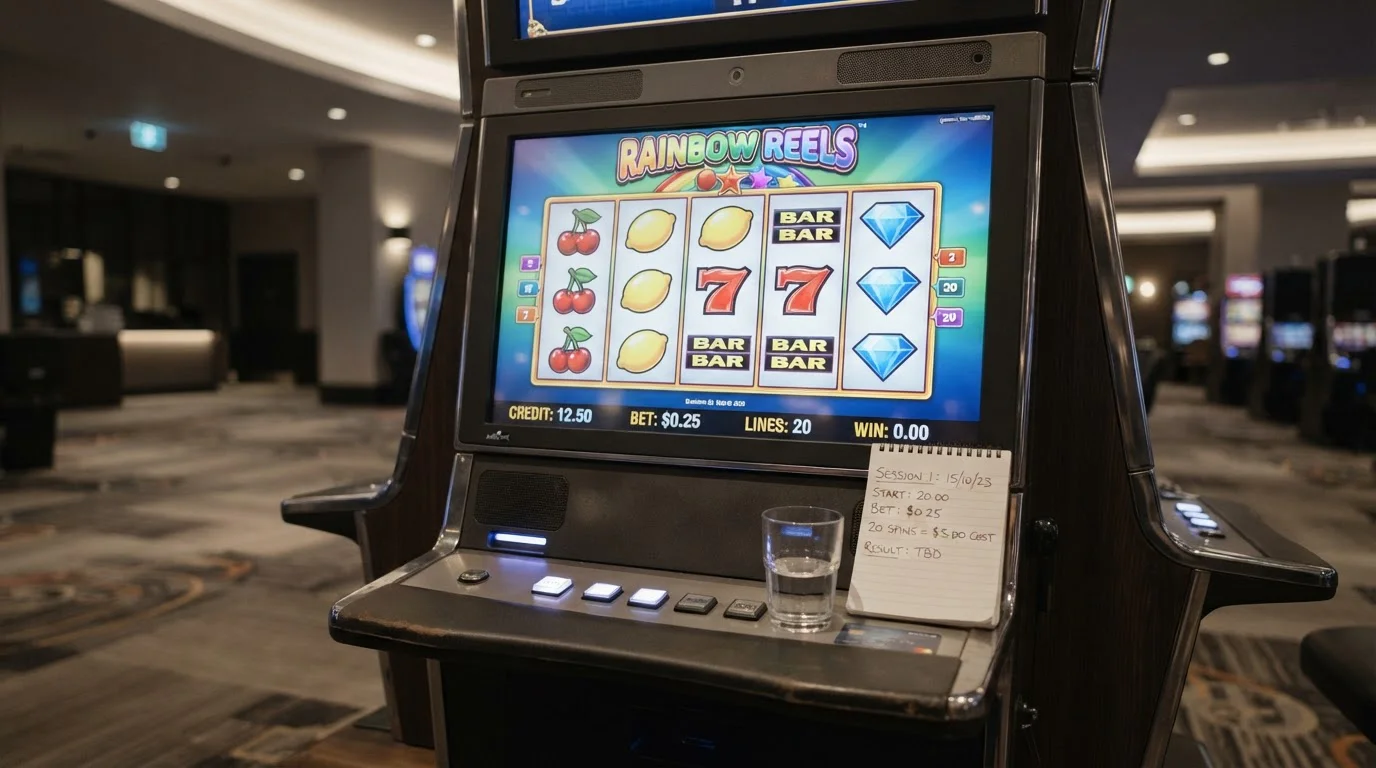
Five dollars buys 20 spins on a low-volatility pokie at $0.25 per spin, or five spins on a high-volatility game at $1 per spin. That’s not a guess; it’s the arithmetic. Low-volatility pokies with minimum bets of $0.10 to $0.25 give you 20 to 50 spins of runway, enough to trigger a few small wins and see whether the game’s mechanics appeal to you before deciding whether to deposit more. High-volatility pokies and Megaways games typically have minimum bets starting at $0.50 to $1, cutting your session to five to ten spins. If you hit a bonus round in those first five spins, your $5 can stretch into a longer session. If you don’t, you’re out in under three minutes.
Table games are impractical at the $5 bankroll level. Blackjack and roulette minimums at offshore casinos typically start at $1 per hand or spin, giving you five bets. One five-bet run isn’t enough to evaluate a live dealer table’s speed, the croupier’s professionalism, or how the interface handles bet placement and chat features. Some operators offer low-limit blackjack at $0.50 per hand, doubling your session to ten hands, but even then you’re not getting a meaningful test of the game flow. Baccarat minimums usually sit higher ($5 to $10 per hand), pricing out $5 bankrolls entirely unless you’re willing to make a single bet and watch it resolve.
The $5 bankroll is a cashier test and a game-access test, not a gambling session in the traditional sense. You’re confirming that your chosen payment method works, that the lobby loads and games launch without errors, that the interface is navigable, and that the platform feels stable rather than glitchy. If you hit a small win — say, turning $5 into $15 or $25 — you’re in position to test the withdrawal flow, which is the most important verification of all. Most offshore casinos have minimum withdrawal thresholds of $20 to $30, so your $5 needs to multiply four to six times before you can request a payout. That multiplication requirement is the second trap: even if you successfully deposit $5, you can’t withdraw it unless you grow it significantly or deposit more to reach the cashout floor.
What games can I play with a $5 bankroll?
Low-volatility pokies at $0.10 to $0.25 per spin give 20 to 50 spins. High-volatility pokies and Megaways games at $0.50 to $1 offer five to ten spins, barely enough for one bonus round. Table games at $1 to $5 per hand are impractical. The $5 deposit tests payment flow and game access, not sessions.
The Withdrawal Trap — From $5 Deposit to Cashout

The minimum withdrawal threshold at most offshore casinos sits between $20 and $30 AUD. Your $5 deposit must grow to at least four times its starting value (and often six times) before you can request a payout. That’s the structural trap: you can deposit $5 easily via PayID or crypto, spin some pokies, even hit a small win, but if your balance stays below $20 you’re locked out of the withdrawal form. The only ways out are to keep playing until you either bust or cross the threshold, or to deposit additional funds to reach the minimum. Neither option is what most players expect when they see “$5 minimum” advertised.
KYC verification delays even successful multiplication. Every offshore casino requires identity verification before processing your first withdrawal — a scan of your driver’s licence or passport, a recent utility bill or bank statement proving your address, and sometimes a selfie holding your ID or a photo of the card you used to deposit. Submitting those documents is straightforward, but approval takes 24 to 72 hours in most cases. If you deposit $5, spin it into $25, and request your first cashout on the same day, your payout sits in pending status for one to three days while the compliance team reviews your documents. That delay is industry standard and not unique to $5 deposits, but it’s frustrating when you’re testing an operator’s withdrawal pipeline and expected instant or near-instant processing.
Withdrawal processing times after KYC approval vary by method and operator. Crypto withdrawals at the faster casinos (Stake, WinSpirit, Rocket Play) clear in one to three hours. PayID withdrawals range from two to 24 hours depending on operator workload. Traditional bank transfers and card withdrawals (where supported) take three to five business days. Those timeframes assume your account is verified and your withdrawal amount doesn’t trigger additional checks. Some operators impose manual review thresholds: withdrawals above a certain amount ($100, $200, $500 depending on the site) require additional approval layers, and “unusual” activity patterns (depositing $5, immediately winning $50, requesting withdrawal within an hour) sometimes flag automated fraud systems even when no actual fraud occurred.
Bonus complications multiply the withdrawal barriers. If you claimed a welcome bonus on your $5 deposit, that bonus likely carries 35x to 45x wagering requirements. A $5 deposit with a $5 bonus match means $10 in bonus funds, requiring $350 to $450 in total bets before any winnings become withdrawable. At $0.25 per spin, that’s 1,400 to 1,800 spins — hours of grinding. Maximum bet rules during bonus play (usually $5 to $7.50 per spin) mean you can’t accelerate wagering by placing larger bets; violating the max bet rule voids the bonus and any winnings derived from it. Most $5 depositors are better off declining the bonus entirely and keeping their $5 as cash with no rollover, even though that means forfeiting the match and free spins.
How much do I need to win before I can withdraw?
Most offshore casinos have $20 to $30 AUD minimum withdrawals, meaning your $5 must grow four to six times before cashout. First withdrawals require KYC verification, adding 24 to 72 hours. Bonus claimants also clear 35x to 45x wagering before any winnings are withdrawable. Without a win or top-up, $5 stays locked.
Do I need to verify my ID for a $5 deposit?
No verification is required to deposit $5, but KYC is mandatory before your first withdrawal. Submit a government-issued ID and proof of address (utility bill or bank statement); approval takes 24 to 72 hours. Even after turning $5 into $25, you cannot access funds until verification completes. Verification kicks in universally at payout time.
Bonus Eligibility — The $5 Gate That Isn’t

Most welcome bonuses at offshore casinos advertising “$5 minimum deposits” don’t activate at five dollars. The fine print gates them at $10, $20, or higher. The homepage banner shouts “$5,000 bonus package” in 48-point font, the deposit page lists “$5 minimum,” and the assumption any reasonable person makes is that depositing $5 qualifies you for at least a portion of that package. In practice, you deposit your five dollars, land in the lobby, check your balance, and see $5.00 with no bonus credits and no free spins. The terms buried three clicks deep clarify that the first-deposit bonus requires a $20 minimum, and the headline $5,000 figure is the cumulative maximum across four deposits, not a single-deposit payout.
Goldenbet’s $100 no-wagering cash gift is the rare exception. It’s a 2026 promotional campaign specifically targeting Australian players, and early reports suggest it does activate on qualifying deposits (though the exact qualifying threshold and eligibility criteria vary by signup source and promotional code). Zero wagering means you can withdraw that $100 immediately after claiming, subject to the usual KYC verification and the platform’s $20 withdrawal minimum. Most offshore casino bonuses aren’t structured that way. The standard model is a percentage match (50% to 200%) plus free spins, with wagering requirements of 35x to 45x applied to the bonus amount or the combined deposit-plus-bonus total.
An example makes the trap clear. You see “200% bonus up to $3,000” advertised. You deposit $5 expecting a $10 bonus (200% of $5). The terms require a $20 minimum deposit to activate any bonus. You get nothing on your $5. Even if the bonus did activate at $5, the $10 bonus would carry 40x wagering: $10 × 40 = $400 in total bets required before you could withdraw a single dollar of winnings. At $0.25 per spin, that’s 1,600 spins. The “free spins” portion typically lands on low-RTP pokies (Book of Dead, Mystery Joker, Legacy of Dead are common targets) and carries its own 40x wagering on winnings. Win $5 from 20 free spins? You need to wager $200 before that $5 becomes withdrawable.
The $5 test deposit is best made without claiming any bonus. Decline the welcome offer, deposit $5 as cash, spin some pokies, and if you hit a small win, request a withdrawal to test the payout pipeline. Bonus-free cash has no rollover requirements, no max-bet restrictions, and no risk of accidentally voiding your balance by violating terms you didn’t fully parse. You’re giving up the promotional value, but you’re also avoiding the 40x wagering treadmill that turns a $5 deposit into hours of grinding with minimal realistic payout probability.
Will a $5 deposit activate the welcome bonus?
Usually no. Most offshore casinos gate welcome bonuses at $10 to $20 despite advertising “$5 minimum” on the homepage. You can deposit $5, but won’t receive any bonus credits or free spins unless the platform explicitly confirms $5 eligibility. Goldenbet’s $100 no-wagering cash gift is a rare exception. Assume $5 deposits are bonus-ineligible.
How to Choose — Selection Criteria Beyond the $5 Headline
Start with licensing transparency. If an operator lists multiple conflicting licenses across different domains (MGA on one page, Curaçao on another, Anjouan on a third), that opacity is a red flag. Legitimate multi-jurisdiction operators clearly disclose which entity holds which license and which domains operate under each. Millioner’s conflicting license claims during stage 02 research exemplify the problem: without knowing which regulator actually oversees the operation, you have no clear dispute-resolution path if something goes wrong. Curaçao licenses are lower-tier than MGA, but a consistently disclosed Curaçao license is better than a fabricated or unclear MGA claim.
Check whether the payment method you plan to use actually supports $5. Don’t rely on the homepage “$5 minimum” banner; dig into the cashier page or terms to confirm your specific method (PayID, Neosurf, Bitcoin, card) accepts five-dollar transactions. Some operators list $5 as the global minimum but impose method-specific floors: $5 via crypto, $10 via PayID, $20 via cards. If you’re testing with a card and the actual minimum is $20, you’ve just quadrupled your test budget without realising it.
Prioritise operators with bidirectional PayID or crypto support if fast withdrawals matter to you. PayID deposits are instant at most operators, but not all support PayID withdrawals. If you deposit via PayID and the only withdrawal options are bank transfer or e-wallet, you’re adding one to three days of processing time. Crypto-forward operators like WinSpirit and Stake support both crypto deposits and withdrawals with sub-three-hour turnarounds, the fastest pipeline in the offshore market. Traditional bank transfers and card withdrawals (where available) sit at the opposite end: three to five business days minimum, sometimes longer if additional verification steps trigger.
Verify minimum withdrawal thresholds before depositing. The $20 to $30 range is standard, but outliers exist. Some operators set floors at $10 (rare), others at $50 or $100 (avoid unless you’re depositing significantly more than $5). If your goal is testing the withdrawal pipeline with a small amount, a $50 minimum withdrawal makes a $5 deposit pointless — you’d need to multiply your bankroll ten times just to request a payout.
Read Casino Guru or similar aggregator safety ratings as a baseline. A Safety Index below 6.0 out of 10 signals unresolved player complaints, predatory terms, or operational instability. That doesn’t mean the platform will steal your $5, but it does mean your risk of encountering payout delays, surprise KYC rejections, or unresponsive support is higher than at better-rated operators. SpinsUp and Millioner both sit at 5.9 in Casino Guru’s database as of 2026, placing them in the “below average” band. KingMaker’s 1.8 rating (excluded from this breakdown’s H3 profiles due to insufficient verified data) falls into “very low,” a tier associated with systemic issues.
Ignore headline bonus sizes when comparing operators for $5 tests. A “$5,000 bonus” is marketing, not a realistic payout scenario at the $5 deposit level. Focus instead on wagering requirements and bonus eligibility floors. If you do plan to claim a bonus, look for operators with 30x to 35x wagering (lower end of the industry range) and confirm that $5 deposits actually qualify. Smash Casino’s claimed 10x wagering is an outlier worth investigating if you can independently verify it, but treat that claim sceptically until you see firsthand evidence or multiple corroborating player reports.
Why do some casinos advertise $5 minimum but reject my $5 deposit?
Payment method restrictions. The casino may genuinely accept $5 via PayID or crypto, but your Visa card has a $10 to $20 processor minimum that overrides the casino’s policy. Merchant category code 7995 (gambling) triggers minimum floors at the acquirer level. Australian banks may also block offshore gambling merchants outright.
Responsible Gambling — When $5 Becomes $500

The $5 deposit framing as a “safe test” or “low-risk entry” works only if five dollars remains five dollars. The structural problem is that offshore casinos are designed to encourage deposit repetition and balance top-ups. You deposit $5, it’s gone in ten spins, the lobby shows a big red “Deposit” button, and PayID makes adding another $10 instant and frictionless. That cycle can turn a controlled $5 test into $50 or $500 in cumulative deposits over a session or a week without you consciously deciding to escalate. The ease of PayID and crypto deposits removes the friction that used to act as a natural brake — walking to an ATM, entering card details, waiting for a bank transfer to clear — and replaces it with one-click top-ups.
Offshore casinos don’t connect to BetStop, Australia’s national self-exclusion register. If you’ve self-excluded domestically, that block doesn’t extend to the offshore platforms listed in this breakdown. Some offshore operators offer their own deposit limits, time-outs, and self-exclusion tools in their account settings, but the robustness and enforceability of those tools varies widely. Curaçao-licensed operators have lighter responsible gambling obligations than MGA-licensed ones, and unlicensed operators have none at all beyond what they voluntarily implement. Setting a $5 deposit limit in your account settings at an offshore casino might work perfectly, or it might be bypassable through customer support, or it might not exist as a feature at all depending on the platform.
Gambling Help Online (1800 858 858) operates 24/7 and provides free confidential counselling for Australian residents. The service covers offshore gambling, not just domestic licensed operators, and can help with practical harm-reduction strategies, financial counselling referrals, and mental health support. If your $5 test deposits have turned into a pattern you’re uncomfortable with, or if you’re chasing losses by depositing more than you intended, reaching out before the amounts escalate further is the clearest path to regaining control. The offshore casino operators listed in this guide have no financial incentive to limit your deposits, and their duty-of-care obligations are weaker than those governing licensed Australian operators. That places the responsibility on you to set and enforce your own limits.
The $5 minimum deposit niche attracts two overlapping player groups: genuinely cautious testers looking to verify payment flow and platform quality before committing larger amounts, and problem gamblers seeking low-barrier re-entry to platforms after depleting their balances at higher-limit sites. Both groups interact with the same “$5 minimum” marketing. The framing as “responsible” or “low-risk” can obscure the fact that five dollars is a starting point, not a cap, and the same instant payment methods that make $5 deposits convenient make $50 or $500 in follow-up deposits just as frictionless.
Minimum Deposit Casinos Australia 2026 — $1, $5, $10, $20
Content created by the «Payment Methods Online» team